Academic Medical Center, Department of Medical Microbiology, Section of Clinical Virology, Amsterdam, The Netherlands.
PLoS One. 2012;7(7):e41191. doi: 10.1371/journal.pone.0041191. Epub 2012 Jul 27.
BACKGROUND & AIMS: Telaprevir, a hepatitis C virus NS3/4A protease inhibitor has significantly improved sustained viral response rates when given in combination with pegylated interferon alfa-2a and ribavirin, compared with current standard of care in hepatitis C virus genotype 1 infected patients. In patients with a failed sustained response, the emergence of drug-resistant variants during treatment has been reported. It is unclear to what extent these variants persist in untreated patients. The aim of this study was to assess using ultra-deep pyrosequencing, whether after 4 years follow-up, the frequency of resistant variants is increased compared to pre-treatment frequencies following 14 days of telaprevir treatment.
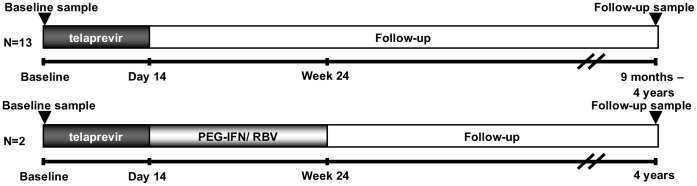
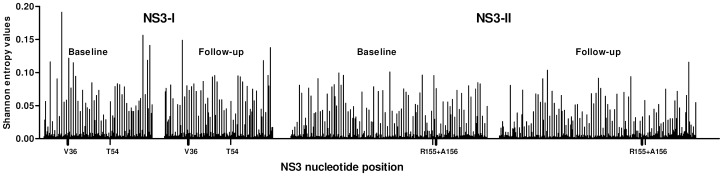
Fifteen patients from 2 previous telaprevir phase 1 clinical studies (VX04-950-101 and VX05-950-103) were included. These patients all received telaprevir monotherapy for 14 days, and 2 patients subsequently received standard of care. Variants at previously well-characterized NS3 protease positions V36, T54, R155 and A156 were assessed at baseline and after a follow-up of 4±1.2 years by ultra-deep pyrosequencing. The prevalence of resistant variants at follow-up was compared to baseline.
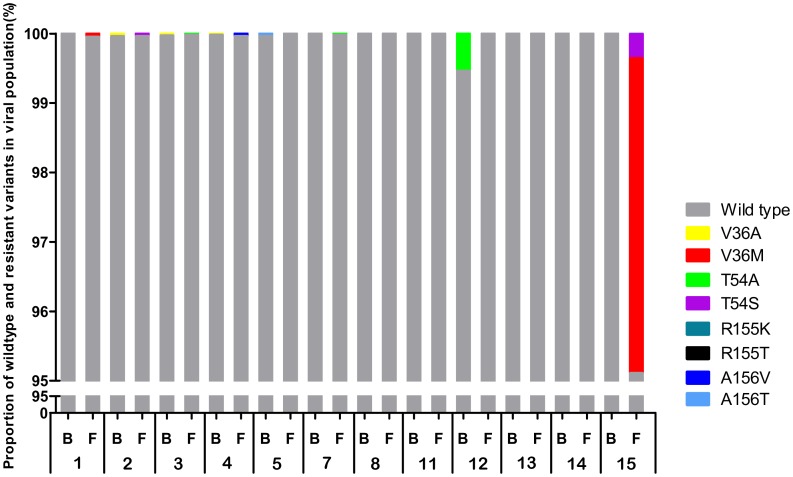
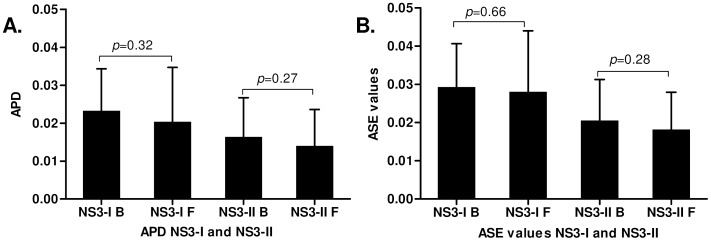
Resistance associated mutations were detectable at low frequency at baseline. In general, prevalence of resistance mutations at follow-up was not increased compared to baseline. Only one patient had a small, but statistically significant, increase in the number of V36M and T54S variants 4 years after telaprevir-dosing.
In patients treated for 14 days with telaprevir monotherapy, ultra-deep pyrosequencing indicates that long-term persistence of resistant variants is rare.
替拉瑞韦是一种丙型肝炎病毒 NS3/4A 蛋白酶抑制剂,与聚乙二醇干扰素 alfa-2a 和利巴韦林联合使用时,与丙型肝炎病毒 1 型感染患者的当前标准治疗相比,显著提高了持续病毒学应答率。在治疗过程中出现耐药变异的失代偿患者中,已有报道。目前尚不清楚这些变异在未治疗的患者中持续存在的程度。本研究旨在使用超深度焦磷酸测序评估,与替拉瑞韦治疗 14 天后的预处理频率相比,在 4 年随访后,耐药变异的频率是否增加。
纳入来自 2 项先前替拉瑞韦 1 期临床研究(VX04-950-101 和 VX05-950-103)的 15 例患者。这些患者均接受替拉瑞韦单药治疗 14 天,其中 2 例随后接受标准治疗。通过超深度焦磷酸测序,在基线和 4±1.2 年随访时,评估先前已充分描述的 NS3 蛋白酶位置 V36、T54、R155 和 A156 的变异。将随访时的耐药变异流行率与基线进行比较。
基线时可检测到低频率的耐药相关突变。一般来说,与基线相比,随访时耐药突变的流行率没有增加。只有 1 例患者在替拉瑞韦给药 4 年后,V36M 和 T54S 变异的数量略有但具有统计学意义的增加。
在接受替拉瑞韦单药治疗 14 天的患者中,超深度焦磷酸测序表明,耐药变异的长期持续存在较为罕见。