Department of Cell Biology and Molecular Genetics, University of Maryland, College Park, Maryland, United States of America.
PLoS One. 2012;7(7):e41712. doi: 10.1371/journal.pone.0041712. Epub 2012 Jul 27.
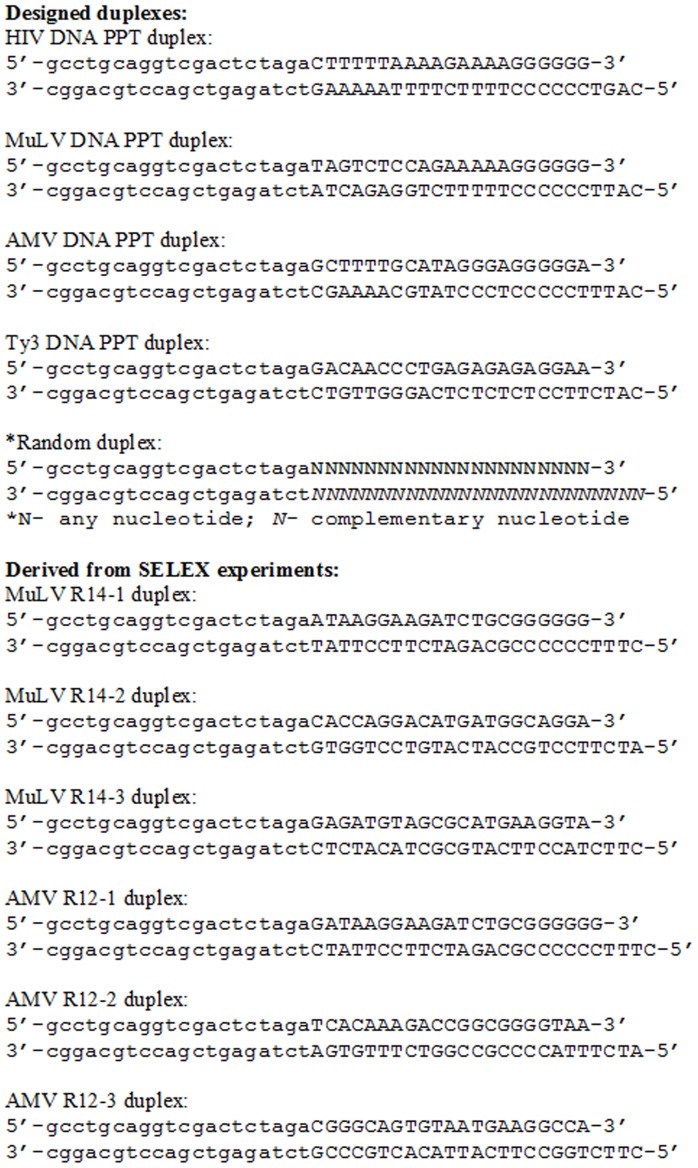
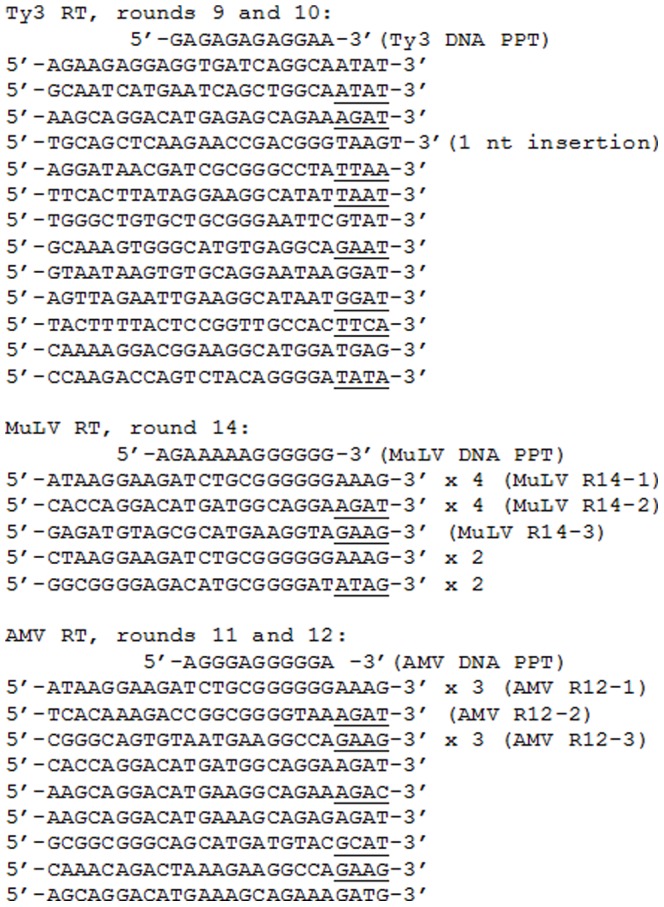
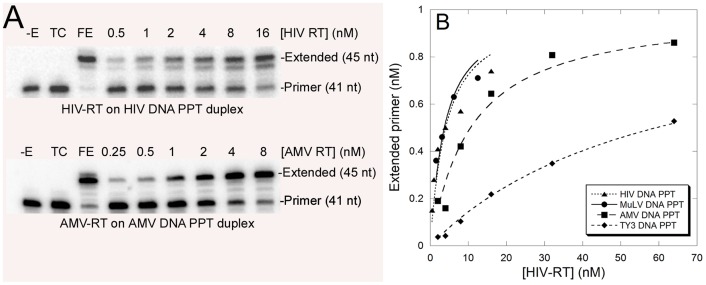
Previous results using a SELEX (Systematic Evolution of Ligands by Exponential Enrichment)-based approach that selected DNA primer-template duplexes binding with high affinity to HIV reverse transcriptase (RT) showed that primers mimicking the 3' end, and in particular the six nt terminal G tract, of the RNA polypurine tract (PPT; HIV PPT: 5'-AAAAGAAAAGGGGGG-3') were preferentially selected. In this report, two viral (Moloney murine leukemia virus (MuLV) and avian myeloblastosis virus (AMV)) and one retrotransposon (Ty3) RTs were used for selection. Like HIV RT, both viral RTs selected duplexes with primer strands mimicking the G tract at the PPT 3' end (AMV PPT: 5'-AGGGAGGGGGA-3'; MuLV PPT: 5'-AGAAAAAGGGGGG-3'). In contrast, Ty3, whose PPT lacks a G tract (5'-GAGAGAGAGGAA-3') showed no selective binding to any duplex sequences. Experiments were also conducted with DNA duplexes (termed DNA PPTs) mimicking the RNA PPT-DNA duplex of each virus and a control duplex with a random DNA sequence. Retroviral RTs bound with high affinity to all viral DNA PPT constructs, with HIV and MuLV RTs showing comparable binding to the counterpart DNA PPT duplexes and reduced affinity to the AMV DNA PPT. AMV RT showed similar behavior with a modest preference for its own DNA PPT. Ty3 RT showed no preferential binding for its own or any other DNA PPT and viral RTs bound the Ty3 DNA PPT with relatively low affinity. In contrast, binding affinity of HIV RT to duplexes containing the HIV RNA PPT was less dependent on the G tract, which is known to be pivotal for efficient extension. We hypothesize that the G tract on the RNA PPT helps shift the binding orientation of RT to the 3' end of the PPT where extension can occur.
先前使用基于指数富集的配体系统进化(SELEX)的方法选择与 HIV 逆转录酶(RT)高亲和力结合的 DNA 引物-模板双链体的结果表明,模拟 RNA 多聚嘌呤链(PPT)的 3' 端的引物,特别是六核苷酸末端 G 链,被优先选择。在本报告中,使用了两种病毒(莫洛尼鼠白血病病毒(MuLV)和禽髓细胞瘤病毒(AMV))和一种反转录转座子(Ty3)RT 进行选择。与 HIV RT 一样,两种病毒 RT 都选择了具有模拟 PPT 3' 端 G 链的引物链的双链体(AMV PPT:5'-AGGGAGGGGGA-3'; MuLV PPT:5'-AGAAAAAGGGGGG-3')。相比之下,Ty3 的 PPT 没有 G 链(5'-GAGAGAGAGGAA-3'),对任何双链序列都没有选择性结合。还进行了使用模拟每种病毒的 RNA PPT-DNA 双链体的 DNA 双链体(称为 DNA PPT)和具有随机 DNA 序列的对照双链体的实验。逆转录病毒 RT 与所有病毒 DNA PPT 构建体高亲和力结合,HIV 和 MuLV RT 对其对应 DNA PPT 双链体表现出可比的结合,对 AMV DNA PPT 的亲和力降低。AMV RT 表现出相似的行为,对其自身的 DNA PPT 略有偏好。Ty3 RT 对其自身或任何其他 DNA PPT 没有优先结合,病毒 RT 对 Ty3 DNA PPT 的结合亲和力相对较低。相比之下,HIV RT 对包含 HIV RNA PPT 的双链体的结合亲和力对 G 链的依赖性较小,G 链已知对有效延伸至关重要。我们假设 RNA PPT 上的 G 链有助于将 RT 的结合取向转移到可以发生延伸的 PPT 的 3' 端。