Anthropological Institute, University of Zurich, Zurich, Switzerland.
PLoS One. 2012;7(7):e41980. doi: 10.1371/journal.pone.0041980. Epub 2012 Jul 25.
Acquisition of bipedality is a hallmark of human evolution. How bipedality evolved from great ape-like locomotor behaviors, however, is still highly debated. This is mainly because it is difficult to infer locomotor function, and even more so locomotor kinematics, from fossil hominin long bones. Structure-function relationships are complex, as long bone morphology reflects phyletic history, developmental programs, and loading history during an individual's lifetime. Here we discriminate between these factors by investigating the morphology of long bones in fetal and neonate great apes and humans, before the onset of locomotion.
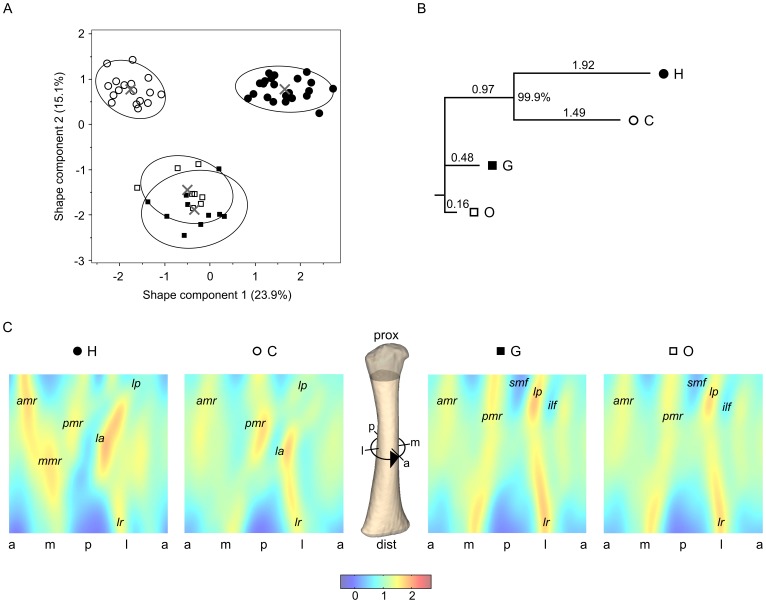
METHODOLOGY/PRINCIPAL FINDINGS: Comparative morphometric analysis of the femoral diaphysis indicates that its morphology reflects phyletic relationships between hominoid taxa to a greater extent than taxon-specific locomotor adaptations. Diaphyseal morphology in humans and chimpanzees exhibits several shared-derived features, despite substantial differences in locomotor adaptations. Orangutan and gorilla morphologies are largely similar, and likely represent the primitive hominoid state.
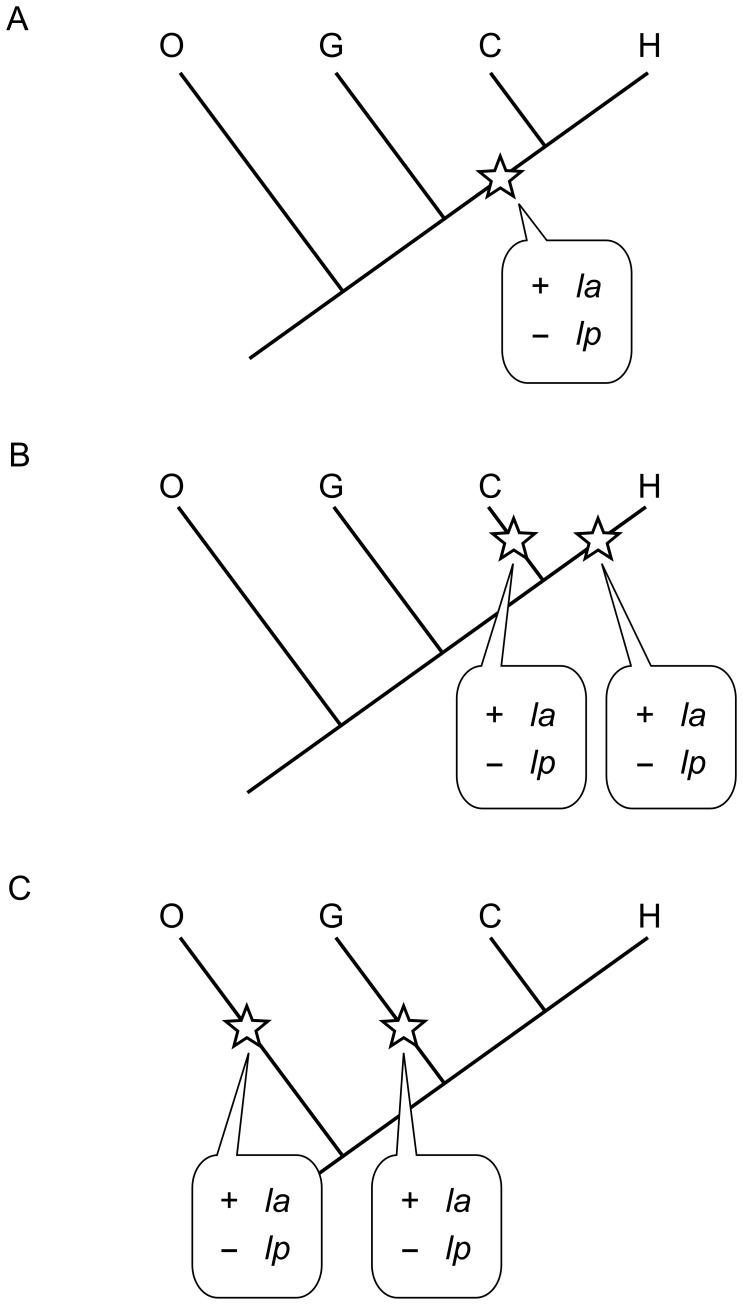
CONCLUSIONS/SIGNIFICANCE: These findings are compatible with two possible evolutionary scenarios. Diaphyseal morphology may reflect retained adaptive traits of ancestral taxa, hence human-chimpanzee shared-derived features may be indicative of the locomotor behavior of our last common ancestor. Alternatively, diaphyseal morphology might reflect evolution by genetic drift (neutral evolution) rather than selection, and might thus be more informative about phyletic relationships between taxa than about locomotor adaptations. Both scenarios are consistent with the hypothesis that knuckle-walking in chimpanzees and gorillas resulted from convergent evolution, and that the evolution of human bipedality is unrelated to extant great ape locomotor specializations.
双足行走的获得是人类进化的标志。然而,双足行走是如何从类人猿般的运动行为进化而来的,仍然存在很大争议。这主要是因为很难从化石人类长骨推断运动功能,更不用说运动运动学了。结构-功能关系非常复杂,因为长骨形态反映了种系历史、发育程序以及个体一生中的加载历史。在这里,我们通过研究胎儿和新生儿大猿和人类长骨的形态,在运动开始之前,区分这些因素。
方法/主要发现:股骨骨干的比较形态计量分析表明,其形态在更大程度上反映了人科分类群之间的种系关系,而不是分类群特异性的运动适应。尽管在运动适应方面存在很大差异,但人类和黑猩猩的骨干形态表现出几种共同衍生的特征。猩猩和大猩猩的形态非常相似,可能代表了原始的人科状态。
结论/意义:这些发现与两种可能的进化情景相兼容。骨干形态可能反映了祖先分类群的保留适应特征,因此人类-黑猩猩的共同衍生特征可能表明我们最后一个共同祖先的运动行为。或者,骨干形态可能反映了遗传漂变(中性进化)而不是选择的进化,因此可能比运动适应更能反映分类群之间的种系关系。这两种情景都与以下假设一致,即黑猩猩和大猩猩的指节行走是趋同进化的结果,而人类双足行走的进化与现存大猿的运动特化无关。