Department of Microbiology, Universidade Eduardo Mondlane, Maputo, Mozambique.
Malar J. 2012 Aug 1;11:252. doi: 10.1186/1475-2875-11-252.
Plasmodium falciparum and HIV-1 infection cause substantial morbidity and mortality in sub-Saharan Africa. Increasing evidence suggests these two pathogens interact negatively when infecting the same individual.
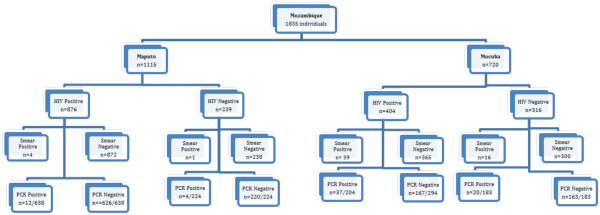
A cross-sectional study among HIV-1 infected and uninfected populations was recruited in Mocuba and Maputo, Mozambique to determine the prevalence of sub-clinical malarial parasitaemia using light microscopy and a nested PCR assay.
The prevalence of sub-clinical P. falciparum parasitaemia was low in Maputo, whether determined by microscopy (0.4%) or PCR (1.9%), but substantially higher in Mocuba (7.6 and 14.7%, respectively). Nested PCR detected nearly 70% more cases of sub-clinical parasitaemia than microscopy, but differences occur by locality. HIV-1 infected persons were more likely to be sub-clinically parasitaemic than HIV-1 uninfected individuals recruited from the same geographic areas. Trimethoprim-sulphamethoxazole use did not substantially reduce sub-clinical parasitaemia.
Dried blood spots are a convenient and sensitive technique for detecting sub-clinical infection with P. falciparum by nested PCR. Prevalence of P. falciparum is substantially lower in Maputo where malaria control programmes have been more active than in the rural town of Mocuba. In Mocuba, among those presenting for HIV-1 counseling and testing, the prevalence of P. falciparum is substantially higher in those who test positive for HIV-1 than those without HIV-1 infection. The clinical implications of sub-clinical P. falciparum infection among HIV-1 infected persons warrant additional study.
恶性疟原虫和 HIV-1 感染在撒哈拉以南非洲地区导致了大量的发病率和死亡率。越来越多的证据表明,这两种病原体在感染同一个体时会产生负面相互作用。
在莫库巴和马普托(莫桑比克)招募了 HIV-1 感染者和未感染者的横断面研究,以使用显微镜和巢式 PCR 检测确定亚临床疟原虫寄生虫血症的患病率。
莫库巴的亚临床恶性疟原虫寄生虫血症的患病率较低,无论是通过显微镜(0.4%)还是 PCR(1.9%)检测,但在马普托则显著更高(分别为 7.6%和 14.7%)。巢式 PCR 比显微镜检测到近 70%的亚临床寄生虫血症病例,但差异存在于不同地区。从同一地理区域招募的 HIV-1 感染者比 HIV-1 未感染者更有可能出现亚临床寄生虫血症。甲氧苄啶-磺胺甲恶唑的使用并没有显著减少亚临床寄生虫血症。
干血斑是一种方便且敏感的技术,可通过巢式 PCR 检测恶性疟原虫的亚临床感染。在疟疾控制计划更为活跃的马普托,恶性疟原虫的患病率明显低于莫库巴农村地区。在莫库巴,在那些接受 HIV-1 咨询和检测的人中,与 HIV-1 未感染者相比,HIV-1 检测呈阳性的人出现恶性疟原虫的患病率明显更高。HIV-1 感染者亚临床恶性疟原虫感染的临床意义值得进一步研究。