Policy Analysis Inc. (PAI), Four Davis Court, Brookline, MA 02445, USA.
BMC Psychiatry. 2012 Aug 2;12:99. doi: 10.1186/1471-244X-12-99.
Schizophrenia and bipolar disorder are chronic debilitating disorders that are often treated with second-generation antipsychotic agents, such as aripiprazole, quetiapine, and ziprasidone. While patients who are hospitalized for schizophrenia and bipolar disorder often receive these agents at discharge, comparatively little information exists on subsequent patterns of pharmacotherapy.
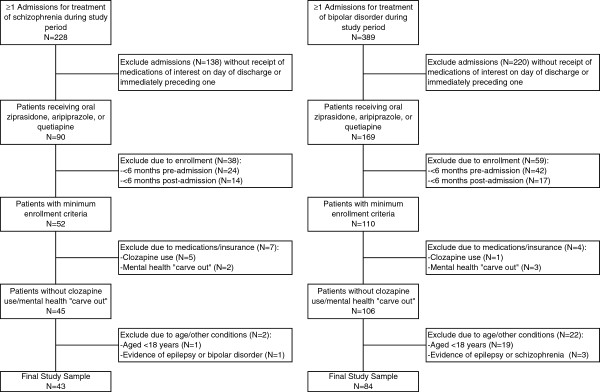
Using a database linking hospital admission records to health insurance claims, we identified all patients hospitalized for schizophrenia (ICD-9-CM diagnosis code 295.XX) or bipolar disorder (296.0, 296.1, 296.4-296.89) between January 1, 2001 and September 30, 2008 who received aripiprazole, quetiapine, or ziprasidone at discharge. Patients not continuously enrolled for 6 months before and after hospitalization ("pre-admission" and "follow-up", respectively) were excluded. We examined patterns of use of these agents during follow-up, including adherence with treatment (using medication possession ratios [MPRs] and cumulative medication gaps [CMGs]) and therapy switching. Analyses were undertaken separately for patients with schizophrenia and bipolar disorder, respectively.
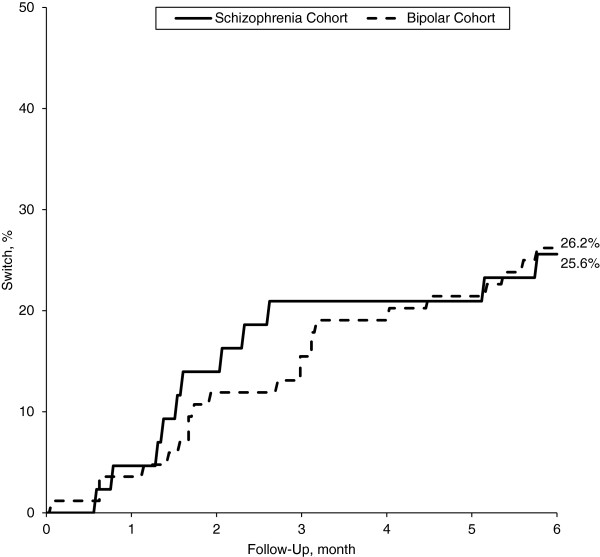
We identified a total of 43 patients with schizophrenia, and 84 patients with bipolar disorder. During the 6-month period following hospitalization, patients with schizophrenia received an average of 101 therapy-days with the second-generation antipsychotic agent prescribed at discharge; for patients with bipolar disorder, the corresponding value was 68 therapy-days. Mean MPR at 6 months was 55.1% for schizophrenia patients, and 37.3% for those with bipolar disorder; approximately one-quarter of patients switched to another agent over this period.
Medication compliance is poor in patients with schizophrenia or bipolar disorder who initiate treatment with aripiprazole, quetiapine, or ziprasidone at hospital discharge.
精神分裂症和双相情感障碍是慢性衰弱性疾病,通常采用第二代抗精神病药物(如阿立哌唑、喹硫平和齐拉西酮)进行治疗。尽管住院的精神分裂症和双相情感障碍患者在出院时通常会接受这些药物治疗,但关于后续药物治疗模式的信息相对较少。
我们使用一个将住院记录与医疗保险索赔相联系的数据库,确定了在 2001 年 1 月 1 日至 2008 年 9 月 30 日期间因精神分裂症(ICD-9-CM 诊断代码 295.XX)或双相情感障碍(296.0、296.1、296.4-296.89)住院的所有患者,这些患者在出院时接受了阿立哌唑、喹硫平或齐拉西酮治疗。未在住院前后连续 6 个月(分别为“入院前”和“随访”)参保的患者被排除在外。我们分别考察了这些患者在随访期间使用这些药物的模式,包括治疗的依从性(使用药物持有率[MPR]和累积药物缺口[CMG])和治疗药物转换。
我们共确定了 43 例精神分裂症患者和 84 例双相情感障碍患者。在出院后的 6 个月期间,精神分裂症患者平均接受了 101 天的第二代抗精神病药物治疗;而双相情感障碍患者的相应值为 68 天。精神分裂症患者在 6 个月时的平均 MPR 为 55.1%,双相情感障碍患者为 37.3%;在此期间,约有四分之一的患者换用了其他药物。
在出院时开始接受阿立哌唑、喹硫平和齐拉西酮治疗的精神分裂症或双相情感障碍患者的药物依从性较差。