Departamento de Bioquímica y Biología Molecular, Universidad de Salamanca, Edificio Departamental Lab.108/112. Plaza Doctores de la Reina s/n, 37007 Salamanca, Spain.
Glycoconj J. 2012 Oct;29(7):539-49. doi: 10.1007/s10719-012-9431-0. Epub 2012 Aug 7.
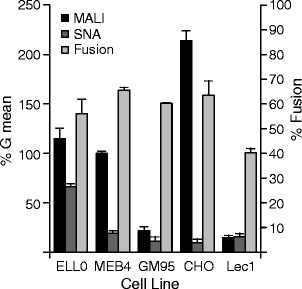
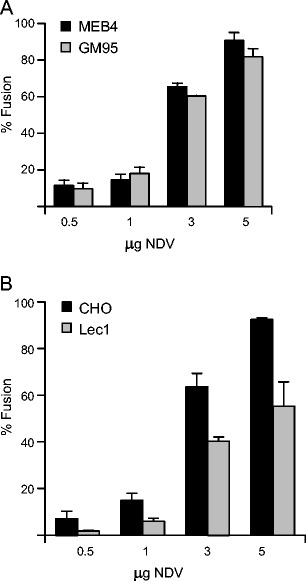
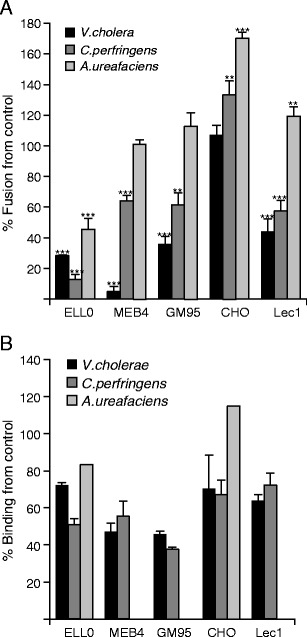
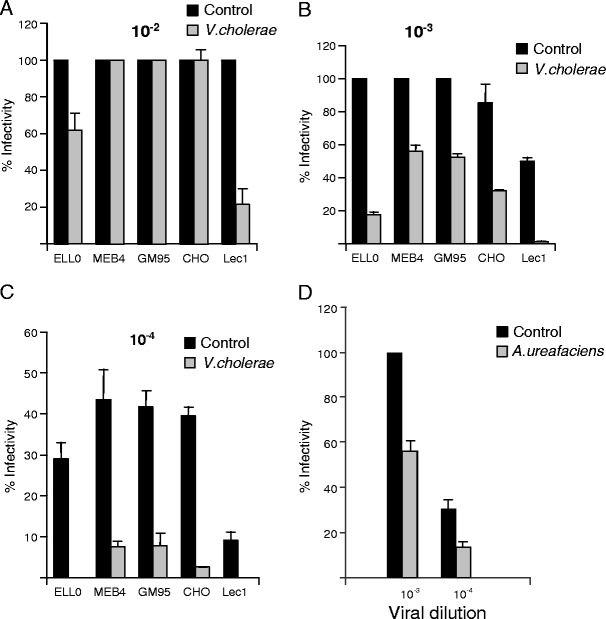
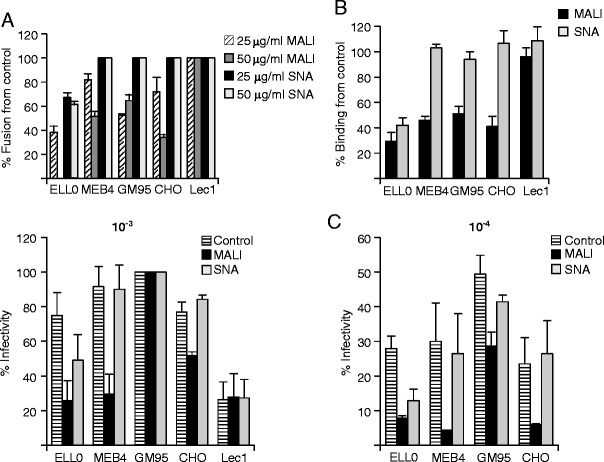
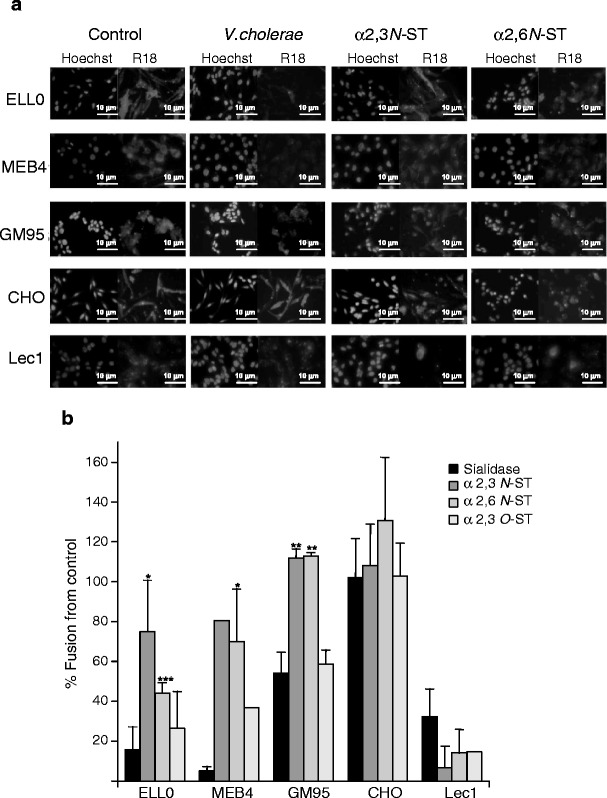
Receptor recognition and binding is the first step in the viral cycle. It has been established that Newcastle Disease Virus (NDV) interacts with sialylated molecules such as gangliosides and glycoproteins at the cell surface. Nevertheless, the specific receptor(s) that mediate virus entry are not well known. We have analysed the role of the sialic acid linkage in the early steps of the viral infection cycle. Pretreatment of ELL-0 cells with both α2,3 and α2,6 specific sialidases led to the inhibition of NDV binding, fusion and infectivity, which were restored after α2,3(N)- and α2,6(N)-sialyltransferase incubation. Moreover, α2,6(N)-sialyltransferases also restored NDV activities in α2-6-linked sialic acid deficient cells. Competition with α2-6 sialic acid-binding lectins led to a reduction in the three NDV activities (binding, fusion and infectivity) suggesting a role for α2-6- linked sialic acid in NDV entry. We conclude that both α2-3- and α2-6- linked sialic acid containing glycoconjugates may be used for NDV infection. NDV was able to efficiently bind, fuse and infect the ganglioside-deficient cell line GM95 to a similar extent to that of its parental MEB4, suggesting that gangliosides are not essential for NDV binding, fusion and infectivity. Nevertheless, the fact that the interaction of NDV with cells deficient in N-glycoprotein expression such as Lec1 was less efficient prompted us to conclude that NDV requires N-linked glycoproteins for efficient attachment and entry into the host cell.
受体识别和结合是病毒周期的第一步。已经确定新城疫病毒(NDV)与细胞表面的唾液酸化分子如神经节苷脂和糖蛋白相互作用。然而,介导病毒进入的特定受体尚不清楚。我们分析了唾液酸连接在病毒感染周期早期步骤中的作用。ELL-0 细胞先用α2,3 和α2,6 特异性唾液酸酶预处理,导致 NDV 结合、融合和感染性被抑制,在用α2,3(N)-和α2,6(N)-唾液酸转移酶孵育后恢复。此外,α2,6(N)-唾液酸转移酶也恢复了α2,6 连接的唾液酸缺陷细胞中的 NDV 活性。与α2,6 连接的唾液酸结合凝集素竞争导致三种 NDV 活性(结合、融合和感染性)降低,表明α2,6 连接的唾液酸在 NDV 进入中起作用。我们得出结论,α2-3-和α2-6-连接的唾液酸糖缀合物都可用于 NDV 感染。NDV 能够有效地结合、融合和感染神经节苷脂缺陷细胞系 GM95,与亲本 MEB4 的程度相似,表明神经节苷脂不是 NDV 结合、融合和感染性所必需的。然而,NDV 与缺乏 N-糖蛋白表达的细胞(如 Lec1)相互作用的效率较低这一事实促使我们得出结论,NDV 需要 N-连接的糖蛋白才能有效地附着和进入宿主细胞。