Department of Immunology & Infection; Faculty of Infectious and Tropical Diseases, London School of Hygiene and Tropical Medicine, London, UK.
Malar J. 2012 Aug 8;11:266. doi: 10.1186/1475-2875-11-266.
Accurate sampling of sub-microscopic gametocytes is necessary for epidemiological studies to identify the infectious reservoir of Plasmodium falciparum. Detection of gametocyte mRNA achieves sensitive detection, but requires careful handling of samples. Filter papers can be used for collecting RNA samples, but rigorous testing of their capacity to withstand adverse storage conditions has not been fully explored.
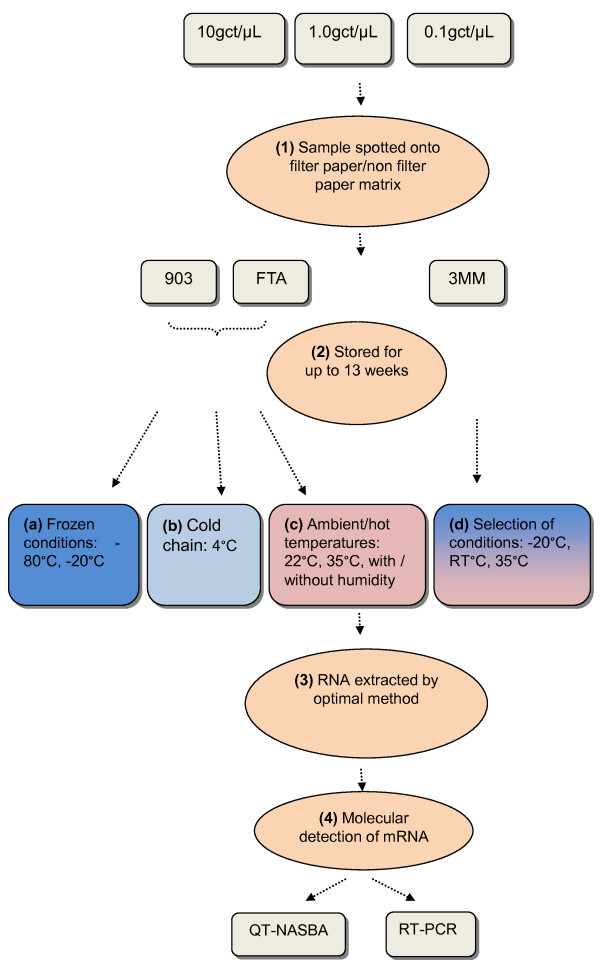
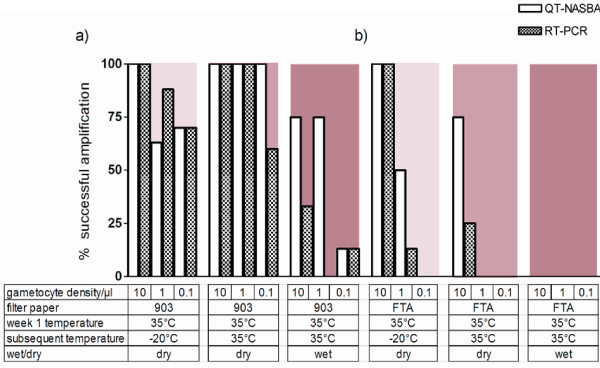
Three gametocyte dilutions: 10/μL, 1.0/μL and 0.1/μL were spotted onto Whatman™ 903 Protein Saver Cards, FTA Classic Cards and 3MM filter papers that were stored under frozen, cold chain or tropical conditions for up to 13 weeks . RNA was extracted, then detected by quantitative nucleic acid sequence-based amplification (QT-NASBA) and reverse-transcriptase PCR (RT-PCR).
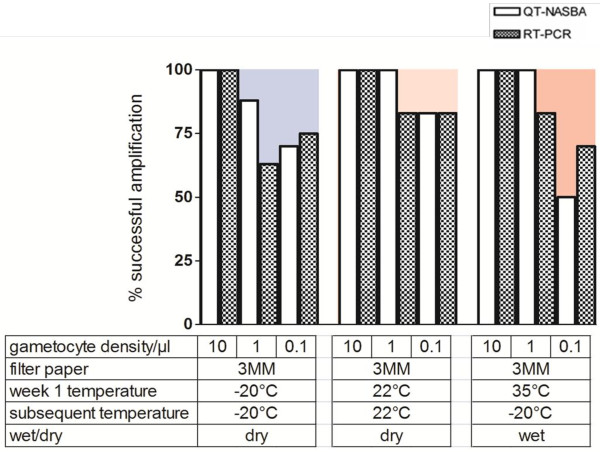
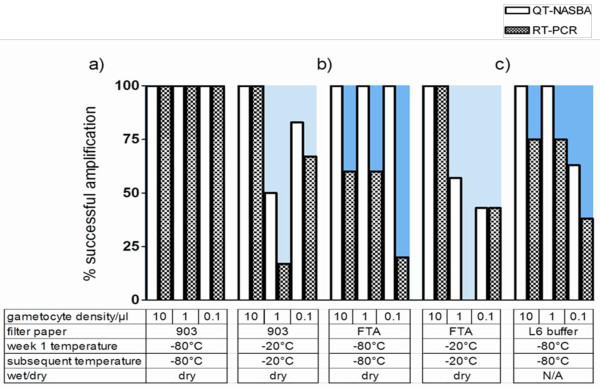
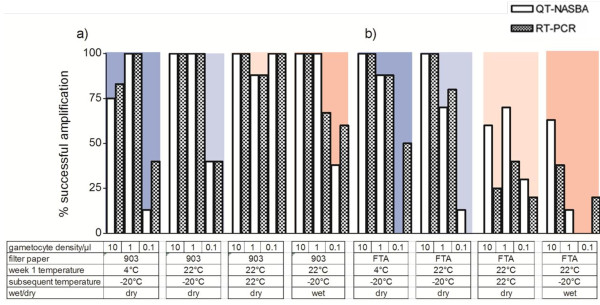
Successful gametocyte detection was more frequently observed from the Whatman 903 Protein Saver Card compared to the Whatman FTA Classic Card, by both techniques (p<0.0001). When papers were stored at higher temperatures, a loss in sensitivity was experienced for the FTA Classic Card but not the 903 Protein Saver Card or Whatman 3MM filter paper. The sensitivity of gametocyte detection was decreased when papers were stored at high humidity.
This study indicates the Whatman 903 Protein Saver Card is better for Pfs25 mRNA sampling compared to the Whatman FTA Classic Card, and that the Whatman 3MM filter paper may prove to be a satisfactory cheaper option for Pfs25 mRNA sampling. When appropriately dried, filter papers provide a useful approach to Pfs25 mRNA sampling, especially in settings where storage in RNA-protecting buffer is not possible.
准确采集亚微观配子体对于识别恶性疟原虫的感染源进行流行病学研究是必要的。检测配子体 mRNA 可实现敏感检测,但需要小心处理样本。滤纸条可用于收集 RNA 样本,但尚未充分探索其承受不利储存条件的能力。
将三个配子体稀释度:10/μL、1.0/μL 和 0.1/μL 点样到 Whatman™ 903 蛋白保存卡、FTA Classic 卡和 3MM 滤纸上,这些样本在冷冻、冷链或热带条件下储存长达 13 周。提取 RNA,然后通过定量核酸序列扩增(QT-NASBA)和逆转录 PCR(RT-PCR)进行检测。
与两种技术(p<0.0001)相比,成功检测配子体的情况更常从 Whatman 903 蛋白保存卡中观察到,而不是从 Whatman FTA Classic 卡中观察到。当纸张储存在较高温度下时,FTA Classic 卡的敏感性会降低,但 903 蛋白保存卡或 Whatman 3MM 滤纸条不会降低。当纸张储存在高湿度下时,检测配子体的敏感性会降低。
本研究表明,与 Whatman FTA Classic 卡相比,Whatman 903 蛋白保存卡更适合用于 Pfs25mRNA 采样,而 Whatman 3MM 滤纸条可能成为 Pfs25mRNA 采样的一种更便宜的满意选择。在适当干燥的情况下,滤纸条为 Pfs25mRNA 采样提供了一种有用的方法,尤其是在无法在 RNA 保护缓冲液中储存的情况下。