Zaki Jamil, Weber Jochen, Ochsner Kevin
Department of Psychology, Harvard University Cambridge, MA, USA.
Front Hum Neurosci. 2012 Aug 2;6:228. doi: 10.3389/fnhum.2012.00228. eCollection 2012.
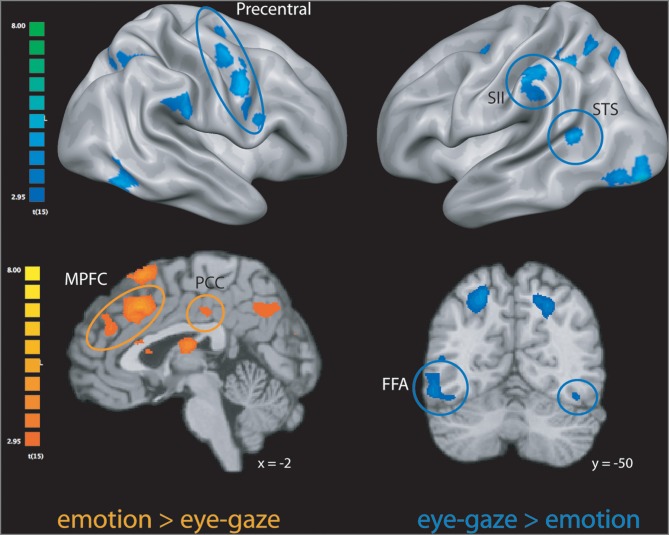
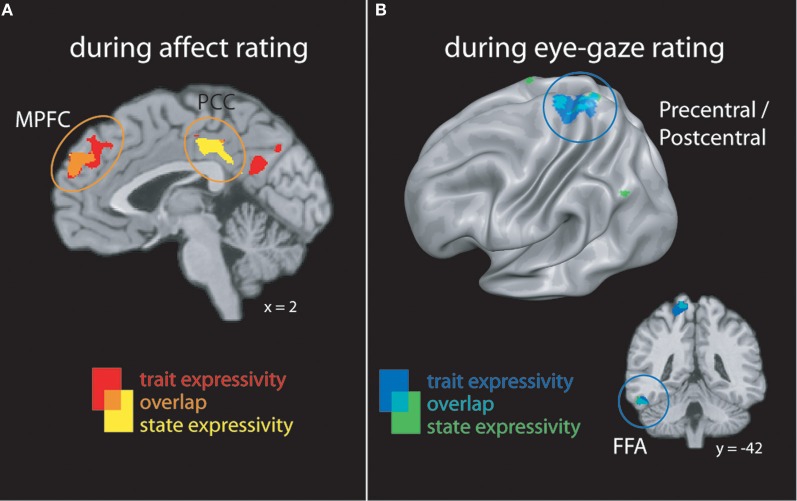
individuals' behavior and dispositions critically affect their interaction partners' information processing. However, cognitive neuroscience studies, partially because of methodological constraints, have remained largely "perceiver-centric": focusing on the abilities, motivations, and goals of social perceivers while largely ignoring interpersonal effects. Here, we address this knowledge gap by examining the neural bases of perceiving emotionally expressive and inexpressive social "targets." Sixteen perceivers were scanned using fMRI while they watched targets discussing emotional autobiographical events. Perceivers continuously rated each target's emotional state or eye-gaze direction. The effects of targets' emotional expressivity on perceiver's brain activity depended on task set: when perceivers explicitly attended to targets' emotions, expressivity predicted activity in neural structures-including medial prefrontal and posterior cingulate cortex-associated with drawing inferences about mental states. When perceivers instead attended to targets' eye-gaze, target expressivity predicted activity in regions-including somatosensory cortex, fusiform gyrus, and motor cortex-associated with monitoring sensorimotor states and biological motion. These findings suggest that expressive targets affect information processing in manner that depends on perceivers' goals. More broadly, these data provide an early step toward understanding the neural bases of interpersonal social cognition.
个体的行为和性格会严重影响其互动伙伴的信息处理。然而,认知神经科学研究部分由于方法上的限制,在很大程度上仍以“感知者为中心”:专注于社会感知者的能力、动机和目标,而在很大程度上忽略了人际间的影响。在此,我们通过研究感知具有情感表达性和无情感表达性的社会“目标”的神经基础来填补这一知识空白。16名感知者在观看目标讨论情感性自传事件时接受功能磁共振成像扫描。感知者持续对每个目标的情绪状态或目光注视方向进行评分。目标的情感表达性对感知者大脑活动的影响取决于任务设定:当感知者明确关注目标的情绪时,表达性可预测与对心理状态进行推理相关的神经结构(包括内侧前额叶和后扣带回皮层)的活动。当感知者转而关注目标的目光注视时,目标的表达性可预测与监测感觉运动状态和生物运动相关的区域(包括体感皮层、梭状回和运动皮层)的活动。这些发现表明,具有表达性的目标以取决于感知者目标的方式影响信息处理。更广泛地说,这些数据为理解人际社会认知的神经基础迈出了早期的一步。