Ma Dengke K, Ringstad Niels
Department of Biology, and McGovern Institute for Brain Research, MIT, Cambridge, MA 02139, USA.
Front Biol (Beijing). 2012 Jun;7(3):246-253. doi: 10.1007/s11515-012-1219-x.
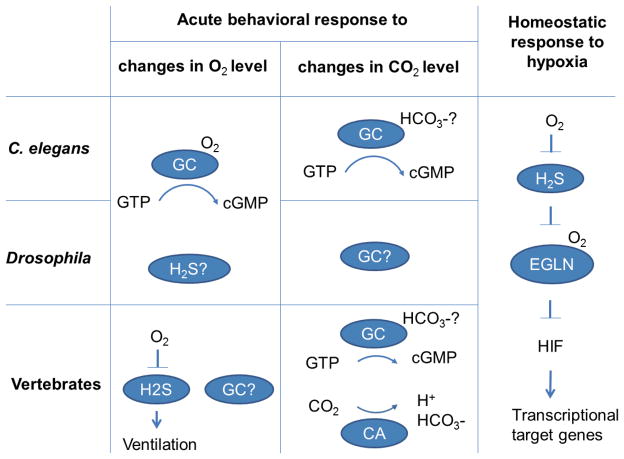
Aerobic metabolism is fundamental for almost all animal life. Cellular consumption of oxygen (O(2)) and production of carbon dioxide (CO(2)) signal metabolic states and physiological stresses. These respiratory gases are also detected as environmental cues that can signal external food quality and the presence of prey, predators and mates. In both contexts, animal nervous systems are endowed with mechanisms for sensing O(2)/CO(2) to trigger appropriate behaviors and maintain homeostasis of internal O(2)/CO(2). Although different animal species show different behavioral responses to O(2)/CO(2), some underlying molecular mechanisms and pathways that function in the detection of respiratory gases are fundamentally similar and evolutionarily conserved. Studies of Caenorhabditis elegans and Drosophila melanogaster have identified roles for cyclic nucleotide signaling and the hypoxia inducible factor (HIF) transcriptional pathway in mediating behavioral responses to respiratory gases. Understanding how simple invertebrate nervous systems detect respiratory gases to control behavior might reveal general principles common to nematodes, insects and vertebrates that function in the molecular sensing of respiratory gases and the neural control of animal behaviors.
有氧代谢是几乎所有动物生命的基础。细胞对氧气(O₂)的消耗和二氧化碳(CO₂)的产生标志着代谢状态和生理应激。这些呼吸气体也被视为环境线索,可表明外部食物质量以及猎物、捕食者和配偶的存在。在这两种情况下,动物神经系统都具备感知O₂/CO₂的机制,以触发适当行为并维持体内O₂/CO₂的稳态。尽管不同动物物种对O₂/CO₂表现出不同的行为反应,但在呼吸气体检测中起作用的一些潜在分子机制和途径在根本上是相似的,并且在进化上是保守的。对秀丽隐杆线虫和黑腹果蝇的研究已经确定了环核苷酸信号传导和缺氧诱导因子(HIF)转录途径在介导对呼吸气体的行为反应中的作用。了解简单的无脊椎动物神经系统如何检测呼吸气体以控制行为,可能会揭示线虫、昆虫和脊椎动物共有的一般原则,这些原则在呼吸气体的分子传感和动物行为的神经控制中发挥作用。