Centre for Health Evaluation and Outcome Sciences, Vancouver, BC, Canada.
BMC Public Health. 2012 Aug 9;12:632. doi: 10.1186/1471-2458-12-632.
Factors associated with HCV incidence among young Aboriginal people in Canada are still not well understood. We sought to estimate time to HCV infection and the relative hazard of risk factors associated HCV infection among young Aboriginal people who use injection drugs in two Canadian cities.
The Cedar Project is a prospective cohort study involving young Aboriginal people in Vancouver and Prince George, British Columbia, who use illicit drugs. Participants' venous blood samples were drawn and tested for HCV antibodies. Analysis was restricted to participants who use used injection drugs at enrolment or any of follow up visit. Cox proportional hazards regression was used to identify independent predictors of time to HCV seroconversion.
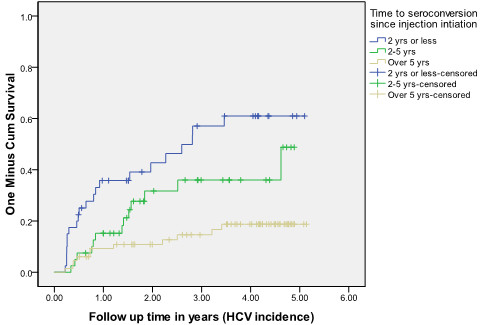
In total, 45 out of 148 participants seroconverted over the study period. Incidence of HCV infection was 26.3 per 100 person-years (95% Confidence Interval [CI]: 16.3, 46.1) among participants who reported using injection drugs for two years or less, 14.4 per 100 person-years (95% CI: 7.7, 28.9) among participants who had been using injection drugs for between two and five years, and 5.1 per 100 person-years (95% CI: 2.6,10.9) among participants who had been using injection drugs for over five years. Independent associations with HCV seroconversion were involvement in sex work in the last six months (Adjusted Hazard Ratio (AHR): 1.59; 95% CI: 1.05, 2.42) compared to no involvement, having been using injection drugs for less than two years (AHR: 4.14; 95% CI: 1.91, 8.94) and for between two and five years (AHR: 2.12; 95%CI: 0.94, 4.77) compared to over five years, daily cocaine injection in the last six months (AHR: 2.47; 95% CI: 1.51, 4.05) compared to less than daily, and sharing intravenous needles in the last six months (AHR: 2.56; 95% CI: 1.47, 4.49) compared to not sharing.
This study contributes to the limited body of research addressing HCV infection among Aboriginal people in Canada. The HCV incidence rate among Cedar Project participants who were new initiates of injection drug use underscores an urgent need for HCV and injection prevention and safety strategies aimed at supporting young people surviving injection drug use and sex work in both cities. Young people must be afforded the opportunity to provide leadership and input in the development of prevention programming.
在加拿大,年轻人中与 HCV 感染相关的因素仍未得到很好的理解。我们试图估计 HCV 感染的时间以及在两个加拿大城市中使用注射毒品的年轻原住民中与 HCV 感染相关的危险因素的相对危险度。
雪松项目是一项前瞻性队列研究,涉及不列颠哥伦比亚省温哥华和乔治王子城的使用非法药物的年轻原住民。采集参与者的静脉血样并检测 HCV 抗体。分析仅限于在入组时或任何随访时使用注射毒品的参与者。使用 Cox 比例风险回归来确定 HCV 血清转换的独立预测因素。
在研究期间,总共 148 名参与者中有 45 名出现 HCV 血清转换。在报告使用注射毒品两年或以下的参与者中,HCV 感染的发生率为每 100 人年 26.3 例(95%置信区间 [CI]:16.3,46.1),在使用注射毒品两年至五年的参与者中,发生率为每 100 人年 14.4 例(95%CI:7.7,28.9),在使用注射毒品超过五年的参与者中,发生率为每 100 人年 5.1 例(95%CI:2.6,10.9)。与 HCV 血清转换相关的独立关联因素包括在过去六个月内从事性工作(调整后的危险比 [AHR]:1.59;95%CI:1.05,2.42)与不参与相比,在过去六个月内使用注射毒品少于两年(AHR:4.14;95%CI:1.91,8.94)和两年至五年(AHR:2.12;95%CI:0.94,4.77)与超过五年相比,在过去六个月内每天注射可卡因(AHR:2.47;95%CI:1.51,4.05)与少于每天相比,以及在过去六个月内共用静脉内针头(AHR:2.56;95%CI:1.47,4.49)与不共用相比。
本研究为加拿大原住民中 HCV 感染的有限研究做出了贡献。雪松项目参与者中,新开始使用注射毒品的 HCV 发病率突出表明,迫切需要针对 HCV 和注射预防以及安全性策略,以支持两个城市中使用注射毒品和从事性工作的年轻人。必须为年轻人提供机会,让他们在预防方案的制定中发挥领导作用和提供投入。