Clinical Pharmacology, Astellas Pharma Inc., 3-17-1, Hasune, Tokyo 174-8612, Japan.
Invest New Drugs. 2013 Apr;31(2):443-51. doi: 10.1007/s10637-012-9867-x. Epub 2012 Aug 16.
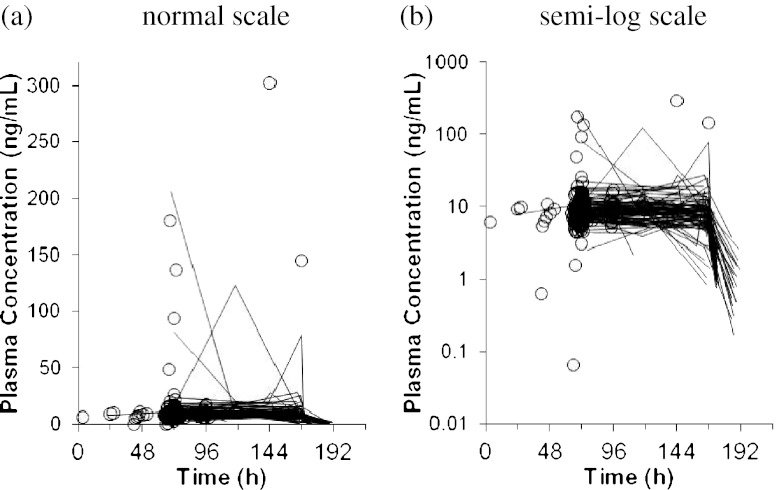
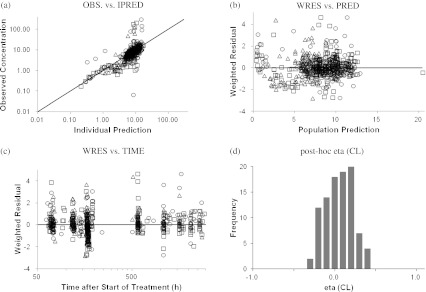
Purpose Population pharmacokinetics (PK) of sepantronium bromide (YM155) was characterized in patients with non-small cell lung cancer, hormone refractory prostate cancer, or unresectable stage III or IV melanoma and enrolled in one of three phase 2 studies conducted in Europe or the U.S. Method Sepantronium was administered as a continuous intravenous infusion (CIVI) at 4.8 mg/m(2)/day over 7 days every 21 days. Population PK analysis was performed using a linear one-compartment model involving total body clearance (CL) and volume of distribution with an inter-individual random effect on CL and a proportional residual errors to describe 578 plasma sepantronium concentrations obtained from a total of 96 patients by NONMEM Version VI. The first-order conditional estimation method with interaction was applied. Results The one-compartment model with one random effect on CL and two different proportional error models provided an adequate description of the data. Creatinine clearance (CLCR), cancer type, and alanine aminotransferase (ALT) were recognized as significant covariates of CL. CLCR was the most influential covariate on sepantronium exposure and predicted to contribute to a 25 % decrease in CL for patients with moderately impaired renal function (CLCR = 40 mL/min) compared to patients with normal CLCR. Cancer type and ALT had a smaller but nonetheless significant contribution. Other patient characteristics such as age, gender, and race were not considered as significant covariates of CL. Conclusions The results provide the important information for optimizing the therapeutic efficacy and minimizing the toxicity for sepantronium in cancer therapy.
在非小细胞肺癌、激素难治性前列腺癌或不可切除的 III 或 IV 期黑色素瘤患者中,对溴化塞潘酮(YM155)进行群体药代动力学(PK)研究,这些患者参加了在欧洲或美国进行的三项 2 期研究中的一项。
塞潘酮以 4.8mg/m²/天的剂量连续静脉输注(CIVI),连续 7 天,每 21 天一次。采用包含总清除率(CL)和分布容积的线性单室模型进行群体 PK 分析,CL 存在个体间随机效应,比例残差用于描述 96 例患者的 578 个血浆塞潘酮浓度,NONMEM Version VI 用于数据分析。采用一阶条件估计法和相互作用。
CL 存在一个随机效应的单室模型和两个不同的比例误差模型对数据进行了适当的描述。肌酐清除率(CLCR)、癌症类型和丙氨酸氨基转移酶(ALT)被认为是 CL 的重要协变量。CLCR 是影响塞潘酮暴露的最主要的协变量,与 CLCR 正常的患者相比,中度肾功能不全(CLCR=40mL/min)的患者 CL 降低 25%。癌症类型和 ALT 也有较小但显著的影响。其他患者特征,如年龄、性别和种族,不被认为是 CL 的重要协变量。
这些结果为优化塞潘酮在癌症治疗中的疗效和最小化毒性提供了重要信息。