Retèl Valesca P, Joore Manuela A, Linn Sabine C, Rutgers Emiel J T, van Harten Wim H
Netherlands Cancer Institute-Antoni van Leeuwenhoek Hospital (NKI-AVL), Department of Psychosocial Research and Epidemiology, Plesmanlaan 121, Amsterdam 1066 CX, The Netherlands.
BMC Res Notes. 2012 Aug 16;5:442. doi: 10.1186/1756-0500-5-442.
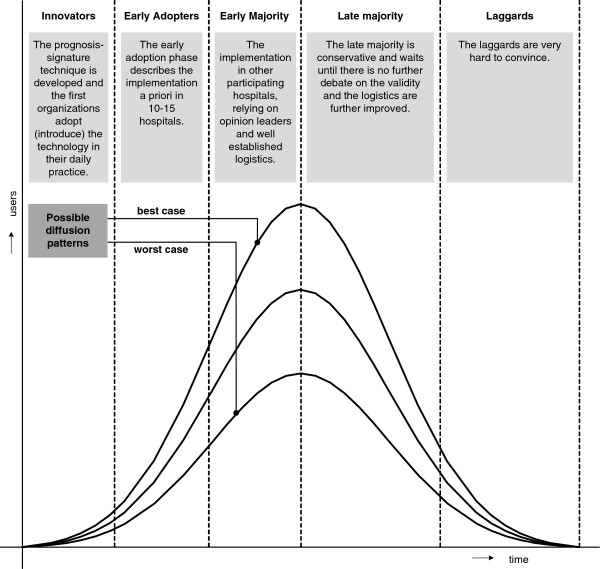
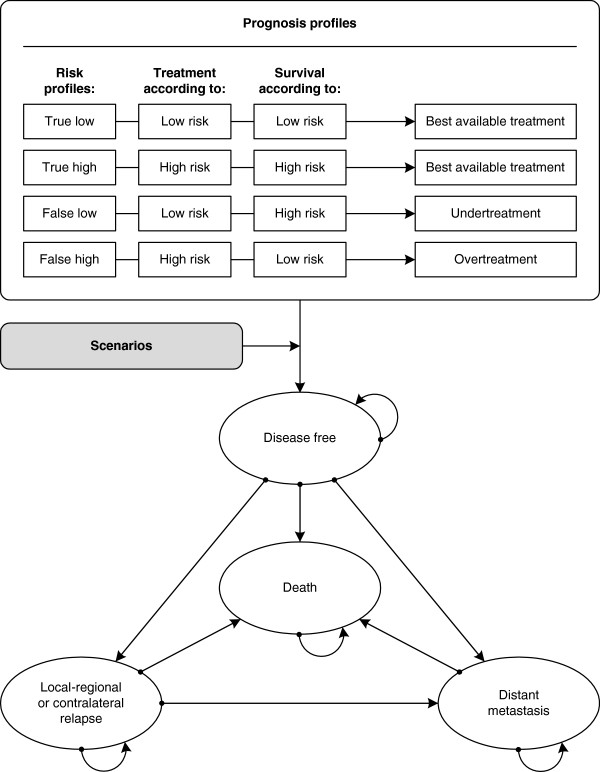
Health Technology Assessment (HTA) information, and in particular cost-effectiveness data is needed to guide decisions, preferably already in early stages of technological development. However, at that moment there is usually a high degree of uncertainty, because evidence is limited and different development paths are still possible. We developed a multi-parameter framework to assess dynamic aspects of a technology -still in development-, by means of scenario drafting to determine the effects, costs and cost-effectiveness of possible future diffusion patterns. Secondly, we explored the value of this method on the case of the clinical implementation of the 70-gene signature for breast cancer, a gene expression profile for selecting patients who will benefit most from chemotherapy.
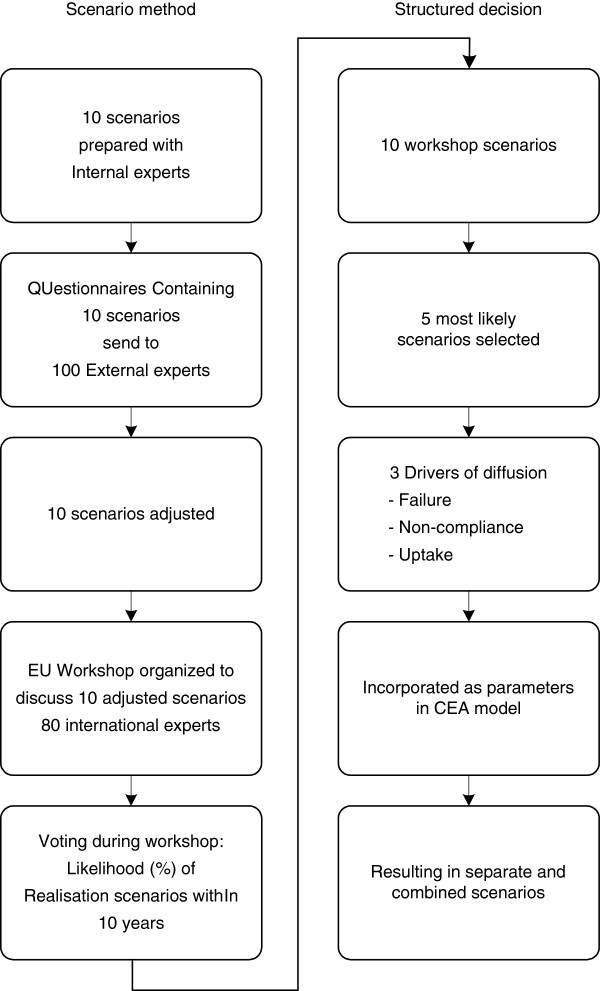
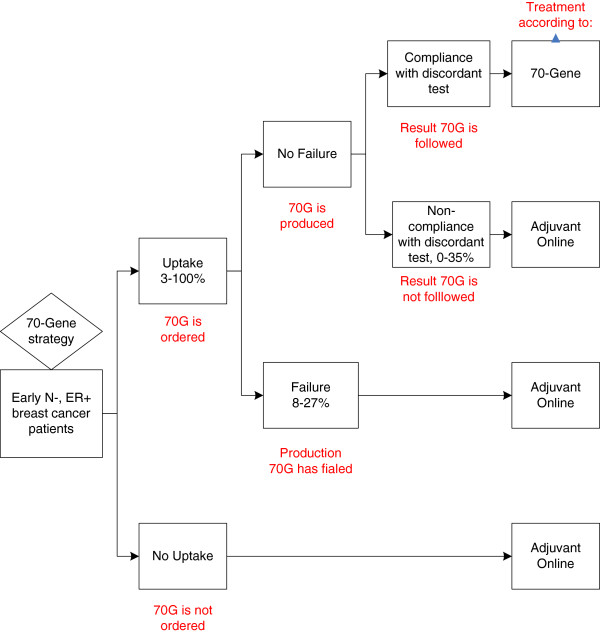
To incorporate process-uncertainty, ten possible scenarios regarding the introduction of the 70-gene signature were drafted with European experts. Out of 5 most likely scenarios, 3 drivers of diffusion (non-compliance, technical failure, and uptake) were quantitatively integrated in a decision-analytical model. For these scenarios, the cost-effectiveness of the 70-gene signature expressed in Incremental Cost-Effectiveness Ratios (ICERs) was compared to clinical guidelines, calculated from the past (2005) until the future (2020).
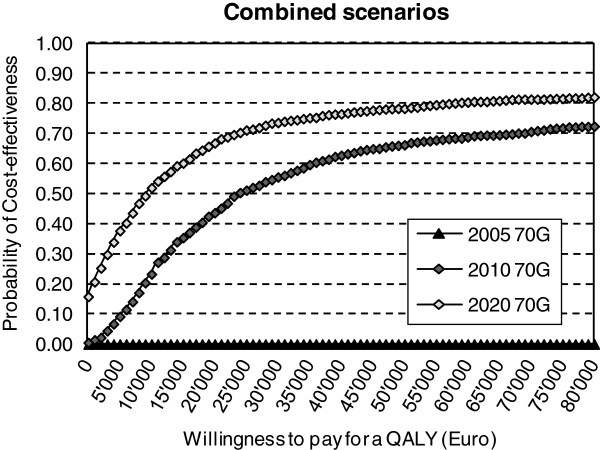
In 2005 the ICER was €1,9 million/quality-adjusted-life-year (QALY), meaning that the 70-gene signature was not yet cost-effective compared to the current clinical guideline. The ICER for the 70-gene signature improved over time with a range of €1,9 million to €26,145 in 2010 and €1,9 million to €11,123/QALY in 2020 depending on the separate scenario used. From 2010, the 70-gene signature should be cost-effective, based on the combined scenario. The uptake-scenario had strongest influence on the cost-effectiveness.
When optimal diffusion of a technology is sought, incorporating process-uncertainty by means of scenario drafting into a decision model may reveal unanticipated developments and can demonstrate a range of possible cost-effectiveness outcomes. The effect of scenarios give additional information on the speed with cost effectiveness might be reached and thus provide a more realistic picture for policy makers, opinion leaders and manufacturers.
卫生技术评估(HTA)信息,尤其是成本效益数据,对于指导决策是必要的,最好在技术开发的早期阶段就有这些数据。然而,在那个阶段通常存在高度的不确定性,因为证据有限且仍有不同的发展路径。我们开发了一个多参数框架,通过情景起草来评估一项仍在开发中的技术的动态方面,以确定未来可能的扩散模式的效果、成本和成本效益。其次,我们以用于乳腺癌的70基因检测的临床应用为例,探讨了这种方法的价值,该基因表达谱用于选择最能从化疗中获益的患者。
为纳入过程不确定性,与欧洲专家一起起草了关于引入70基因检测的十种可能情景。在5种最有可能的情景中,将3个扩散驱动因素(不依从、技术失败和采用率)定量整合到一个决策分析模型中。对于这些情景,将以增量成本效益比(ICERs)表示的70基因检测的成本效益与从过去(2005年)到未来(2020年)计算的临床指南进行比较。
2005年,ICER为190万欧元/质量调整生命年(QALY),这意味着与当前临床指南相比,70基因检测尚不具有成本效益。70基因检测的ICER随时间有所改善,2010年范围为190万欧元至26,145欧元,2020年根据所使用的不同情景,范围为190万欧元至11,123欧元/QALY。从2010年起,基于综合情景,70基因检测应该具有成本效益。采用率情景对成本效益的影响最大。
当寻求技术的最佳扩散时,通过情景起草将过程不确定性纳入决策模型可能会揭示意外的发展情况,并能展示一系列可能的成本效益结果。情景的影响提供了关于实现成本效益的速度的额外信息,从而为政策制定者、意见领袖和制造商提供更现实的情况。