Autism Research and Treatment Center, AL-Amodi Autism Research Chair, Department of Physiology, King Saud University, Riyadh, Saudi Arabia.
J Neuroinflammation. 2012 Aug 17;9:201. doi: 10.1186/1742-2094-9-201.
Aside from the skeletal health affection, vitamin D deficiency has been implicated as a potential environmental factor triggering for some autoimmune disorders. Vitamin D might play a role in the regulation of the production of auto-antibodies. Immunomodulatory effects of vitamin D may act not only through modulation of T-helper cell function, but also through induction of CD4(+)CD25(high) regulatory T-cells. We are the first to investigate the relationship between serum levels of 25-hydroxy vitamin D and anti-myelin-associated glycoprotein (anti-MAG) auto-antibodies in autistic children.
Serum levels of 25-hydroxy vitamin D and anti-MAG auto-antibodies were measured in 50 autistic children, aged between 5 and 12 years, and 30 healthy-matched children. Serum 25-hydroxy vitamin D levels 10-30 ng/mL and < 10 ng/mL were defined as vitamin D insufficiency and deficiency, respectively.
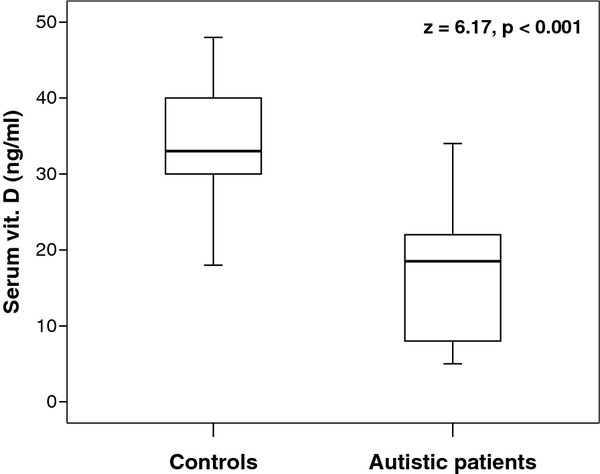
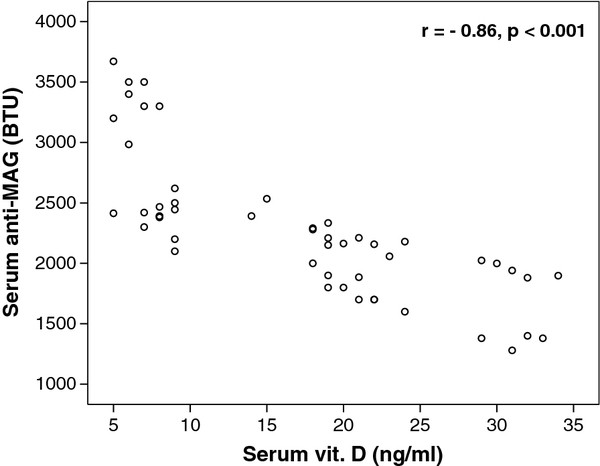
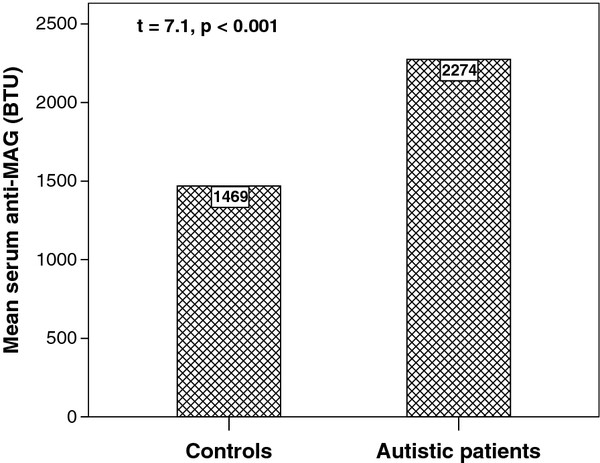
Autistic children had significantly lower serum levels of 25-hydroxy vitamin D than healthy children (P < 0.001) with 40% and 48% being vitamin D deficient and insufficient, respectively. Serum 25-hydroxy vitamin D had significant negative correlations with Childhood Autism Rating Scale (P < 0.001). Increased levels of serum anti-MAG auto-antibodies were found in 70% of autistic patients. Serum 25-hydroxy vitamin D levels had significant negative correlations with serum levels of anti-MAG auto-antibodies (P < 0.001).
Vitamin D deficiency was found in some autistic children and this deficiency may contribute to the induction of the production of serum anti-MAG auto-antibodies in these children. However, future studies looking at a potential role of vitamin D in the pathophysiology and treatment of autism are warranted.
除了骨骼健康的影响,维生素 D 缺乏已被认为是一些自身免疫性疾病的潜在环境因素。维生素 D 可能在自身抗体的产生调节中发挥作用。维生素 D 的免疫调节作用不仅可以通过调节辅助性 T 细胞功能来发挥,还可以通过诱导 CD4+CD25+调节性 T 细胞来发挥作用。我们是第一个研究自闭症儿童血清 25-羟维生素 D 水平与抗髓鞘相关糖蛋白(anti-MAG)自身抗体之间关系的研究。
测量了 50 名 5-12 岁自闭症儿童和 30 名健康匹配儿童的血清 25-羟维生素 D 和抗-MAG 自身抗体水平。血清 25-羟维生素 D 水平在 10-30ng/mL 和<10ng/mL 之间分别定义为维生素 D 不足和缺乏。
自闭症儿童血清 25-羟维生素 D 水平明显低于健康儿童(P<0.001),分别有 40%和 48%的儿童维生素 D 缺乏和不足。血清 25-羟维生素 D 与儿童自闭症评定量表(Childhood Autism Rating Scale)呈显著负相关(P<0.001)。在 70%的自闭症患者中发现血清 anti-MAG 自身抗体水平升高。血清 25-羟维生素 D 水平与血清 anti-MAG 自身抗体水平呈显著负相关(P<0.001)。
一些自闭症儿童存在维生素 D 缺乏,这种缺乏可能导致这些儿童产生血清 anti-MAG 自身抗体。然而,未来需要研究维生素 D 在自闭症的病理生理学和治疗中的潜在作用。