Graduate School of Health Sciences, Kumamoto Health Science University, Kumamoto 861-5598, Japan.
Mol Pain. 2012 Aug 20;8:58. doi: 10.1186/1744-8069-8-58.
5-hydroxytryptamine (5-HT) is one of the major neurotransmitters widely distributed in the CNS. Several 5-HT receptor subtypes have been identified in the spinal dorsal horn which act on both pre- and postsynaptic sites of excitatory and inhibitory neurons. However, the receptor subtypes and sites of actions as well as underlying mechanism are not clarified rigorously. Several electrophysiological studies have been performed to investigate the effects of 5-HT on excitatory transmission in substantia gelatinosa (SG) of the spinal cord. In the present study, to understand the effects of 5-HT on the inhibitory synaptic transmission and to identify receptor subtypes, the blind whole cell recordings were performed from SG neurons of rat spinal cord slices.
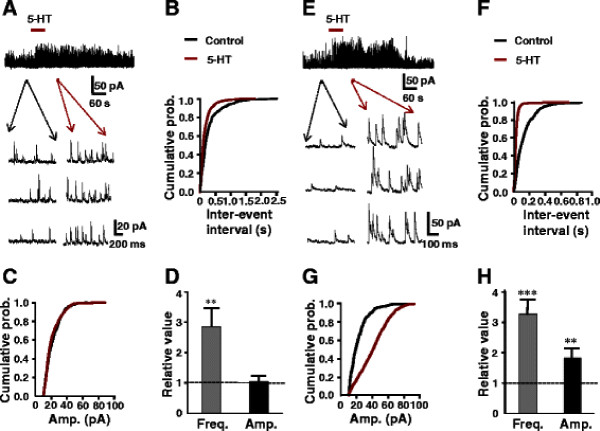
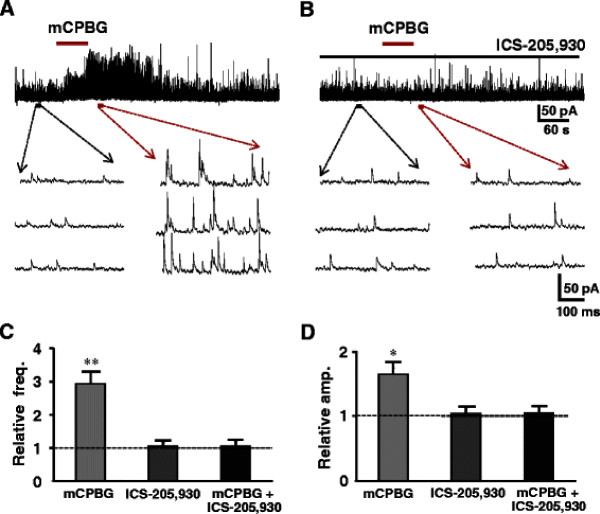
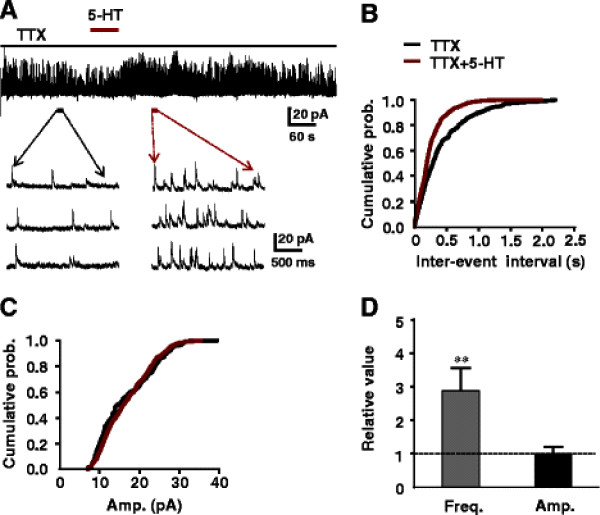
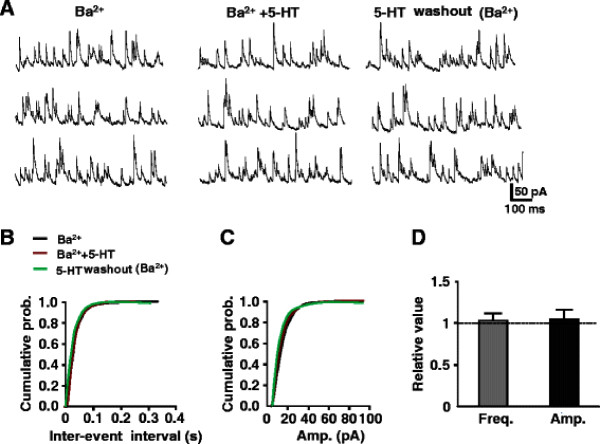
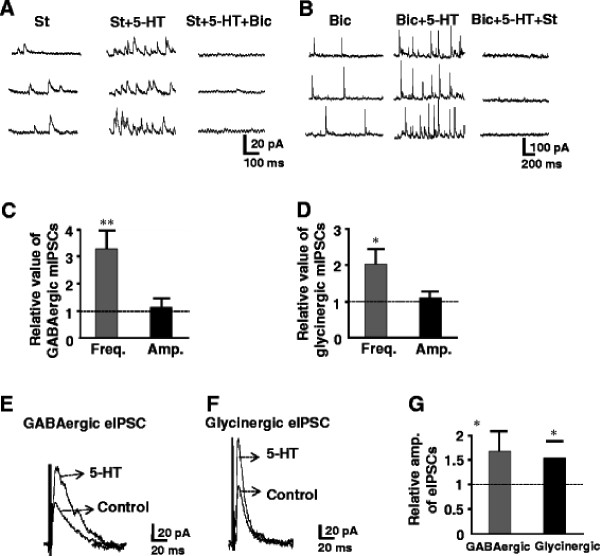
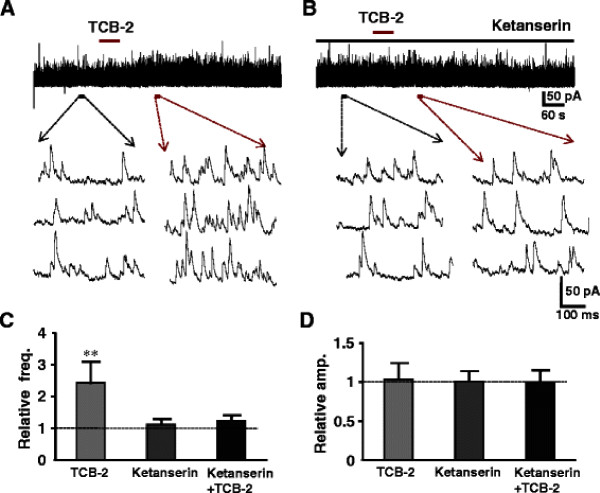
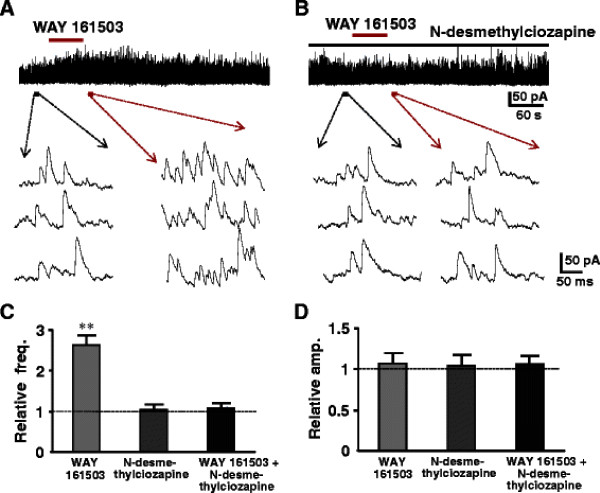
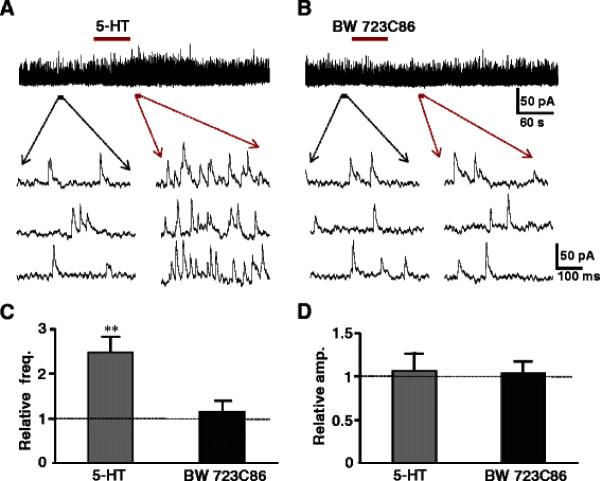
Bath applied 5-HT (50 μM) increased the frequency but not amplitudes of spontaneous inhibitory postsynaptic currents (sIPSCs) in 58% of neurons, and both amplitude and frequency in 23% of neurons. The frequencies of GABAergic and glycinergic mIPSCs were both enhanced. TTX (0.5 μM) had no effect on the increasing frequency, while the enhancement of amplitude of IPSCs was eliminated. Evoked-IPSCs (eIPSCs) induced by focal stimulation near the recording neurons in the presence of CNQX and APV were enhanced in amplitude by 5-HT. In the presence of Ba(2+) (1 mM), a potassium channel blocker, 5-HT had no effect on both frequency and amplitude. A 5-HT(2A) receptor agonist, TCB-2 mimicked the 5-HT effect, and ketanserin, an antagonist of 5-HT(2A) receptor, inhibited the effect of 5-HT partially and TCB-2 almost completely. A 5-HT(2C) receptor agonist WAY 161503 mimicked the 5-HT effect and this effect was blocked by a 5-HT(2C) receptor antagonist, N-desmethylclozapine. The amplitudes of sIPSCs were unaffected by 5-HT(2A) or 5-HT(2C) agonists. A 5-HT(3) receptor agonist mCPBG enhanced both amplitude and frequency of sIPSCs. This effect was blocked by a 5-HT(3) receptor antagonist ICS-205,930. The perfusion of 5-HT(2B) receptor agonist had no effect on sIPSCs.
Our results demonstrated that 5-HT modulated the inhibitory transmission in SG by the activation of 5-HT(2A) and 5-HT(2C) receptors subtypes located predominantly at inhibitory interneuron terminals, and 5-HT(3) receptors located at inhibitory interneuron terminals and soma-dendrites, consequently enhanced both frequency and amplitude of IPSCs.
5-羟色胺(5-HT)是中枢神经系统中广泛分布的主要神经递质之一。在脊髓背角中已经鉴定出几种 5-HT 受体亚型,它们作用于兴奋性和抑制性神经元的突触前和突触后部位。然而,受体亚型和作用部位以及潜在的机制尚未得到严格阐明。已经进行了几项电生理学研究,以研究 5-HT 对脊髓胶状质(SG)中兴奋性传递的影响。在本研究中,为了了解 5-HT 对抑制性突触传递的影响并鉴定受体亚型,我们从大鼠脊髓切片的 SG 神经元中进行了盲全细胞记录。
5-HT(50μM)在 58%的神经元中增加了自发性抑制性突触后电流(sIPSCs)的频率而不增加幅度,在 23%的神经元中增加了幅度和频率。GABA 能和甘氨酸能 mIPSCs 的频率均增强。TTX(0.5μM)对增加频率没有影响,而 IPSC 幅度的增强则被消除。在存在 CNQX 和 APV 的情况下,通过记录神经元附近的焦点刺激诱导的诱发 IPSC(eIPSCs)的幅度被 5-HT 增强。在存在 1mM Ba(2+)(钾通道阻滞剂)的情况下,5-HT 对频率和幅度均无影响。5-HT(2A) 受体激动剂 TCB-2 模拟了 5-HT 的作用,5-HT(2A) 受体拮抗剂酮色林部分抑制了 5-HT 的作用,而 TCB-2 几乎完全抑制了 5-HT 的作用。5-HT(2C) 受体激动剂 WAY 161503 模拟了 5-HT 的作用,而 5-HT(2C) 受体拮抗剂 N-去甲基氯氮平阻断了该作用。5-HT(2A) 或 5-HT(2C) 激动剂对 sIPSCs 的幅度没有影响。5-HT(3) 受体激动剂 mCPBG 增强了 sIPSCs 的幅度和频率。该作用被 5-HT(3) 受体拮抗剂 ICS-205,930 阻断。5-HT(2B) 受体激动剂的灌注对 sIPSCs 没有影响。
我们的结果表明,5-HT 通过激活主要位于抑制性中间神经元末梢的 5-HT(2A) 和 5-HT(2C) 受体亚型以及位于抑制性中间神经元末梢和体树突的 5-HT(3) 受体,调制 SG 中的抑制性传递,从而增强 IPSC 的频率和幅度。