Sylvester Comprehensive Cancer Center, University of Miami, Miami, Florida 33136, USA.
Mol Cancer Res. 2012 Oct;10(10):1271-81. doi: 10.1158/1541-7786.MCR-12-0145. Epub 2012 Aug 21.
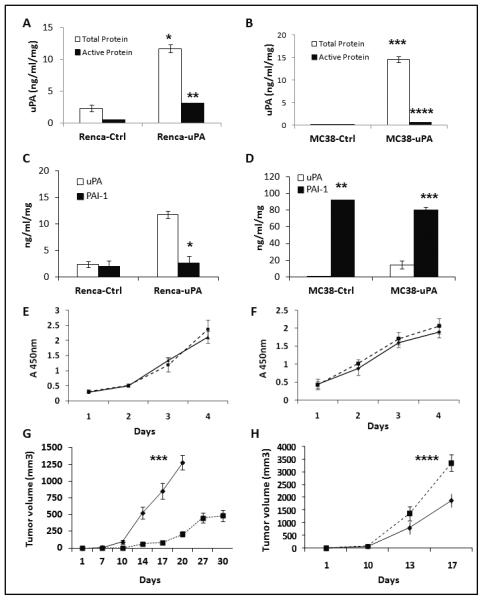
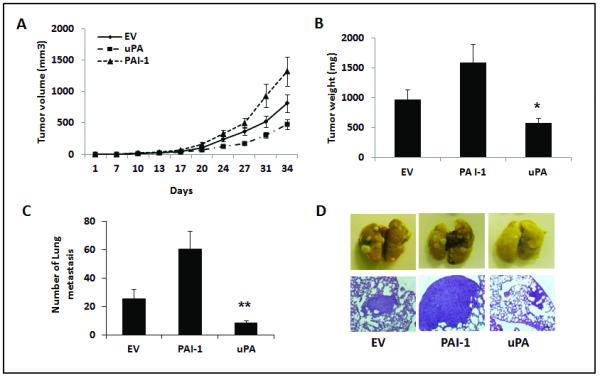
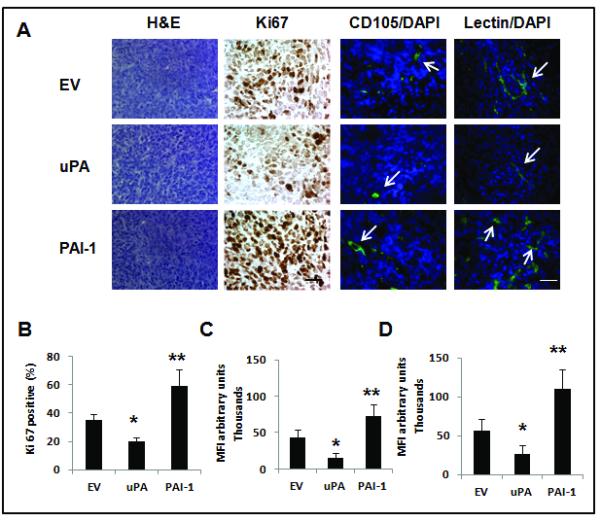
Tumor proteases and inhibitors have been associated with paradoxical effects on tumor progression in preclinical and clinical settings. We previously reported that urokinase (uPA) overexpression delays tumor progression in mammary cancer. This study aimed to determine the role of plasminogen activator inhibitor-1 (PAI-1) on uPA's paradoxical in vivo effects. Using syngeneic murine models, we found that stable uPA overexpression promoted in vivo growth of colon tumors (MC-38) naturally expressing high PAI-1, whereas growth inhibition was observed in renal tumors (RENCA) expressing lower PAI-1 levels. In murine mammary carcinoma (4T1), uPA overexpression shifted the uPA/PAI-1 balance in favor of the protease, resulting in significantly reduced tumor growth and metastases in vivo. Conversely, increased tumor progression was observed in stable PAI-1 overexpressing 4T1 tumors as compared with uPA-overexpressing and control tumors. These effects were associated with downregulation of metastases promoting genes in uPA-overexpressing tumors, such as metalloproteinases, CXCL-1, c-Fos, integrin α-5, VEGF-A, PDGF-α, and IL-1β. In PAI-1-overexpressing tumors, many of the above genes were upregulated. PAI-1 overexpressing tumors had increased total and new tumor microvessels, and increased tumor cell proliferation, whereas the opposite effects were found in uPA-overexpressing tumors. Finally, PAI-1 downregulation led to significant inhibition of 4T1 tumor growth and metastases in vivo. In conclusion, uPA's dual effects on tumor progression occur in the context of its interactions with endogenous PAI-1 expression. Our studies uncover novel mechanisms of in vivo tumor control by modulation of the balance between tumor proteases and inhibitors, which may be exploited therapeutically.
肿瘤蛋白酶和抑制剂与临床前和临床环境中的肿瘤进展的矛盾效应有关。我们之前报道过尿激酶(uPA)过表达可延迟乳腺癌的肿瘤进展。本研究旨在确定纤溶酶原激活物抑制剂-1(PAI-1)对 uPA 体内矛盾作用的影响。使用同源小鼠模型,我们发现稳定的 uPA 过表达促进了高表达 PAI-1 的结肠肿瘤(MC-38)的体内生长,而在表达较低 PAI-1 水平的肾肿瘤(RENCA)中观察到生长抑制。在小鼠乳腺癌(4T1)中,uPA 过表达使 uPA/PAI-1 平衡有利于蛋白酶,导致体内肿瘤生长和转移明显减少。相反,与 uPA 过表达和对照肿瘤相比,稳定过表达 PAI-1 的 4T1 肿瘤的肿瘤进展增加。这些作用与 uPA 过表达肿瘤中促进转移的基因(如金属蛋白酶、CXCL-1、c-Fos、整合素 α-5、VEGF-A、PDGF-α 和 IL-1β)下调有关。在 PAI-1 过表达的肿瘤中,上述许多基因上调。PAI-1 过表达的肿瘤中总肿瘤和新肿瘤微血管增多,肿瘤细胞增殖增加,而 uPA 过表达的肿瘤则出现相反的效果。最后,PAI-1 的下调导致 4T1 肿瘤在体内生长和转移的显著抑制。总之,uPA 对肿瘤进展的双重作用发生在其与内源性 PAI-1 表达相互作用的背景下。我们的研究揭示了通过调节肿瘤蛋白酶和抑制剂之间的平衡来控制体内肿瘤的新机制,这可能具有治疗潜力。