National Human Genome Research Institute, National Institutes of Health, Bethesda, Maryland, United States of America.
PLoS Genet. 2012;8(8):e1002871. doi: 10.1371/journal.pgen.1002871. Epub 2012 Aug 9.
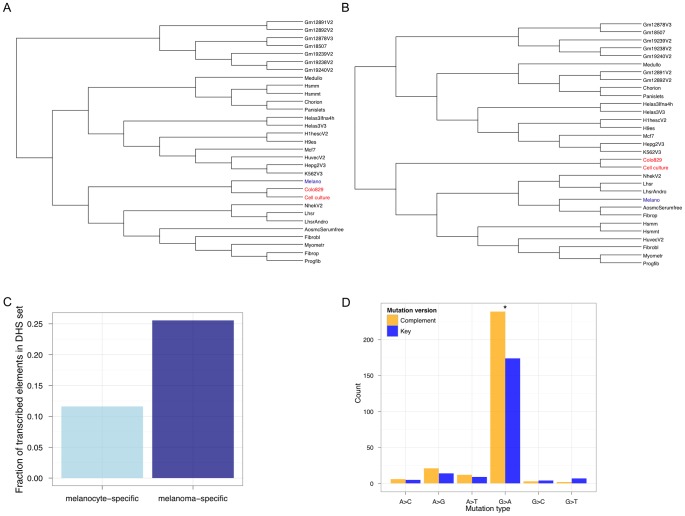
Much emphasis has been placed on the identification, functional characterization, and therapeutic potential of somatic variants in tumor genomes. However, the majority of somatic variants lie outside coding regions and their role in cancer progression remains to be determined. In order to establish a system to test the functional importance of non-coding somatic variants in cancer, we created a low-passage cell culture of a metastatic melanoma tumor sample. As a foundation for interpreting functional assays, we performed whole-genome sequencing and analysis of this cell culture, the metastatic tumor from which it was derived, and the patient-matched normal genomes. When comparing somatic mutations identified in the cell culture and tissue genomes, we observe concordance at the majority of single nucleotide variants, whereas copy number changes are more variable. To understand the functional impact of non-coding somatic variation, we leveraged functional data generated by the ENCODE Project Consortium. We analyzed regulatory regions derived from multiple different cell types and found that melanocyte-specific regions are among the most depleted for somatic mutation accumulation. Significant depletion in other cell types suggests the metastatic melanoma cells de-differentiated to a more basal regulatory state. Experimental identification of genome-wide regulatory sites in two different melanoma samples supports this observation. Together, these results show that mutation accumulation in metastatic melanoma is nonrandom across the genome and that a de-differentiated regulatory architecture is common among different samples. Our findings enable identification of the underlying genetic components of melanoma and define the differences between a tissue-derived tumor sample and the cell culture created from it. Such information helps establish a broader mechanistic understanding of the linkage between non-coding genomic variations and the cellular evolution of cancer.
人们非常重视鉴定、功能特征分析和肿瘤基因组体细胞变异的治疗潜力。然而,大多数体细胞变异位于编码区之外,其在癌症进展中的作用仍有待确定。为了建立一个测试癌症中非编码体细胞变异功能重要性的系统,我们创建了一个转移性黑素瘤肿瘤样本的低传代细胞培养物。作为解释功能测定的基础,我们对该细胞培养物、其衍生的转移性肿瘤以及患者匹配的正常基因组进行了全基因组测序和分析。在比较细胞培养物和组织基因组中鉴定的体细胞突变时,我们观察到大多数单核苷酸变异的一致性,而拷贝数变化则更具可变性。为了了解非编码体细胞变异的功能影响,我们利用了 ENCODE 项目联盟生成的功能数据。我们分析了来自多种不同细胞类型的调控区域,发现黑素细胞特异性区域是体细胞突变积累最少的区域之一。其他细胞类型的显著缺失表明转移性黑素瘤细胞去分化为更基础的调控状态。在两个不同的黑素瘤样本中对全基因组调控位点的实验鉴定支持了这一观察结果。总之,这些结果表明,转移性黑素瘤中的突变积累在整个基因组中是非随机的,去分化的调控结构在不同样本中很常见。我们的发现使我们能够确定黑素瘤的潜在遗传成分,并定义组织衍生的肿瘤样本与其创建的细胞培养物之间的差异。这些信息有助于建立对非编码基因组变异与癌症细胞进化之间联系的更广泛的机制理解。