Department of Neurosurgery, Kanazawa University Kanazawa, Ishikawa, Japan.
Front Oncol. 2012 Aug 14;2:98. doi: 10.3389/fonc.2012.00098. eCollection 2012.
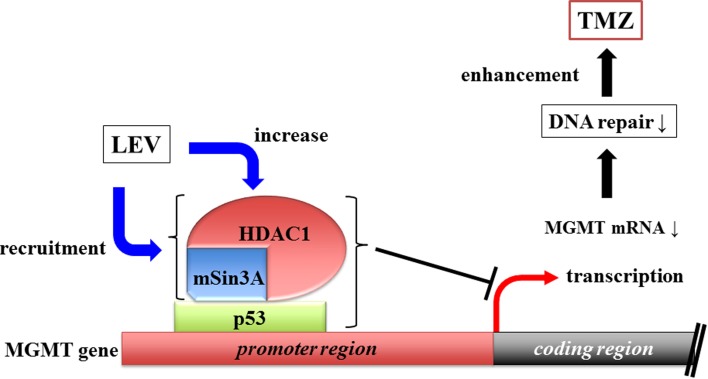
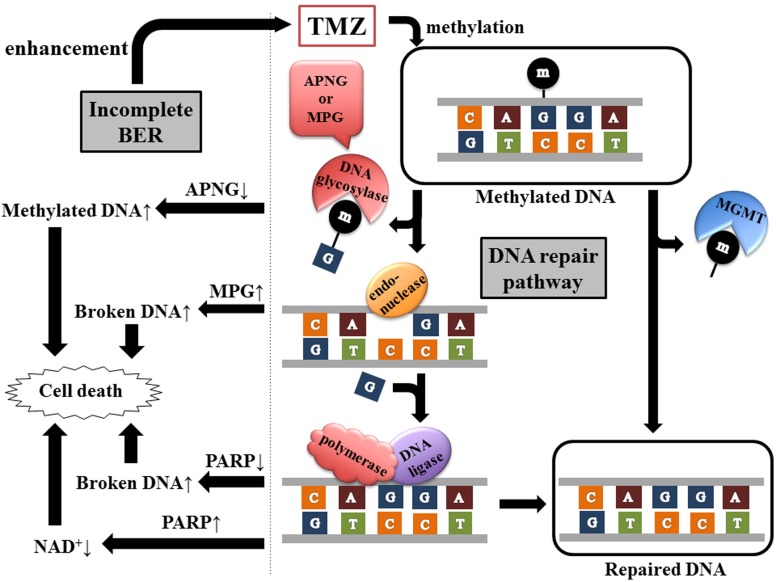
A combined therapy of the alkylating agent temozolomide (TMZ) and radiotherapy is standard treatment, and it improves the survival of patients with newly diagnosed glioblastoma (GBM). The DNA repair enzyme O(6)-methylguanine-DNA methyltransferase (MGMT) removes the most cytotoxic lesions generated by TMZ, O(6)-methylguanine, establishing MGMT as one of the most important DNA repair mechanisms of TMZ-induced DNA damage. Thus, the expression of MGMT, its activity, and its promoter methylation status are associated with the response of GBM to TMZ, confirming that MGMT promotes clinical resistance to TMZ. Previous studies have shown that a variety of drugs such as interferon-β (IFN-β), levetiracetam (LEV), resveratrol, and valproic acid (VAP) increased the sensitivity of TMZ through MGMT-dependent or MGMT-independent mechanisms. In this review, we describe drugs and promising molecules that influence the responsiveness of GBM to TMZ and discuss their putative mechanism of action. In MGMT-positive GBMs, drugs that modulate MGMT activity could enhance the therapeutic activity of TMZ. Thus, administration of these drugs as an adjunct to TMZ chemotherapy may have clinical applications in patients with malignant gliomas to improve the outcome.
替莫唑胺(TMZ)联合放疗法是标准治疗方案,可改善新诊断胶质母细胞瘤(GBM)患者的生存。DNA 修复酶 O(6)-甲基鸟嘌呤-DNA 甲基转移酶(MGMT)可清除 TMZ 产生的最具细胞毒性的损伤物 O(6)-甲基鸟嘌呤,这使 MGMT 成为 TMZ 诱导的 DNA 损伤最重要的 DNA 修复机制之一。因此,MGMT 的表达、其活性及其启动子甲基化状态与 GBM 对 TMZ 的反应相关,证实 MGMT 促进了 TMZ 的临床耐药性。先前的研究表明,多种药物,如干扰素-β(IFN-β)、左乙拉西坦(LEV)、白藜芦醇和丙戊酸(VAP),通过 MGMT 依赖性或非 MGMT 依赖性机制增加 TMZ 的敏感性。在这篇综述中,我们描述了影响 GBM 对 TMZ 反应性的药物和有前途的分子,并讨论了它们推测的作用机制。在 MGMT 阳性 GBM 中,调节 MGMT 活性的药物可增强 TMZ 的治疗活性。因此,这些药物作为 TMZ 化疗的辅助药物可能在改善恶性胶质瘤患者的预后方面具有临床应用价值。