ETH, Institute of Microbiology, Zurich, Switzerland.
PLoS One. 2012;7(8):e43421. doi: 10.1371/journal.pone.0043421. Epub 2012 Aug 16.
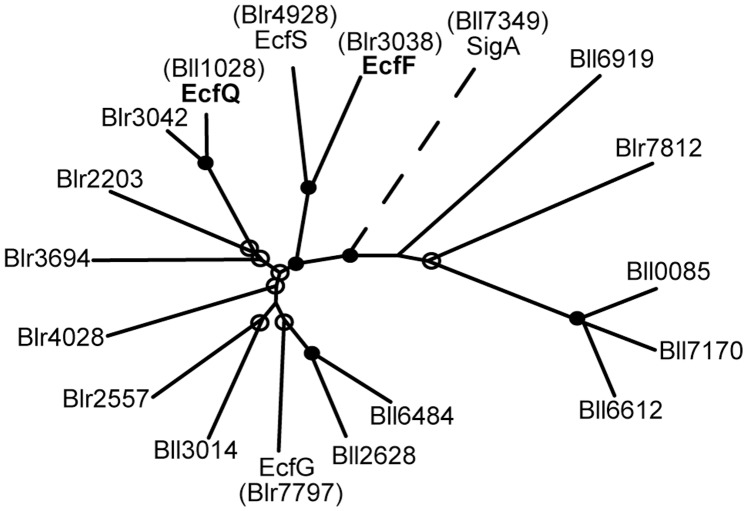
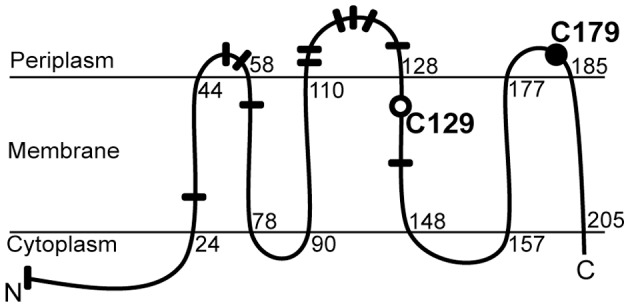
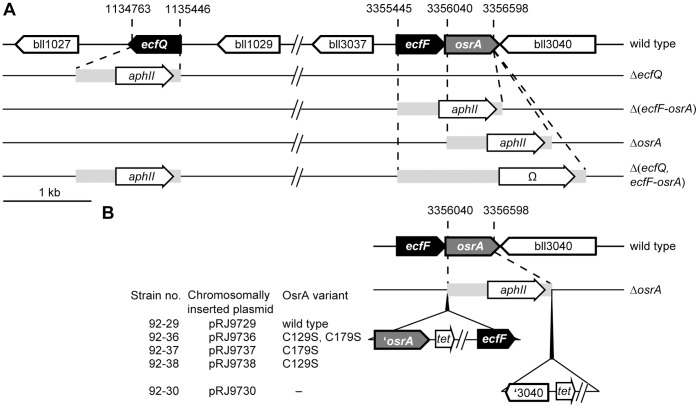
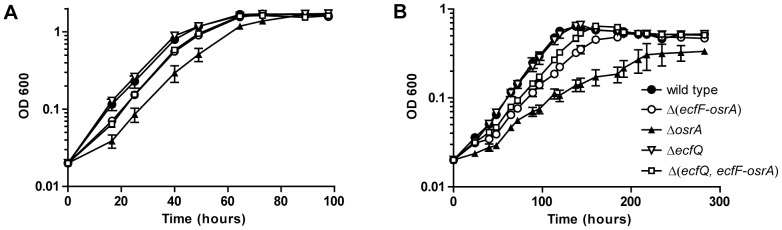
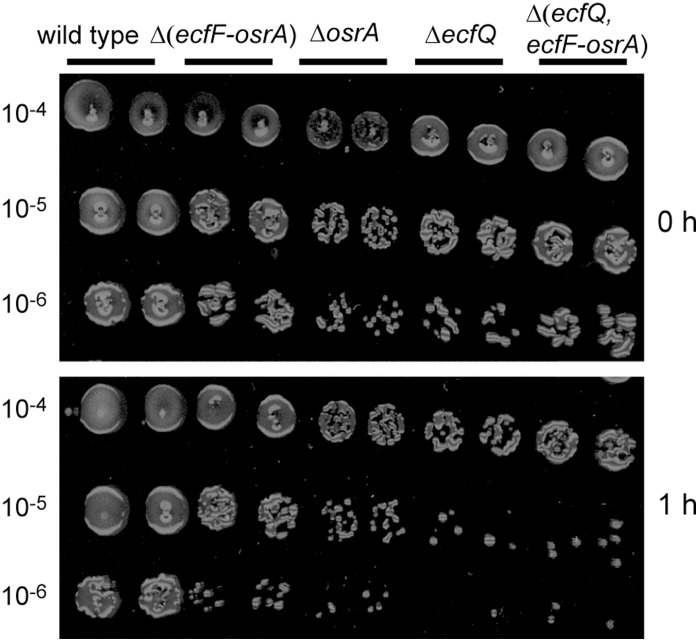
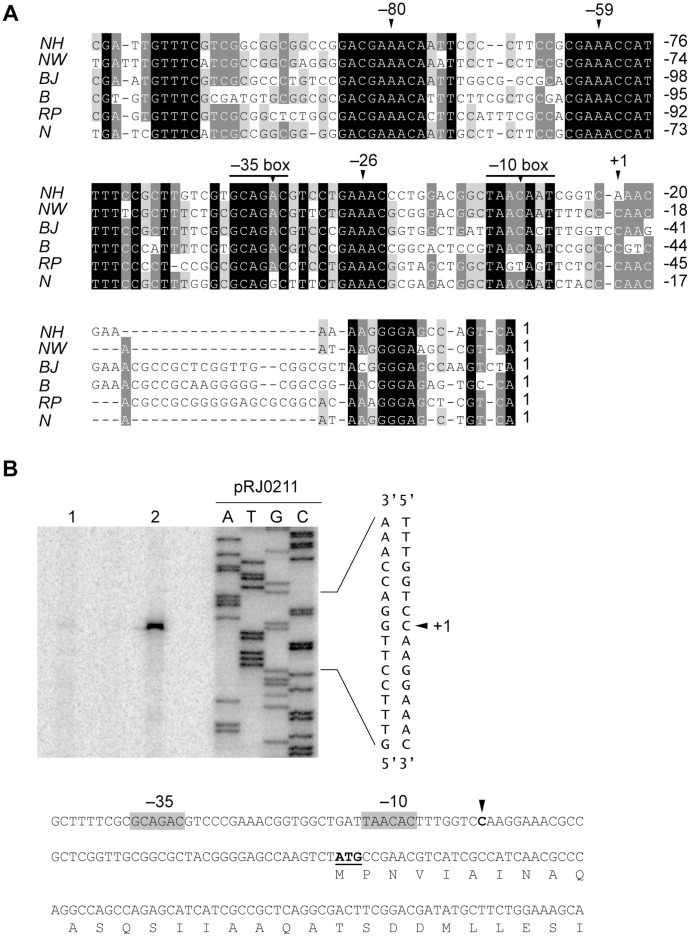
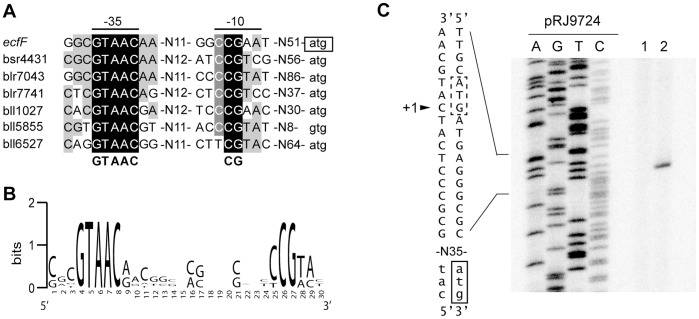
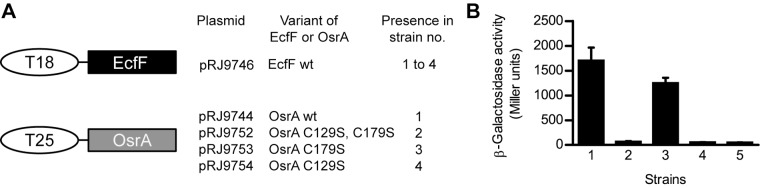
Extracytoplasmic function (ECF) σ factors control the transcription of genes involved in different cellular functions, such as stress responses, metal homeostasis, virulence-related traits, and cell envelope structure. The genome of Bradyrhizobium japonicum, the nitrogen-fixing soybean endosymbiont, encodes 17 putative ECF σ factors belonging to nine different ECF σ factor families. The genes for two of them, ecfQ (bll1028) and ecfF (blr3038), are highly induced in response to the reactive oxygen species hydrogen peroxide (H(2)O(2)) and singlet oxygen ((1)O(2)). The ecfF gene is followed by the predicted anti-σ factor gene osrA (blr3039). Mutants lacking EcfQ, EcfF plus OsrA, OsrA alone, or both σ factors plus OsrA were phenotypically characterized. While the symbiotic properties of all mutants were indistinguishable from the wild type, they showed increased sensitivity to singlet oxygen under free-living conditions. Possible target genes of EcfQ and EcfF were determined by microarray analyses, and candidate genes were compared with the H(2)O(2)-responsive regulon. These experiments disclosed that the two σ factors control rather small and, for the most part, distinct sets of genes, with about half of the genes representing 13% of the members of H(2)O(2)-responsive regulon. To get more insight into transcriptional regulation of both σ factors, the 5' ends of ecfQ and ecfF mRNA were determined. The presence of conserved sequence motifs in the promoter region of ecfQ and genes encoding EcfQ-like σ factors in related α-proteobacteria suggests regulation via a yet unknown transcription factor. By contrast, we have evidence that ecfF is autoregulated by transcription from an EcfF-dependent consensus promoter, and its product is negatively regulated via protein-protein interaction with OsrA. Conserved cysteine residues 129 and 179 of OsrA are required for normal function of OsrA. Cysteine 179 is essential for release of EcfF from an EcfF-OsrA complex upon H(2)O(2) stress while cysteine 129 is possibly needed for EcfF-OsrA interaction.
细胞外功能(ECF)σ因子控制参与不同细胞功能的基因转录,例如应激反应、金属稳态、毒力相关特征和细胞包膜结构。固氮大豆共生体根瘤菌的基因组编码 17 种推定的 ECF σ因子,属于九个不同的 ECF σ因子家族。其中两个基因,ecfQ(bll1028)和 ecfF(blr3038),对活性氧过氧化氢(H₂O₂)和单线态氧(¹O₂)的反应高度诱导。ecfF 基因后面跟着预测的反 σ 因子基因 osrA(blr3039)。缺乏 EcfQ、EcfF 加 OsrA、OsrA 单独或两个 σ 因子加 OsrA 的突变体进行了表型特征描述。虽然所有突变体的共生特性与野生型没有区别,但它们在自由生活条件下对单线态氧的敏感性增加。通过微阵列分析确定了 EcfQ 和 EcfF 的可能靶基因,并将候选基因与 H₂O₂ 反应调节子进行了比较。这些实验表明,这两个 σ 因子控制着相当小的、大部分是不同的基因集,其中约一半的基因代表 H₂O₂ 反应调节子的 13%成员。为了更深入地了解这两个 σ 因子的转录调控,确定了 ecfQ 和 ecfF mRNA 的 5'端。ecfQ 启动子区域和相关α变形菌中编码 EcfQ 样 σ 因子的基因中保守序列基序的存在表明通过尚未知的转录因子进行调节。相比之下,我们有证据表明,ecfF 通过依赖于 EcfF 的共有启动子的转录进行自身调控,并且其产物通过与 OsrA 的蛋白-蛋白相互作用受到负调控。OsrA 的保守半胱氨酸残基 129 和 179 对于 OsrA 的正常功能是必需的。半胱氨酸 179 对于 H₂O₂ 应激时 EcfF 从 EcfF-OsrA 复合物中的释放是必需的,而半胱氨酸 129 可能对于 EcfF-OsrA 相互作用是必需的。