Division of Medical Oncology, University of Colorado, MS 8117, 12801 E. 17th Ave, Aurora, CO 80045, USA.
Clin Cancer Res. 2012 Sep 1;18(17):4570-9. doi: 10.1158/1078-0432.CCR-12-0550. Epub 2012 Aug 23.
Oncogenic gene fusions involving the 3' region of ROS1 kinase have been identified in various human cancers. In this study, we sought to characterize ROS1 fusion genes in non-small cell lung cancer (NSCLC) and establish the fusion proteins as drug targets.
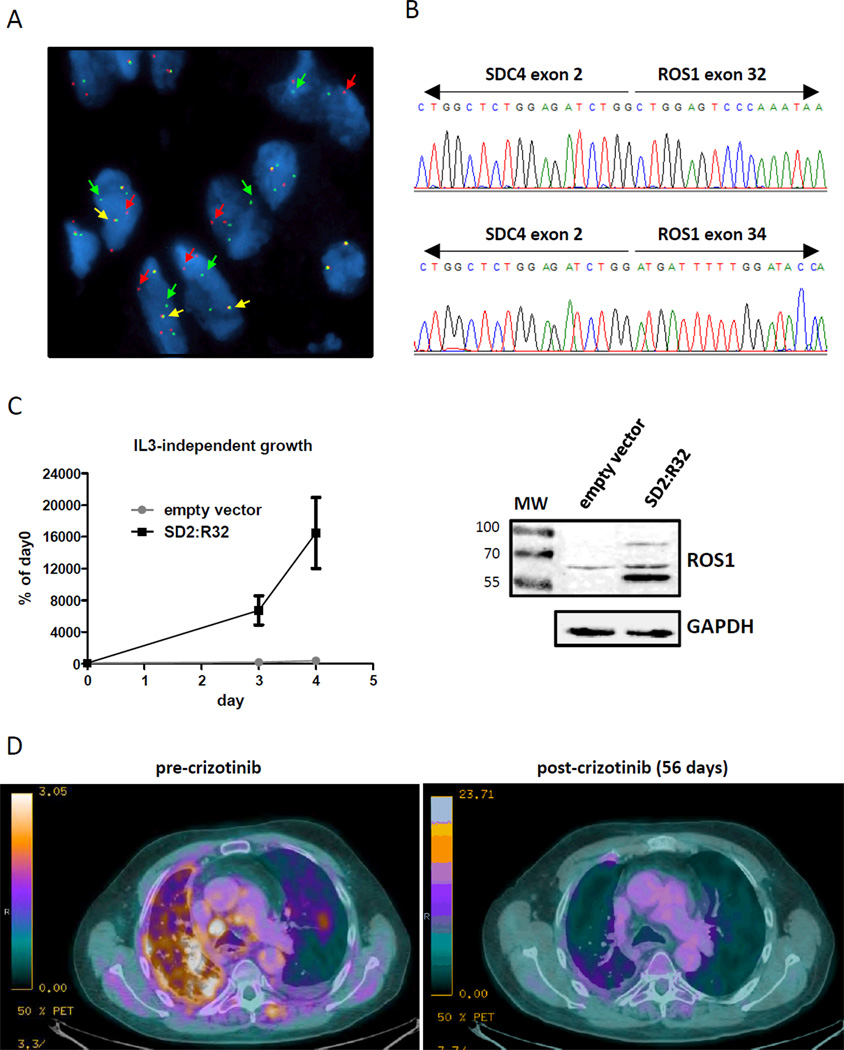
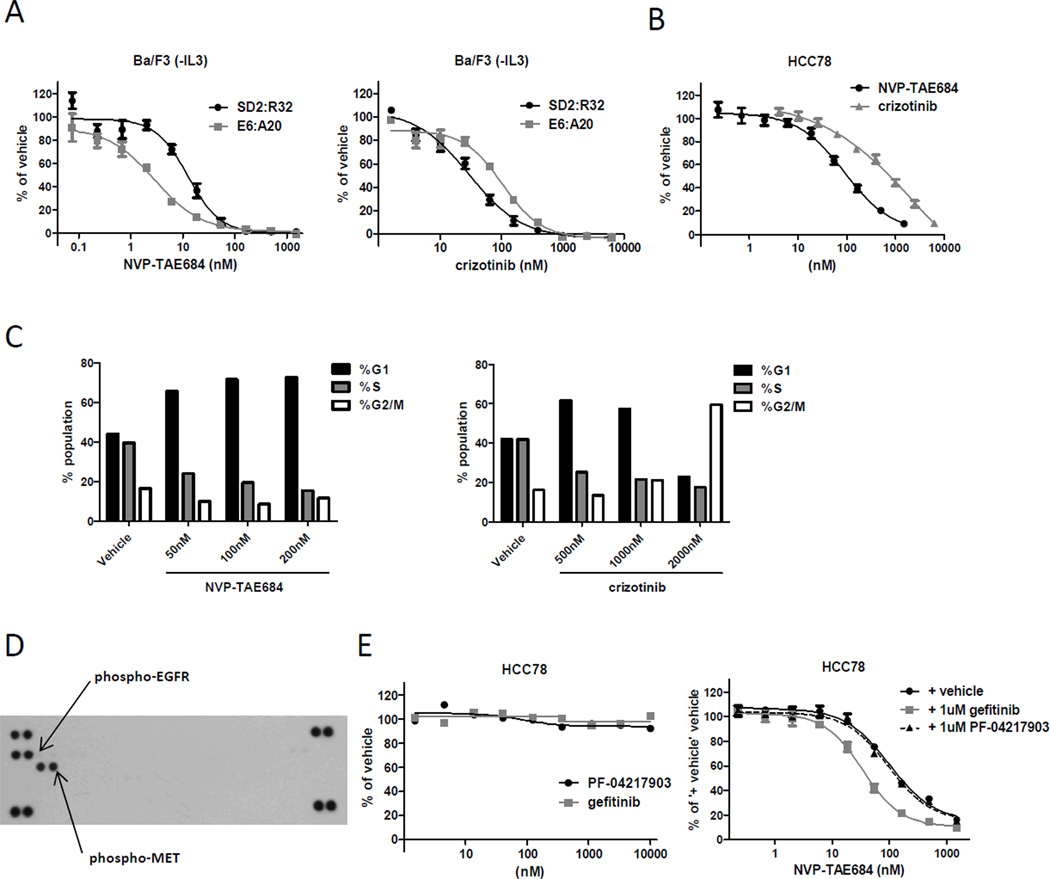
An NSCLC tissue microarray (TMA) panel containing 447 samples was screened for ROS1 rearrangement by FISH. This assay was also used to screen patients with NSCLC. In positive samples, the identity of the fusion partner was determined through inverse PCR and reverse transcriptase PCR. In addition, the clinical efficacy of ROS1 inhibition was assessed by treating a ROS1-positive patient with crizotinib. The HCC78 cell line, which expresses the SLC34A2-ROS1 fusion, was treated with kinase inhibitors that have activity against ROS1. The effects of ROS1 inhibition on proliferation, cell-cycle progression, and cell signaling pathways were analyzed by MTS assay, flow cytometry, and Western blotting.
In the TMA panel, 5 of 428 (1.2%) evaluable samples were found to be positive for ROS1 rearrangement. In addition, 1 of 48 patients tested positive for rearrangement, and this patient showed tumor shrinkage upon treatment with crizotinib. The patient and one TMA sample displayed expression of the recently identified SDC4-ROS1 fusion, whereas two TMA samples expressed the CD74-ROS1 fusion and two others expressed the SLC34A2-ROS1 fusion. In HCC78 cells, treatment with ROS1 inhibitors was antiproliferative and downregulated signaling pathways that are critical for growth and survival.
ROS1 inhibition may be an effective treatment strategy for the subset of patients with NSCLC whose tumors express ROS1 fusion genes.
ROS1 激酶 3' 区的致癌基因突变融合已在多种人类癌症中被发现。本研究旨在鉴定非小细胞肺癌(NSCLC)中的 ROS1 融合基因,并将融合蛋白确立为药物靶点。
通过 FISH 对包含 447 例样本的 NSCLC 组织微阵列(TMA)进行 ROS1 重排筛选。该检测还用于筛选 NSCLC 患者。在阳性样本中,通过反向 PCR 和逆转录 PCR 确定融合伙伴的身份。此外,通过用克唑替尼治疗一名 ROS1 阳性患者来评估 ROS1 抑制的临床疗效。用对 ROS1 有活性的激酶抑制剂处理表达 SLC34A2-ROS1 融合的 HCC78 细胞系,分析 ROS1 抑制对增殖、细胞周期进程和细胞信号通路的影响。
在 TMA 面板中,在 428 个可评估样本中的 5 个(1.2%)被发现存在 ROS1 重排阳性。此外,在 48 例患者中,有 1 例经检测发现重排阳性,该患者接受克唑替尼治疗后肿瘤缩小。该患者和一个 TMA 样本表达了最近鉴定的 SDC4-ROS1 融合,而两个 TMA 样本表达了 CD74-ROS1 融合,另外两个样本表达了 SLC34A2-ROS1 融合。在 HCC78 细胞中,ROS1 抑制剂的治疗具有抗增殖作用,并下调了对生长和存活至关重要的信号通路。
ROS1 抑制可能是表达 ROS1 融合基因的 NSCLC 患者亚群的有效治疗策略。