Radiation Risk Reduction Research Program, Research Center for Radiation Protection, National Institute of Radiological Sciences, Anagawa 4-9-1, Inage-ku, Chiba 263-8555, Japan.
J Radiat Res. 2013 Jan;54(1):45-51. doi: 10.1093/jrr/rrs077. Epub 2012 Aug 24.
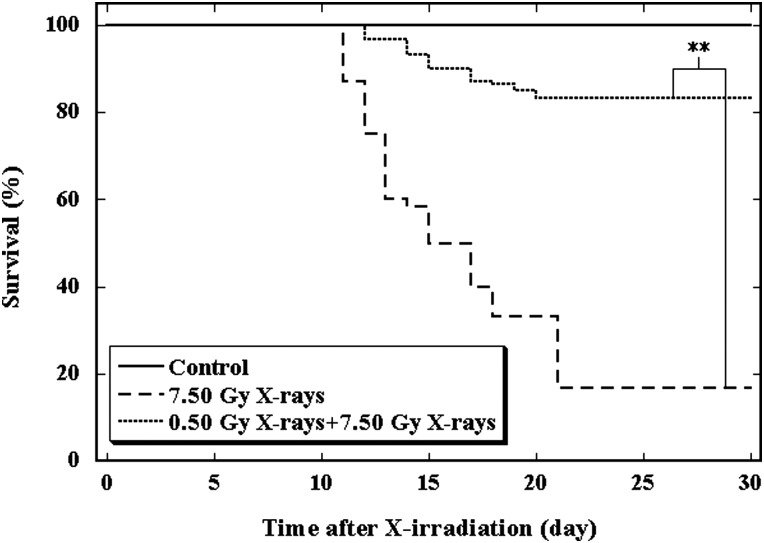
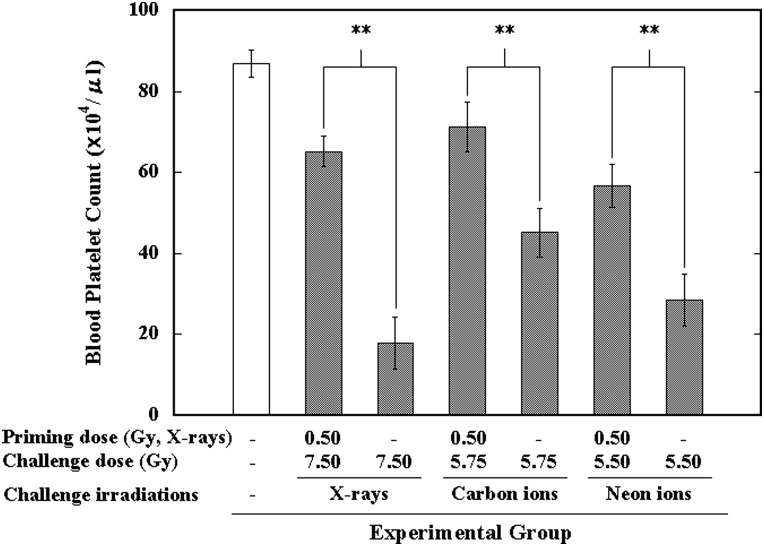
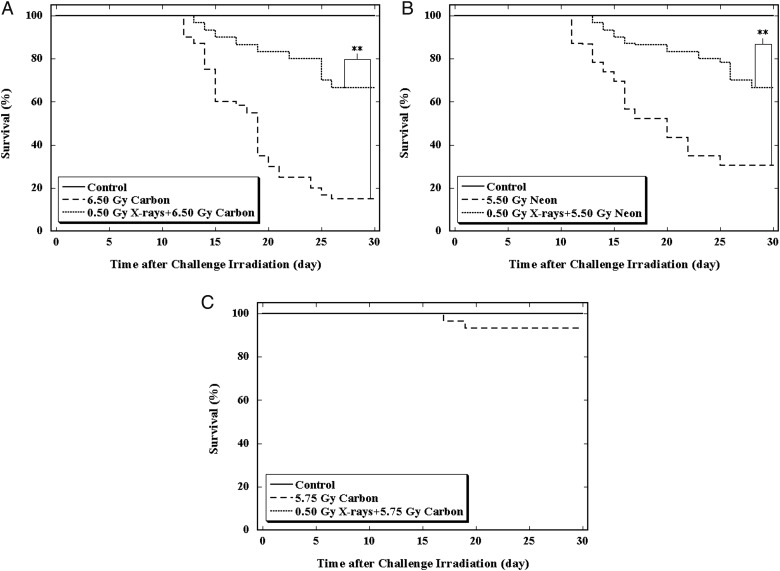
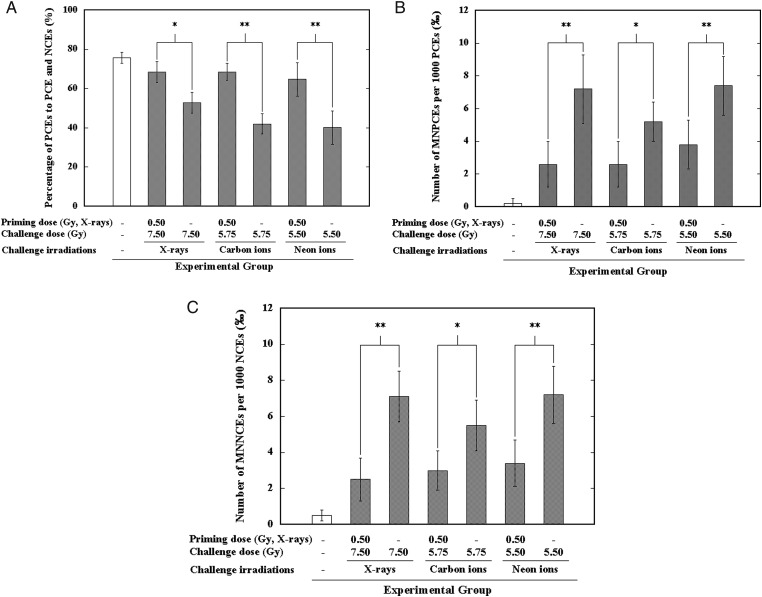
Existence of adaptive response (AR) was previously demonstrated in C57BL/6J mice. Irradiations were performed by delivering a priming low dose of X-rays (0.50 Gy) in combination with a challenge high dose of accelerated carbon or neon ion particles. AR was characterized by significantly decreased mortality in the 30-day survival test. This mouse AR model ('Yonezawa Effect') was originally established by using X-rays as both the priming and challenge irradiations. The underlying mechanism was due to radio-resistance occurring in blood-forming tissues. In this study, we verified the existence of AR and further investigated residual damage in the hematopoietic system in surviving animals. Results showed that the priming low dose of X-rays could relieve the detrimental effects on the hematopoietic system. We observed both an improvement in the blood platelet count and the ratio of polychromatic erythrocytes (PCEs) to the sum of PCEs and normochromatic erythrocytes (NCEs) and a marked reduction of the incidences of micronucleated PCEs and micronucleated NCEs. These findings suggest that the priming low dose of low linear energy transfer (LET) X-rays induced a protective effect on the hematopoietic system, which may play an important role in both rescue from acute lethal damage (mouse killing) and prevention of late detrimental consequences (residual anhematopoiesis and delayed genotoxic effects) caused by exposure to a high challenge dose from low-LET (X-ray) or high-LET (carbon and neon ion) irradiations. These findings provide new knowledge of the characterization of the Yonezawa Effect by providing new insight into the mechanistic study of AR in vivo.
先前已经证明,在 C57BL/6J 小鼠中存在适应性反应 (AR)。通过将低剂量 X 射线(0.50 Gy)与加速的碳或氖离子束的高剂量进行联合照射,来进行辐照。适应性反应的特征是在 30 天存活试验中死亡率显著降低。该小鼠适应性反应模型(“Yonezawa 效应”)最初是使用 X 射线作为引发和挑战照射来建立的。其潜在机制是由于造血组织中出现了耐辐射性。在这项研究中,我们验证了适应性反应的存在,并进一步研究了幸存动物的造血系统中的残留损伤。结果表明,低剂量 X 射线的引发可以减轻对造血系统的有害影响。我们观察到血小板计数的提高以及多色性红细胞(PCE)与 PCE 和正常染色红细胞(NCE)总和的比值提高,并且微核 PCE 和微核 NCE 的发生率显著降低。这些发现表明,低线性能量转移(LET)X 射线的低剂量引发了对造血系统的保护作用,这可能在从急性致死性损伤(杀死小鼠)中进行抢救以及预防由低 LET(X 射线)或高 LET(碳和氖离子)照射引起的高挑战剂量引起的迟发性有害后果(残留的无血液形成和延迟的遗传毒性作用)中发挥重要作用。这些发现为 Yonezawa 效应的特征描述提供了新知识,为体内适应性反应的机制研究提供了新的见解。