Attinkara Ragam, Mwinyi Jessica, Truninger Kaspar, Regula Jaroslaw, Gaj Pawel, Rogler Gerhard, Kullak-Ublick Gerd A, Eloranta Jyrki J
Department of Clinical Pharmacology and Toxicology, University Hospital, Zurich, Switzerland.
BMC Res Notes. 2012 Aug 28;5:461. doi: 10.1186/1756-0500-5-461.
Pathogenesis of inflammatory bowel diseases (IBD), ulcerative colitis (UC) and Crohn's disease (CD), involves interaction between environmental factors and inappropriate immune responses in the intestine of genetically predisposed individuals. Bile acids and their nuclear receptor, FXR, regulate inflammatory responses and barrier function in the intestinal tract.
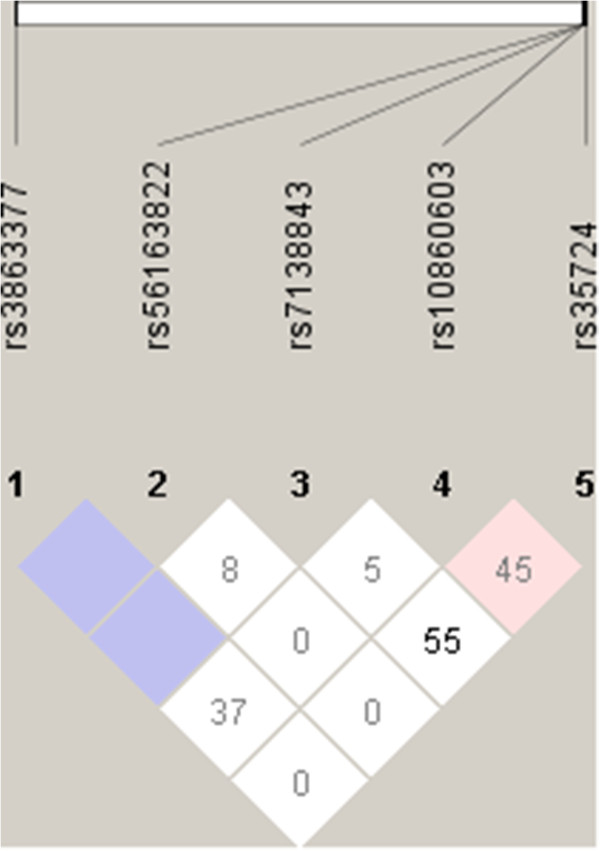
We studied the association of five variants (rs3863377, rs7138843, rs56163822, rs35724, rs10860603) of the NR1H4 gene encoding FXR with IBD. 1138 individuals (591 non-IBD, 203 UC, 344 CD) were genotyped for five NR1H4 genetic variants with TaqMan SNP Genotyping Assays.
We observed that the NR1H4 SNP rs3863377 is significantly less frequent in IBD cases than in non-IBD controls (allele frequencies: P = 0.004; wild-type vs. SNP carrier genotype frequencies: P = 0.008), whereas the variant rs56163822 is less prevalent in non-IBD controls (allele frequencies: P = 0.027; wild-type vs. SNP carrier genotype frequencies: P = 0.035). The global haplotype distribution between IBD and control patients was significantly different (P = 0.003). This also held true for the comparison between non-IBD and UC groups (P = 0.004), but not for the comparison between non-IBD and CD groups (P = 0.079).
We show that genetic variation in FXR is associated with IBD, further emphasizing the link between bile acid signaling and intestinal inflammation.
炎症性肠病(IBD),包括溃疡性结肠炎(UC)和克罗恩病(CD),其发病机制涉及环境因素与遗传易感性个体肠道中不适当免疫反应之间的相互作用。胆汁酸及其核受体FXR可调节肠道中的炎症反应和屏障功能。
我们研究了编码FXR的NR1H4基因的五个变体(rs3863377、rs7138843、rs56163822、rs35724、rs10860603)与IBD的关联。采用TaqMan SNP基因分型检测法对1138名个体(591名非IBD患者、203名UC患者、344名CD患者)的五个NR1H4基因变体进行基因分型。
我们观察到,IBD患者中NR1H4 SNP rs3863377的频率显著低于非IBD对照(等位基因频率:P = 0.004;野生型与SNP携带者基因型频率:P = 0.008),而变体rs56163822在非IBD对照中不太常见(等位基因频率:P = 0.027;野生型与SNP携带者基因型频率:P = 0.035)。IBD患者与对照患者之间的总体单倍型分布存在显著差异(P = 0.003)。非IBD组与UC组之间的比较也是如此(P = 0.004),但非IBD组与CD组之间的比较则不然(P = 0.079)。
我们表明FXR的基因变异与IBD相关,进一步强调了胆汁酸信号传导与肠道炎症之间的联系。