St. John's Institute of Dermatology, King's College London and NIHR Biomedical Research Centre, London, United Kingdom.
PLoS One. 2012;7(8):e44219. doi: 10.1371/journal.pone.0044219. Epub 2012 Aug 28.
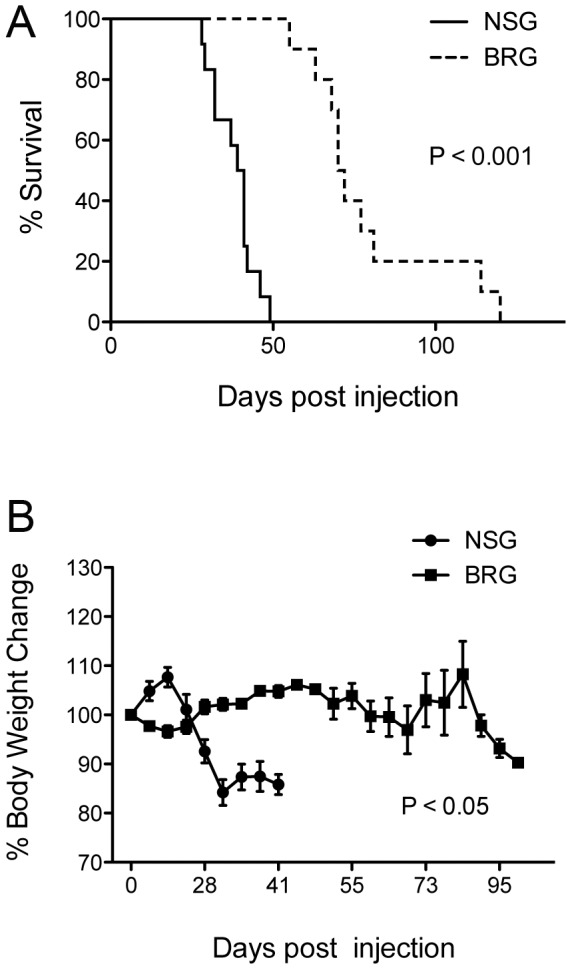
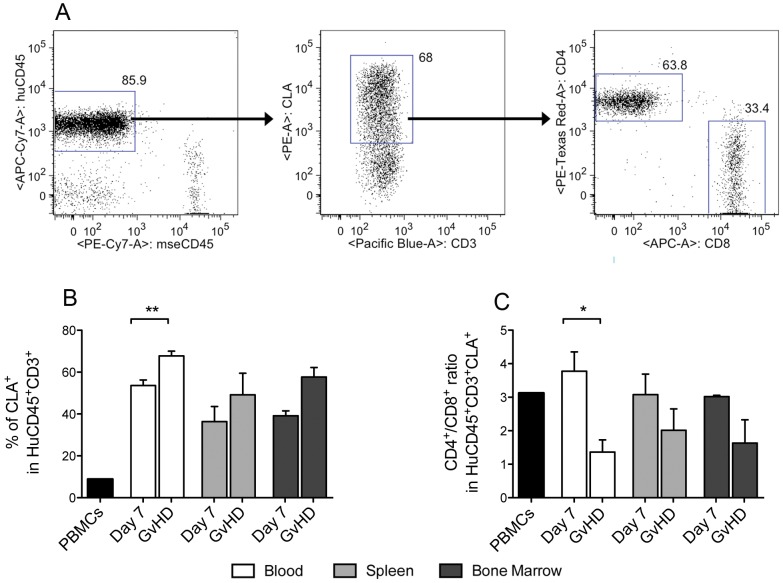
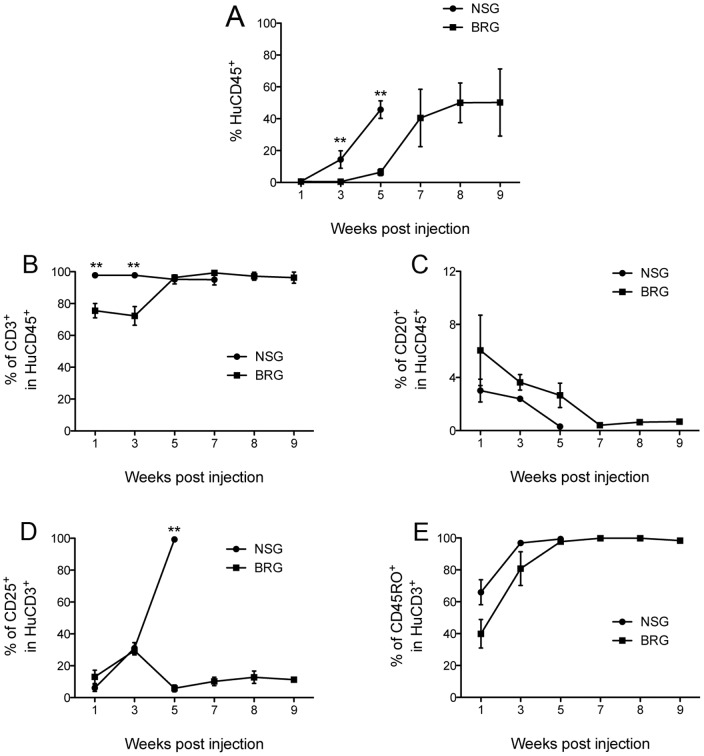
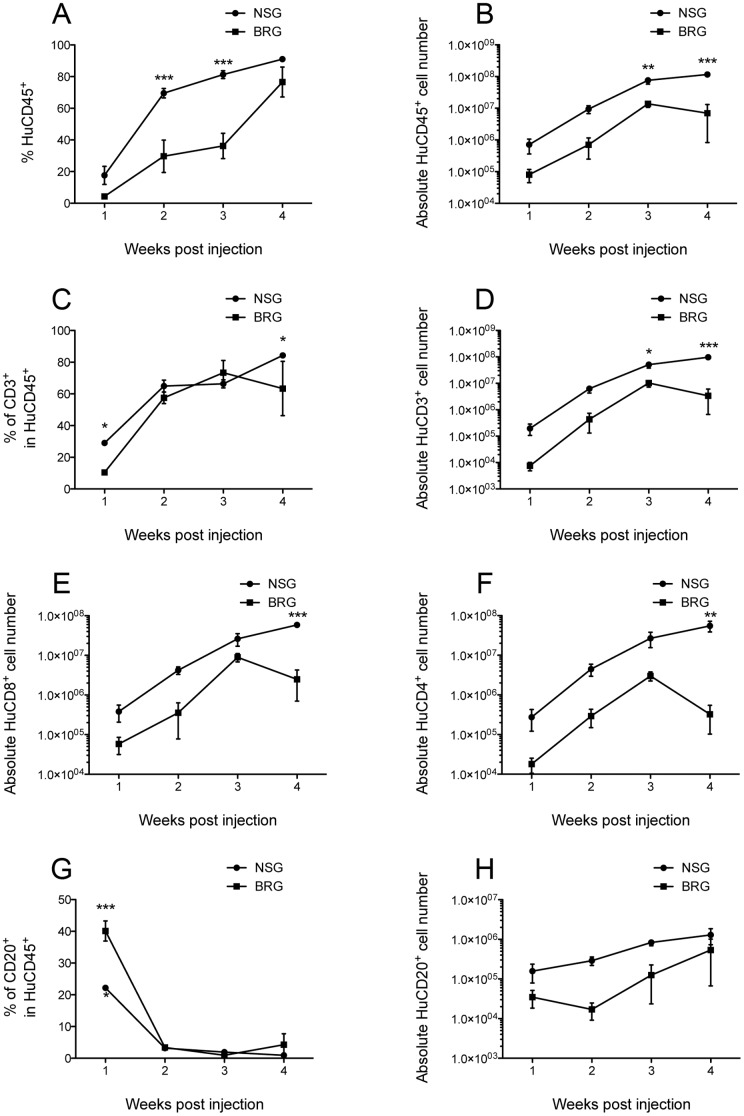
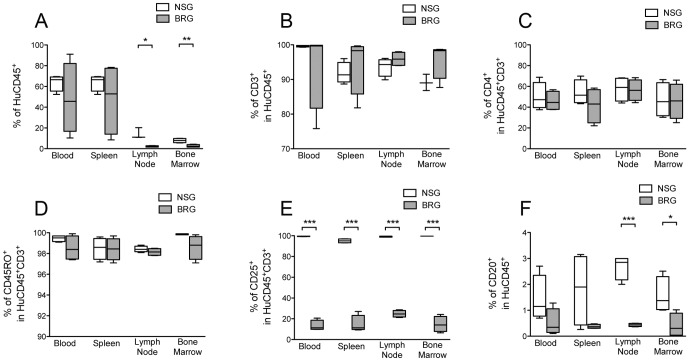
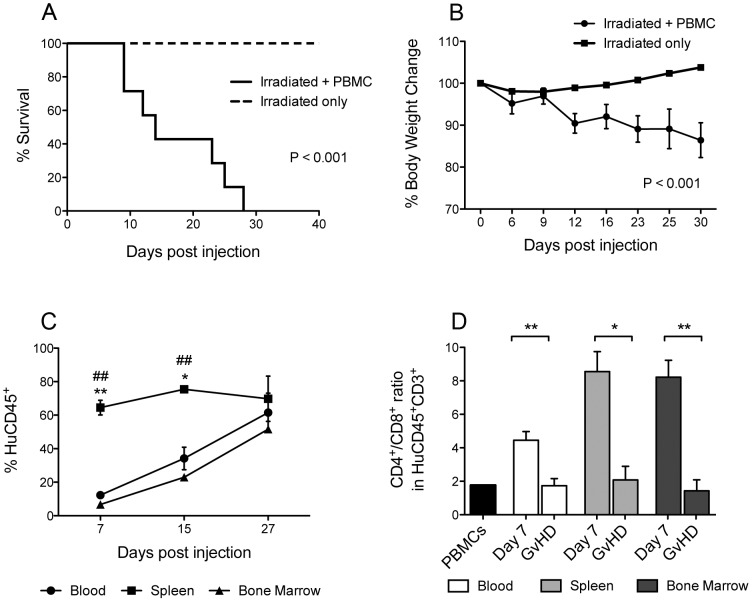
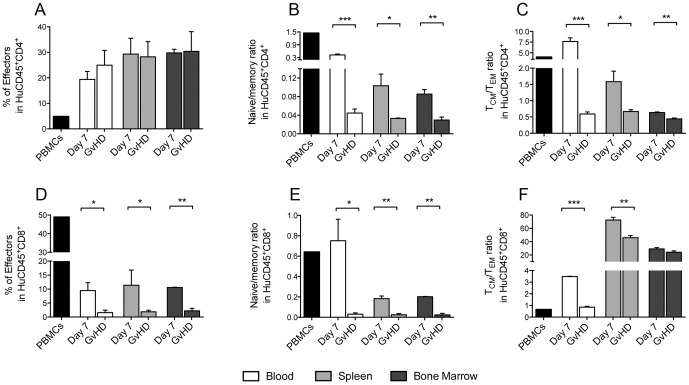
The occurrence of Graft-versus-Host Disease (GvHD) is a prevalent and potentially lethal complication that develops following hematopoietic stem cell transplantation. Humanized mouse models of xenogeneic-GvHD based upon immunodeficient strains injected with human peripheral blood mononuclear cells (PBMC; "Hu-PBMC mice") are important tools to study human immune function in vivo. The recent introduction of targeted deletions at the interleukin-2 common gamma chain (IL-2Rγ(null)), notably the NOD-scid IL-2Rγ(null) (NSG) and BALB/c-Rag2(null) IL-2Rγ(null) (BRG) mice, has led to improved human cell engraftment. Despite their widespread use, a comprehensive characterisation of engraftment and GvHD development in the Hu-PBMC NSG and BRG models has never been performed in parallel. We compared engrafted human lymphocyte populations in the peripheral blood, spleens, lymph nodes and bone marrow of these mice. Kinetics of engraftment differed between the two strains, in particular a significantly faster expansion of the human CD45(+) compartment and higher engraftment levels of CD3(+) T-cells were observed in NSG mice, which may explain the faster rate of GvHD development in this model. The pathogenesis of human GvHD involves anti-host effector cell reactivity and cutaneous tissue infiltration. Despite this, the presence of T-cell subsets and tissue homing markers has only recently been characterised in the peripheral blood of patients and has never been properly defined in Hu-PBMC models of GvHD. Engrafted human cells in NSG mice shows a prevalence of tissue homing cells with a T-effector memory (T(EM)) phenotype and high levels of cutaneous lymphocyte antigen (CLA) expression. Characterization of Hu-PBMC mice provides a strong preclinical platform for the application of novel immunotherapies targeting T(EM)-cell driven GvHD.
移植物抗宿主病(GvHD)的发生是造血干细胞移植后一种常见且潜在致命的并发症。用人外周血单个核细胞(PBMC)注射免疫缺陷株构建的异种 GvHD 人源化小鼠模型(“Hu-PBMC 小鼠”)是研究体内人类免疫功能的重要工具。最近,在白细胞介素 2 共同γ链(IL-2Rγ(null))靶向缺失的基础上,特别是 NOD-scid IL-2Rγ(null)(NSG)和 BALB/c-Rag2(null)IL-2Rγ(null)(BRG)小鼠的引入,导致了人细胞植入的改善。尽管它们被广泛应用,但 Hu-PBMC NSG 和 BRG 模型中的植入和 GvHD 发展的综合特征从未进行过平行比较。我们比较了这两种小鼠外周血、脾脏、淋巴结和骨髓中植入的人类淋巴细胞群体。两种菌株的植入动力学不同,特别是在 NSG 小鼠中观察到人类 CD45(+)细胞群的快速扩张和 CD3(+)T 细胞的更高植入水平,这可能解释了该模型中 GvHD 发展更快的原因。人类 GvHD 的发病机制涉及抗宿主效应细胞反应和皮肤组织浸润。尽管如此,T 细胞亚群和组织归巢标志物的存在直到最近才在患者的外周血中得到描述,并且在 GvHD 的 Hu-PBMC 模型中从未得到正确定义。NSG 小鼠中植入的人类细胞表现出组织归巢细胞的普遍性,具有 T 效应记忆(T(EM))表型和高水平的皮肤淋巴细胞抗原(CLA)表达。Hu-PBMC 小鼠的特征描述为靶向 T(EM)-细胞驱动的 GvHD 的新型免疫疗法提供了强大的临床前平台。