Australian Rivers Institute, Griffith School of Environment, Griffith University, Nathan, Queensland, Australia, 4111.
J Insect Sci. 2012;12:6. doi: 10.1673/031.012.0601.
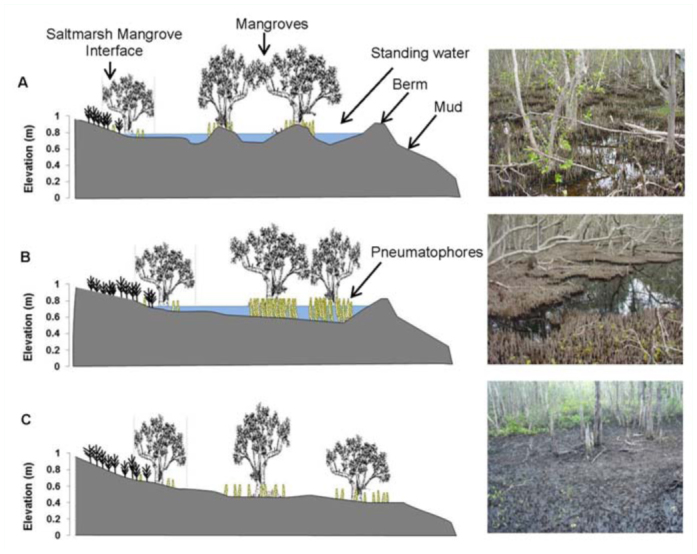
Our aim was to investigate the oviposition and larval habitats of the saltwater mosquito Aedes vigilax (Skuse) (Diptera: Culicidae) in a mangrove forest system in subtropical Queensland, Australia. Eggshells (indicators of oviposition) and larvae were sampled in three habitat classes that were depicted in a schematic model. Two classes were in depressions or basins, either with hummocks or dense pneumatophore substrates, both of which retained water after tidal flooding. The third class was in freely flushed mangroves that corresponded with more frequent tidal connections than the depression classes. ANOVA and Tukey-Kramer tests were used to analyze the data. The null hypotheses were rejected: the hummock class was a significant habitat based on both eggshell and larval data. The conclusion was that mosquito production in the mangrove system was distributed unevenly between habitat classes, and that the hummock class had conditions suited to the requirements of the immature stages of Ae. vigilax. This research has the potential to inform mosquito management strategies by focusing treatment on the problem habitats and underpinning habitat modifications including reducing water retention in the basins.
我们的目的是调查澳大利亚亚热带昆士兰州红树林系统中盐水伊蚊(库蚊科)的产卵和幼虫栖息地。在一个示意性模型中描述了三个生境类别,对卵壳(产卵的指示物)和幼虫进行了采样。两个类别在洼地或盆地中,要么有隆起的土墩,要么有密集的气生根基质,两者在潮汐洪水后都保留了水。第三个类别是在自由冲刷的红树林中,与洼地类别相比,这种红树林与潮汐的连接更为频繁。使用 ANOVA 和 Tukey-Kramer 检验来分析数据。零假设被拒绝:基于卵壳和幼虫数据,土墩类是一个重要的栖息地。结论是,红树林系统中的蚊子产量在生境类别之间分布不均,土墩类具有适合伊蚊幼虫发育阶段要求的条件。这项研究有可能通过将处理重点放在有问题的栖息地,并支持包括减少盆地蓄水在内的栖息地改造,为蚊子管理策略提供信息。