Department of Pharmacology, Brain Science and Engineering Institute, Kyungpook National University School of Medicine, Daegu, Korea.
Curr Neuropharmacol. 2012 Mar;10(1):72-9. doi: 10.2174/157015912799362733.
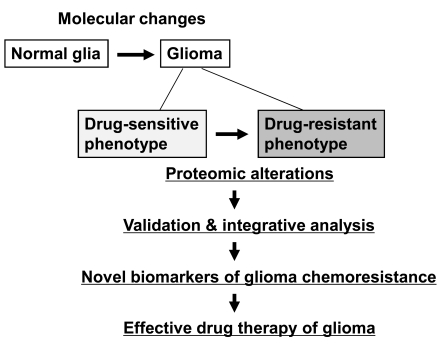
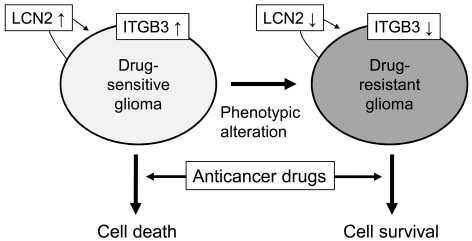
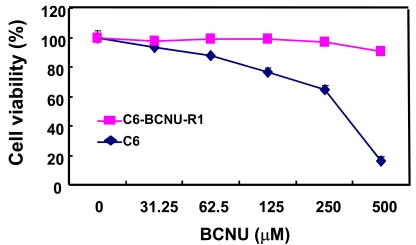
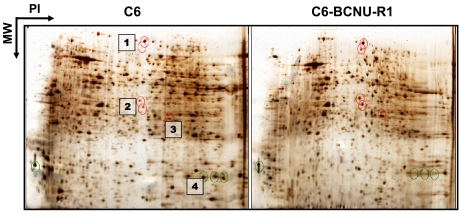
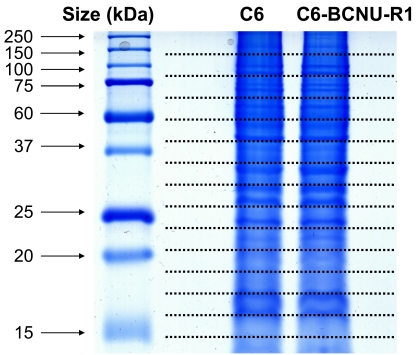
Malignant glioma is the most common and destructive form of primary brain tumor. Along with surgery and radiation, chemotherapy remains as the major treatment modality. The emergence of drug resistance, however, often leads to a therapeutic failure in the treatment of glioma, precluding long-term survival of the patients. A proteomic approach has recently been adapted for the mechanistic analysis of glioma drug resistance. The proteomic analysis of drug-resistant glioma led to the discovery of novel biomarkers that can be used for the prognosis of glioma as well as for monitoring the drug response or resistance of glioma. These proteomics-based biomarkers can also be a druggable target that one can exploit for successful glioma chemotherapy. In this review, recent reports on proteomic analysis of glioma from the perspective of chemoresistance are discussed with a focus on the proteome profiles of glioma cells that are resistant to the alkylating agent, 1, 3-bis (2-chloroethyl)-1-nitrosourea (BCNU), as a prime example. Among numerous proteins that were up- or down-regulated in drug-resistant glioma cells, lipocalin 2 (LCN2) and integrin β3 (ITGB3) were identified as key proteins that determine the survival and death of glioma cells. LCN2, ITGB3, and other proteins identified by proteomic analysis could be utilized to overcome glioma chemoresistance.
恶性脑胶质瘤是最常见和最具破坏性的原发性脑肿瘤。除了手术和放疗外,化疗仍然是主要的治疗方式。然而,耐药性的出现往往导致胶质瘤治疗失败,使患者无法长期生存。最近,蛋白质组学方法被用于分析胶质瘤的耐药机制。对耐药性脑胶质瘤的蛋白质组学分析导致了新的生物标志物的发现,这些标志物可用于预测脑胶质瘤的预后以及监测脑胶质瘤对药物的反应或耐药性。这些基于蛋白质组学的生物标志物也可以作为一个可治疗的靶点,为成功的脑胶质瘤化疗提供帮助。在这篇综述中,我们从化疗耐药性的角度讨论了最近关于脑胶质瘤蛋白质组学分析的报告,重点介绍了对烷化剂 1,3-双(2-氯乙基)-1-亚硝脲(BCNU)耐药的脑胶质瘤细胞的蛋白质组图谱,作为一个主要的例子。在耐药性脑胶质瘤细胞中上调或下调的众多蛋白质中,发现了脂质运载蛋白 2(LCN2)和整合素 β3(ITGB3)是决定脑胶质瘤细胞存活和死亡的关键蛋白。蛋白质组学分析鉴定的 LCN2、ITGB3 和其他蛋白质可用于克服脑胶质瘤的化疗耐药性。