Department of Bioinformatics, Vision Research Foundation, Chennai 600006, India.
Lipids Health Dis. 2012 Sep 4;11:109. doi: 10.1186/1476-511X-11-109.
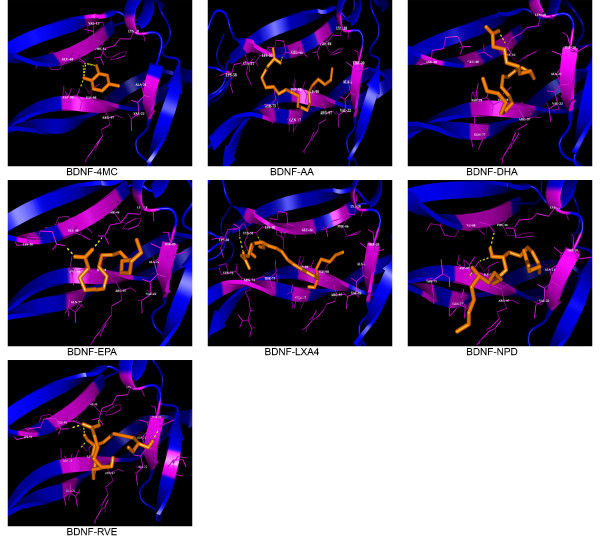
Brain-derived neurotrophic factor (BDNF) is a potent neurotrophic factor that is implicated in the regulation of food intake and body weight. Polyunsaturated fatty acids (PUFAs) localised in cell membranes have been shown to alter the levels of BDNF in the brain, suggesting that PUFAs and BDNF could have physical interaction with each other. To decipher the molecular mechanism through which PUFAs modulates BDNF's activity, molecular docking was performed for BDNF with PUFAs and its metabolites, with 4-Methyl Catechol as a control.
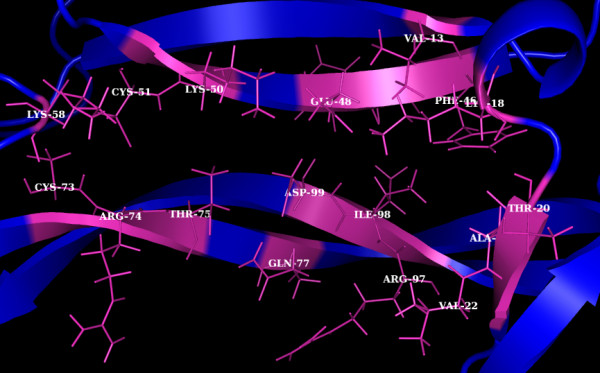
Inferring from molecular docking studies, lipoxin A4 (LXA4), and a known anti-inflammatory bioactive metabolite derived from PUFAs, with a binding energy of -3.98 Kcal/mol and dissociation constant of 1.2 mM showed highest binding affinity for BDNF in comparison to other PUFAs and metabolites considered in the study. Further, the residues Lys 18, Thr 20, Ala 21, Val 22, Phe 46, Glu 48, Lys 50, Lys 58, Thr 75, Gln 77, Arg 97 and Ile 98 form hot point motif, which on interaction enhances BDNF's function.
These results suggest that PUFAs and their metabolites especially, LXA4, modulate insulin resistance by establishing a physical interaction with BDNF. Similar interaction(s) was noted between BDNF and resolvins and protectins but were of lesser intensity compared to LXA4.
脑源性神经营养因子(BDNF)是一种有效的神经营养因子,它参与了食物摄入和体重的调节。存在于细胞膜中的多不饱和脂肪酸(PUFAs)已被证明可以改变大脑中的 BDNF 水平,这表明 PUFAs 和 BDNF 可能相互发生物理作用。为了解译 PUFAs 调节 BDNF 活性的分子机制,我们对 BDNF 与 PUFAs 及其代谢物进行了分子对接,以 4-甲基儿茶酚作为对照。
从分子对接研究推断,脂氧素 A4(LXA4)和一种已知的源自 PUFAs 的抗炎生物活性代谢物,其结合能为-3.98 Kcal/mol,解离常数为 1.2 mM,与研究中考虑的其他 PUFAs 和代谢物相比,对 BDNF 具有最高的结合亲和力。此外,残基 Lys 18、Thr 20、Ala 21、Val 22、Phe 46、Glu 48、Lys 50、Lys 58、Thr 75、Gln 77、Arg 97 和 Ile 98 形成热点基序,相互作用增强了 BDNF 的功能。
这些结果表明,PUFAs 及其代谢物,特别是 LXA4,通过与 BDNF 建立物理相互作用来调节胰岛素抵抗。BDNF 与 resolvins 和 protectins 之间也存在类似的相互作用,但与 LXA4 相比,其相互作用强度较低。