Post Graduate Program in Neuroscience, Institute of Basic Sciences/Health, Federal University of Rio Grande do Sul (UFRGS), Porto Alegre, RS, Brazil.
Lipids Health Dis. 2014 Mar 5;13:44. doi: 10.1186/1476-511X-13-44.
Although several studies have reported an association between mental disorders and serum levels of brain-derived neurotrophic factor (BDNF), this association is still poorly understood. The study of factors associated with both BDNF levels and mental disorders, such as n-3 polyunsaturated fatty acids (n-3 PUFAs), may help to elucidate the mechanisms mediating the relationship between the two variables. Therefore, the present study aimed to evaluate whether the intake n-3 PUFAs correlates with serum levels of BDNF.
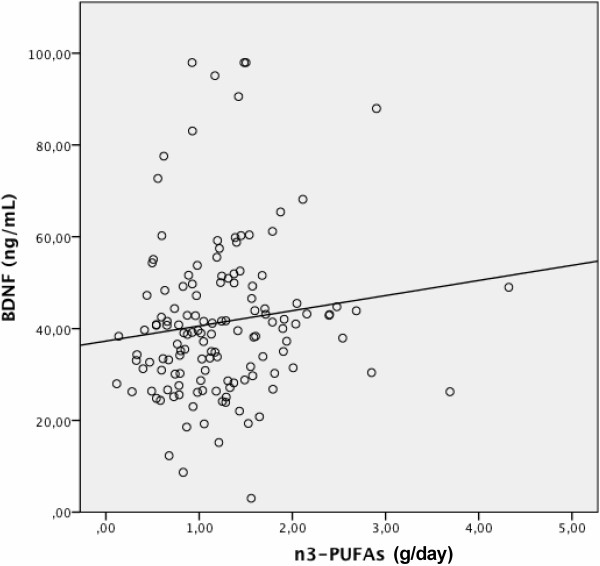
This study involved 137 adolescents drawn from a community sample, including a group with high levels of anxiety, assessed using the Screen for Children and Anxiety Related Emotional Disorders. Blood samples were collected and serum BDNF levels were measured. n-3 PUFAs were estimated using a food frequency questionnaire for adolescents. Correlations were performed to assess the association between n-3 PUFAs intake and BDNF levels. Effects of potential confounders (total fat consumption, age, gender and anxiety) were examined using linear regression models. There was a direct correlation between n-3 PUFAs consumption and serum BDNF levels, which remained significant even after accounting for potential confounders.
We were able to detect a correlation between n-3 PUFAs intake and peripheral BDNF levels. Our study was limited by its small sample size, and our external validity may be restricted by the oversampling of anxious adolescents. Our findings may help determine the nature of the association between mental disorders and serum levels of BDNF. However, more studies are needed to elucidate the possible mechanisms by which n-3 PUFAs intake affects BDNF levels, and how this may lead to an increased vulnerability to psychiatric disorders.
尽管有几项研究报告称精神障碍与脑源性神经营养因子(BDNF)的血清水平之间存在关联,但这种关联仍知之甚少。研究与 BDNF 水平和精神障碍相关的因素,如 n-3 多不饱和脂肪酸(n-3 PUFAs),可能有助于阐明介导这两个变量之间关系的机制。因此,本研究旨在评估 n-3 PUFAs 的摄入量是否与 BDNF 的血清水平相关。
本研究涉及来自社区样本的 137 名青少年,包括一组使用儿童焦虑相关情绪障碍筛查工具评估的焦虑水平较高的青少年。采集血液样本并测量血清 BDNF 水平。使用青少年食物频率问卷估计 n-3 PUFAs 的摄入量。进行相关性分析以评估 n-3 PUFAs 摄入量与 BDNF 水平之间的关联。使用线性回归模型检查总脂肪摄入量、年龄、性别和焦虑等潜在混杂因素的影响。n-3 PUFAs 的摄入量与血清 BDNF 水平之间存在直接相关性,即使考虑到潜在混杂因素,这种相关性仍然显著。
我们能够检测到 n-3 PUFAs 摄入量与外周 BDNF 水平之间的相关性。我们的研究受到样本量小的限制,并且我们的外部有效性可能受到焦虑青少年过度抽样的限制。我们的研究结果可能有助于确定精神障碍与血清 BDNF 水平之间关联的性质。然而,需要更多的研究来阐明 n-3 PUFAs 摄入量如何影响 BDNF 水平以及这如何导致对精神障碍的易感性增加的可能机制。