Taylor I C, Kingston R E
Department of Molecular Biology, Massachusetts General Hospital, Boston 02114.
Mol Cell Biol. 1990 Jan;10(1):165-75. doi: 10.1128/mcb.10.1.165-175.1990.
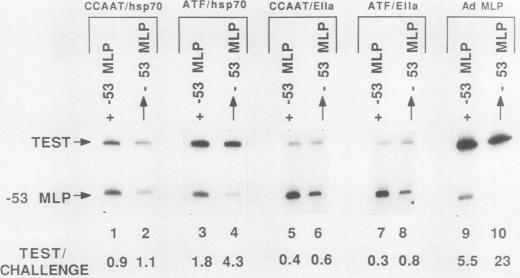
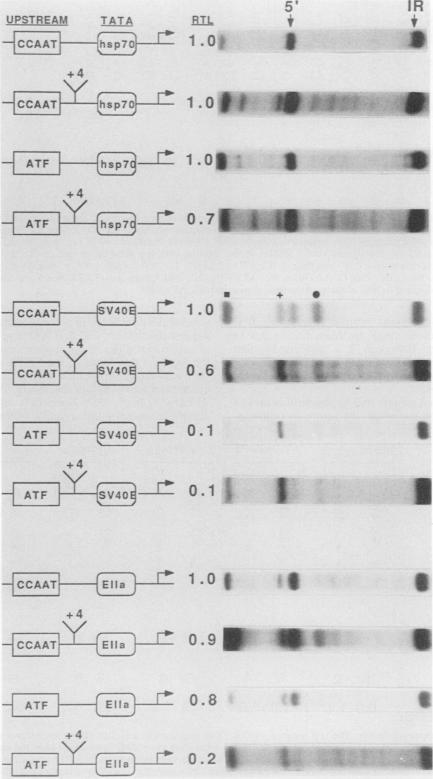
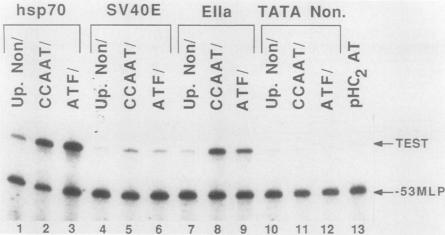
To investigate interactions between transcription factors on mammalian promoters, we constructed a set of 24 variations of the human HSP70 gene promoter in which six upstream sequence motifs are paired in every possible combination with four TATA motifs. These promoters were analyzed for in vivo expression, and selected constructs were examined by in vitro template commitment studies. Activation transcription factor (ATF) and CP1 showed dramatically different interactions with the factor(s) bound to the TATA region. CP1 functioned in vivo regardless of the TATA motif that it was paired with and was not capable of sequestering the core promoter complex in a template commitment assay. ATF activity was dramatically altered by changing the TATA motif, and ATF was able to sequester the core promoter complex. These data suggest that CP1 and ATF function by distinct mechanisms that differ with respect to interaction with the factor(s) at the TATA box. Factor Sp1 also appeared to function by a TATA-independent mechanism. These data imply that the ability of a factor to function is determined not only by the intrinsic properties of the factor but also by promoter context.
为了研究哺乳动物启动子上转录因子之间的相互作用,我们构建了一组24种人类HSP70基因启动子变体,其中六个上游序列基序与四个TATA基序以各种可能的组合配对。对这些启动子进行体内表达分析,并通过体外模板结合研究检查选定的构建体。激活转录因子(ATF)和CP1与结合在TATA区域的因子表现出截然不同的相互作用。CP1在体内发挥作用,无论与之配对的TATA基序如何,并且在模板结合试验中不能隔离核心启动子复合物。通过改变TATA基序,ATF的活性发生显著改变,并且ATF能够隔离核心启动子复合物。这些数据表明,CP1和ATF通过不同的机制发挥作用,这些机制在与TATA框处的因子相互作用方面存在差异。因子Sp1似乎也通过TATA非依赖机制发挥作用。这些数据表明,一个因子发挥作用的能力不仅取决于该因子的内在特性,还取决于启动子背景。