Julius L. Chambers Biomedical/ Biotechnology Research Institute & Department of Chemistry, North Carolina Central University, 1801 Fayetteville Street, Durham, NC 27707, USA.
BMC Genomics. 2012 Sep 4;13:451. doi: 10.1186/1471-2164-13-451.
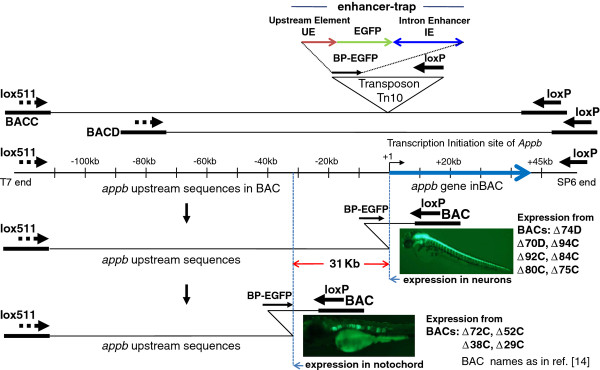
Non-coding DNA in and around the human Amyloid Precursor Protein (APP) gene that is central to Alzheimer's disease (AD) shares little sequence similarity with that of appb in zebrafish. Identifying DNA domains regulating expression of the gene in such situations becomes a challenge. Taking advantage of the zebrafish system that allows rapid functional analyses of gene regulatory sequences, we previously showed that two discontinuous DNA domains in zebrafish appb are important for expression of the gene in neurons: an enhancer in intron 1 and sequences 28-31 kb upstream of the gene. Here we identify the putative transcription factor binding sites responsible for this distal cis-acting regulation, and use that information to identify a regulatory region of the human APP gene.
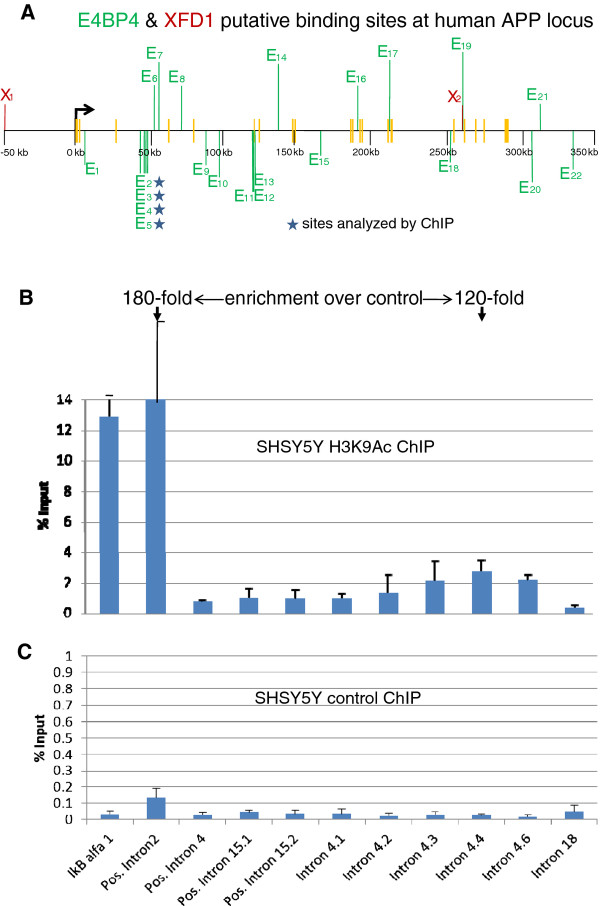
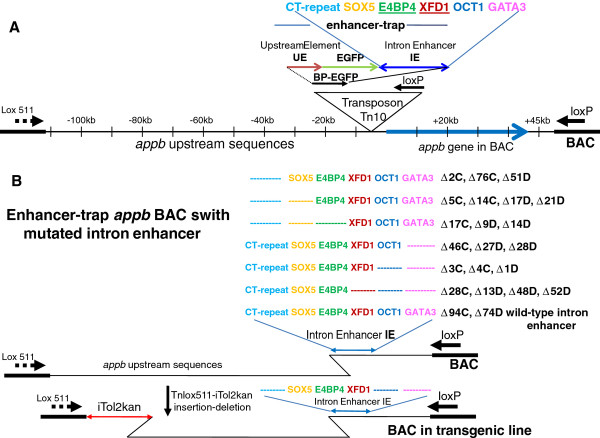
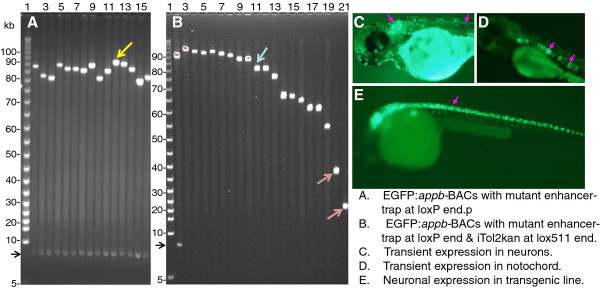
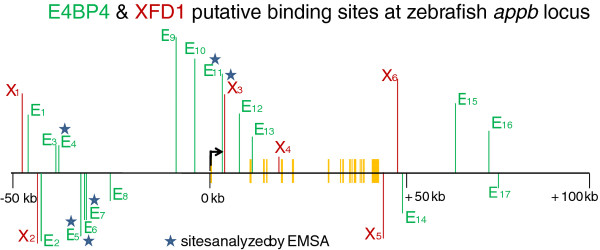
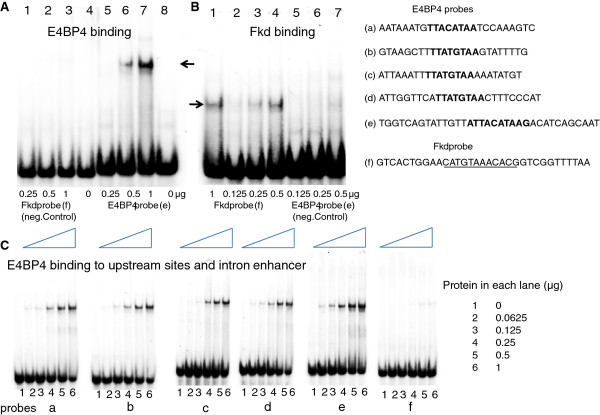
Functional analyses of intron 1 enhancer mutations in enhancer-trap BACs expressed as transgenes in zebrafish identified putative binding sites of two known transcription factor proteins, E4BP4/ NFIL3 and Forkhead, to be required for expression of appb. A cluster of three E4BP4 sites at -31 kb is also shown to be essential for neuron-specific expression, suggesting that the dependence of expression on upstream sequences is mediated by these E4BP4 sites. E4BP4/ NFIL3 and XFD1 sites in the intron enhancer and E4BP4/ NFIL3 sites at -31 kb specifically and efficiently bind the corresponding zebrafish proteins in vitro. These sites are statistically over-represented in both the zebrafish appb and the human APP genes, although their locations are different. Remarkably, a cluster of four E4BP4 sites in intron 4 of human APP exists in actively transcribing chromatin in a human neuroblastoma cell-line, SHSY5Y, expressing APP as shown using chromatin immunoprecipitation (ChIP) experiments. Thus although the two genes share little sequence conservation, they appear to share the same regulatory logic and are regulated by a similar set of transcription factors.
The results suggest that the clock-regulated and immune system modulator transcription factor E4BP4/ NFIL3 likely regulates the expression of both appb in zebrafish and APP in humans. It suggests potential human APP gene regulatory pathways, not on the basis of comparing DNA primary sequences with zebrafish appb but on the model of conservation of transcription factors.
人类淀粉样前体蛋白(APP)基因周围的非编码 DNA 与阿尔茨海默病(AD)中心的 APPb 在斑马鱼中几乎没有序列相似性。在这种情况下,确定调节基因表达的 DNA 结构域成为一个挑战。利用允许快速分析基因调控序列功能的斑马鱼系统,我们之前表明,斑马鱼 appb 中的两个不连续 DNA 结构域对于神经元中基因的表达很重要:内含子 1 中的增强子和基因上游 28-31kb 的序列。在这里,我们确定了负责这种远端顺式作用调节的假定转录因子结合位点,并利用该信息鉴定了人类 APP 基因的调控区域。
在斑马鱼中作为转基因表达的增强子陷阱 BAC 的内含子 1 增强子突变的功能分析鉴定了两个已知转录因子蛋白 E4BP4/NFIL3 和 Forkhead 的假定结合位点对于 appb 的表达是必需的。-31kb 处的三个 E4BP4 位点簇也被证明对于神经元特异性表达是必不可少的,这表明表达对上游序列的依赖是由这些 E4BP4 位点介导的。内含子增强子中的 E4BP4/NFIL3 和 XFD1 位点以及-31kb 处的 E4BP4/NFIL3 位点在体外特异性且有效地结合相应的斑马鱼蛋白。这些位点在斑马鱼 appb 和人类 APP 基因中均高度重复出现,尽管它们的位置不同。值得注意的是,在表达 APP 的人类神经母细胞瘤细胞系 SHSY5Y 中,人类 APP 基因第 4 内含子中的四个 E4BP4 位点簇存在于活跃转录的染色质中,如染色质免疫沉淀(ChIP)实验所示。因此,尽管这两个基因没有共享序列保守性,但它们似乎共享相同的调控逻辑,并受相似的转录因子调控。
结果表明,时钟调节和免疫系统调节剂转录因子 E4BP4/NFIL3 可能调节斑马鱼中的 appb 和人类中的 APP 的表达。它提示了潜在的人类 APP 基因调控途径,不是基于与斑马鱼 appb 比较 DNA 一级序列,而是基于转录因子的保守模型。