
基于动态心电图的 T 波交替和心率震荡可预测伴或不伴糖尿病的心肌梗死后患者的心脏死亡率。
Ambulatory ECG-based T-wave alternans and heart rate turbulence can predict cardiac mortality in patients with myocardial infarction with or without diabetes mellitus.
机构信息
Department of Cardiology, The First Affiliated Hospital of China Medical University, Shenyang 110001, China.
出版信息
Cardiovasc Diabetol. 2012 Sep 6;11:104. doi: 10.1186/1475-2840-11-104.
BACKGROUND
Many patients who survive a myocardial infarction (MI) remain at risk of sudden cardiac death despite revascularization and optimal medical treatment. We used the modified moving average (MMA) method to assess the utility of T-wave alternans (TWA) and heart rate turbulence (HRT) as risk markers in MI patients with or without diabetes mellitus (DM).
METHODS
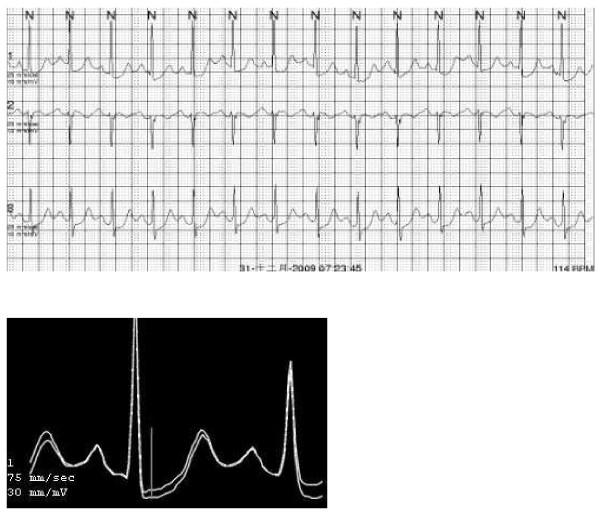
We prospectively enrolled 248 consecutive patients: 96 with MI (post-MI patients); 77 MI with DM (post-MI + DM patients); 75 controls without cardiovascular disease (group control). Both TWA and HRT were measured on ambulatory electrocardiograms (AECGs). HRT was assessed by two parameters ─ turbulence onset (TO) and turbulence slope (TS). HRT was considered positive when both TO ≥0% and TS ≤2.5 ms/R-R interval were met. The endpoint was cardiac mortality.
RESULTS
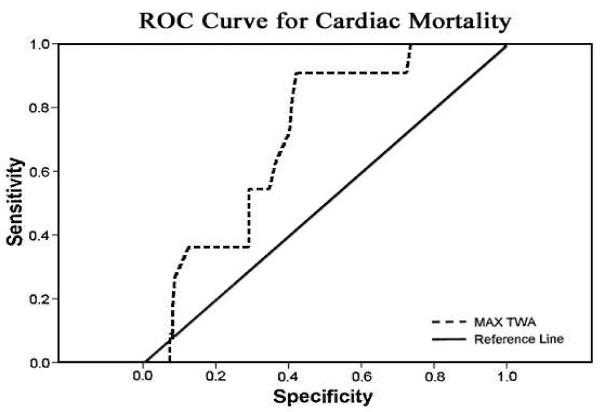
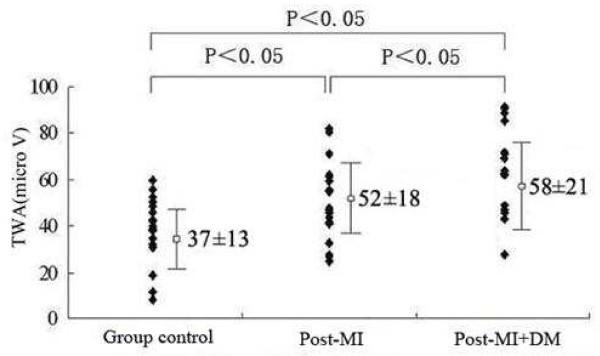
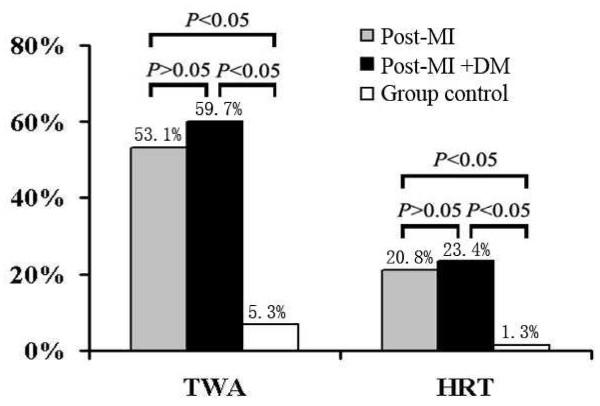
TWA values differed significantly between MI and controls. Post-MI + DM patients had higher TWA values than post-MI patients (58 ± 21 μV VS 52 ± 18 μV, P = 0.029). Impaired HRT--increased TO and decreased TS were observed in MI patients with or without DM. During follow-up of 578 ± 146 days, cardiac death occurred in ten patients and three of them suffered sudden cardiac death (SCD). Multivariate analysis determined that a HRT-positive outcome [HR (95% CI): 5.01, 1.33-18.85; P = 0.017], as well as the combination of abnormal TWA (≥47 μV) and positive HRT had significant association with the endpoint [HR (95% CI): 9.08, 2.21-37.2; P = 0.002)].
CONCLUSION
This study indicates that AECGs-based TWA and HRT can predict cardiac mortality in MI patients with or without DM. Combined analysis TWA and HRT may be a convenient and useful method of identifying patients at high risk for cardiovascular death.
背景
许多心肌梗死(MI)幸存患者尽管进行了血运重建和最佳药物治疗,但仍有发生心源性猝死的风险。我们使用修正移动平均值(MMA)方法评估 T 波交替(TWA)和心率震荡(HRT)作为伴有或不伴有糖尿病(DM)的 MI 患者的风险标志物的效用。
方法
我们前瞻性纳入 248 例连续患者:96 例 MI(MI 后患者);77 例 MI 合并 DM(MI 后+DM 患者);75 例无心血管疾病的对照者(对照组)。在动态心电图(AECG)上同时测量 TWA 和 HRT。HRT 通过两个参数来评估——震荡起始(TO)和震荡斜率(TS)。当 TO≥0%且 TS≤2.5ms/R-R 间期时,HRT 被认为是阳性。终点为心脏死亡率。
结果
MI 和对照组之间 TWA 值差异显著。MI 后+DM 患者的 TWA 值高于 MI 后患者(58±21μV 比 52±18μV,P=0.029)。伴有或不伴有 DM 的 MI 患者存在 HRT 受损——TO 增加和 TS 降低。在 578±146 天的随访期间,有 10 例患者发生心脏死亡,其中 3 例发生心源性猝死(SCD)。多变量分析确定 HRT 阳性结果[HR(95%CI):5.01,1.33-18.85;P=0.017]以及异常 TWA(≥47μV)和阳性 HRT 的联合与终点有显著相关性[HR(95%CI):9.08,2.21-37.2;P=0.002]。
结论
本研究表明,基于 AECG 的 TWA 和 HRT 可预测伴有或不伴有 DM 的 MI 患者的心脏死亡率。联合分析 TWA 和 HRT 可能是一种识别心血管死亡高危患者的便捷、有效的方法。
 Zotero 插件