Department of Biosciences and Bioengineering, Indian Institute of Technology Bombay, Mumbai, Maharashtra, India.
PLoS One. 2012;7(8):e44311. doi: 10.1371/journal.pone.0044311. Epub 2012 Aug 31.
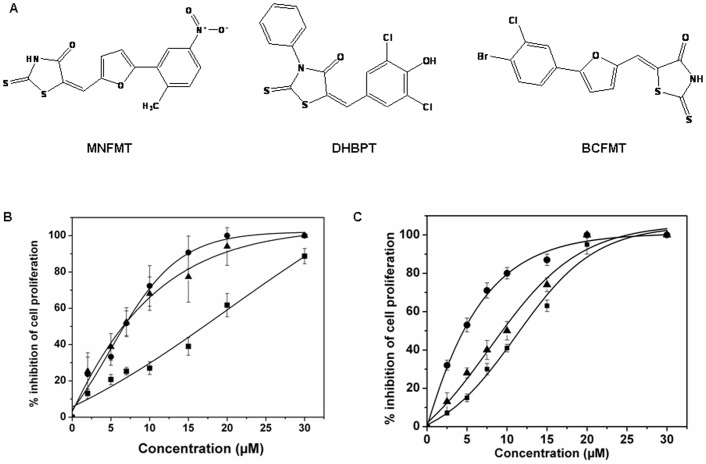
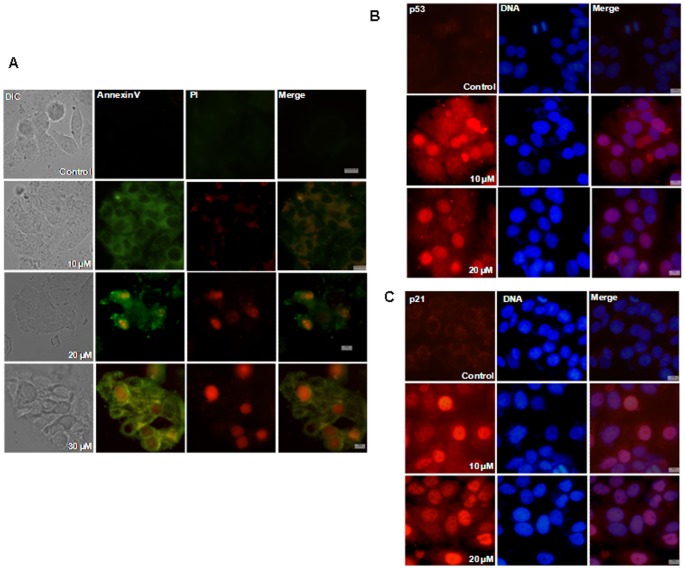
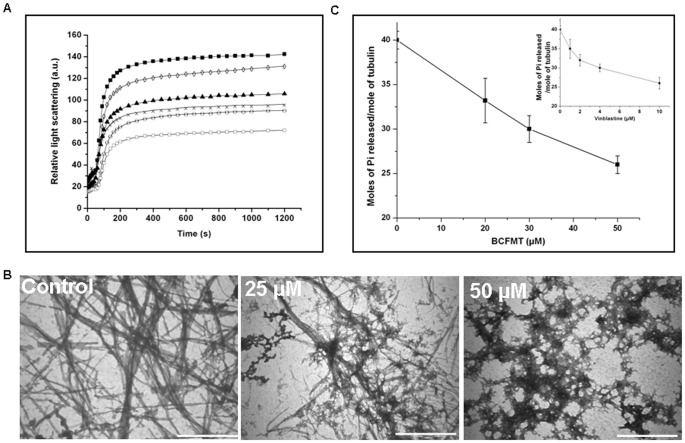
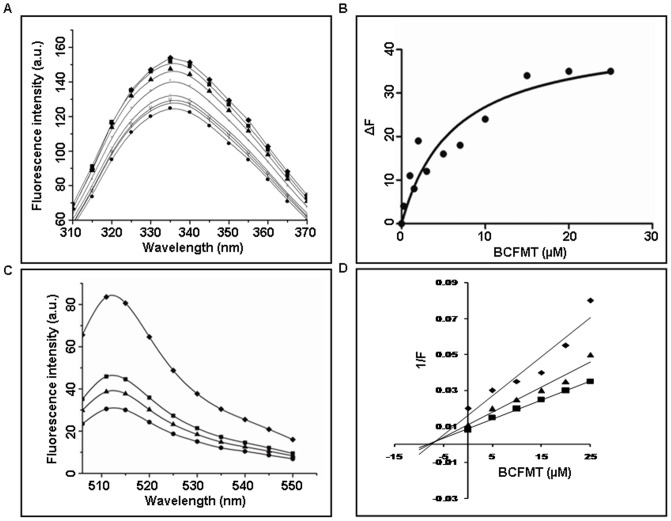
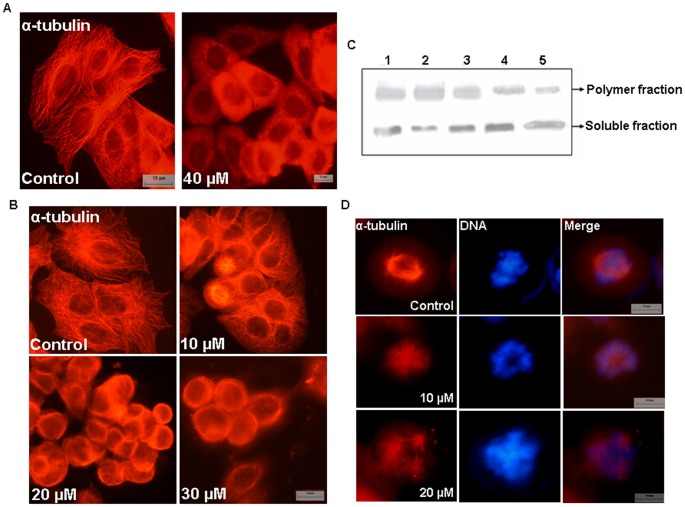
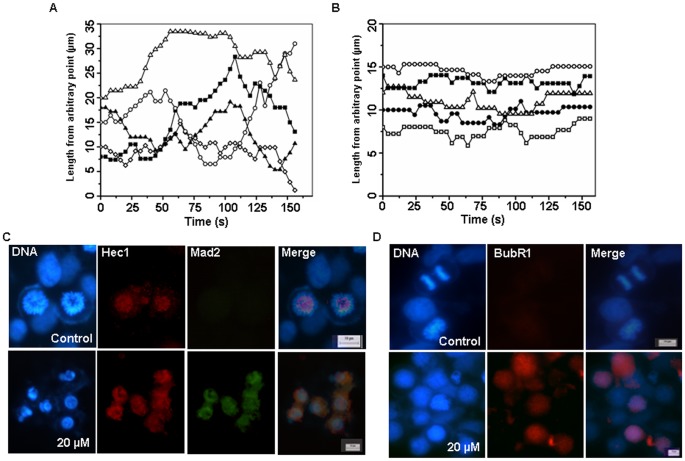
Using cell based screening assay, we identified a novel anti-tubulin agent (Z)-5-((5-(4-bromo-3-chlorophenyl)furan-2-yl)methylene)-2-thioxothiazolidin-4-one (BCFMT) that inhibited proliferation of human cervical carcinoma (HeLa) (IC(50), 7.2 ± 1.8 µM), human breast adenocarcinoma (MCF-7) (IC(50), 10.0 ± 0.5 µM), highly metastatic breast adenocarcinoma (MDA-MB-231) (IC(50), 6.0 ± 1 µM), cisplatin-resistant human ovarian carcinoma (A2780-cis) (IC(50), 5.8 ± 0.3 µM) and multi-drug resistant mouse mammary tumor (EMT6/AR1) (IC(50), 6.5 ± 1 µM) cells. Using several complimentary strategies, BCFMT was found to inhibit cancer cell proliferation at G2/M phase of the cell cycle apparently by targeting microtubules. In addition, BCFMT strongly suppressed the dynamics of individual microtubules in live MCF-7 cells. At its half maximal proliferation inhibitory concentration (10 µM), BCFMT reduced the rates of growing and shortening phases of microtubules in MCF-7 cells by 37 and 40%, respectively. Further, it increased the time microtubules spent in the pause (neither growing nor shortening detectably) state by 135% and reduced the dynamicity (dimer exchange per unit time) of microtubules by 70%. In vitro, BCFMT bound to tubulin with a dissociation constant of 8.3 ± 1.8 µM, inhibited tubulin assembly and suppressed GTPase activity of microtubules. BCFMT competitively inhibited the binding of BODIPY FL-vinblastine to tubulin with an inhibitory concentration (K(i)) of 5.2 ± 1.5 µM suggesting that it binds to tubulin at the vinblastine site. In cultured cells, BCFMT-treatment depolymerized interphase microtubules, perturbed the spindle organization and accumulated checkpoint proteins (BubR1 and Mad2) at the kinetochores. BCFMT-treated MCF-7 cells showed enhanced nuclear accumulation of p53 and its downstream p21, which consequently activated apoptosis in these cells. The results suggested that BCFMT inhibits proliferation of several types of cancer cells including drug resistance cells by suppressing microtubule dynamics and indicated that the compound may have chemotherapeutic potential.
使用基于细胞的筛选测定法,我们鉴定出一种新型的抗微管剂(Z)-5-((5-(4-溴-3-氯苯基)呋喃-2-基)亚甲基)-2-硫代噻唑烷-4-酮(BCFMT),其抑制人宫颈癌(HeLa)(IC(50),7.2±1.8µM)、人乳腺癌(MCF-7)(IC(50),10.0±0.5µM)、高转移性乳腺癌(MDA-MB-231)(IC(50),6.0±1µM)、顺铂耐药人卵巢癌细胞(A2780-cis)(IC(50),5.8±0.3µM)和多药耐药鼠乳腺癌(EMT6/AR1)(IC(50),6.5±1µM)细胞的增殖。通过几种互补策略,发现 BCFMT 通过靶向微管明显抑制细胞周期的 G2/M 期的癌细胞增殖。此外,BCFMT 强烈抑制活 MCF-7 细胞中单个微管的动力学。在其半最大增殖抑制浓度(10µM)下,BCFMT 将 MCF-7 细胞中微管的生长和缩短阶段的速率分别降低了 37%和 40%。此外,它将微管处于暂停(既不生长也不明显缩短)状态的时间增加了 135%,并将微管的动力学(单位时间内的二聚体交换)降低了 70%。在体外,BCFMT 与微管蛋白的解离常数为 8.3±1.8µM,抑制微管蛋白的组装并抑制微管的 GTPase 活性。BCFMT 竞争性抑制 BODIPY FL-长春花碱与微管蛋白的结合,抑制浓度(K(i))为 5.2±1.5µM,表明它结合在长春花碱结合位点上。在培养的细胞中,BCFMT 处理使间期微管解聚,扰乱纺锤体组织并在动粒处积累检查点蛋白(BubR1 和 Mad2)。BCFMT 处理的 MCF-7 细胞显示出核内 p53 及其下游 p21 的积累增加,从而激活这些细胞中的细胞凋亡。结果表明,BCFMT 通过抑制微管动力学抑制多种类型的癌细胞包括耐药细胞的增殖,并表明该化合物可能具有化疗潜力。