Department of Neurobiology, Duke University Medical Center, Durham, NC, 27710, USA.
J Neurodev Disord. 2012 Jul 30;4(1):21. doi: 10.1186/1866-1955-4-21.
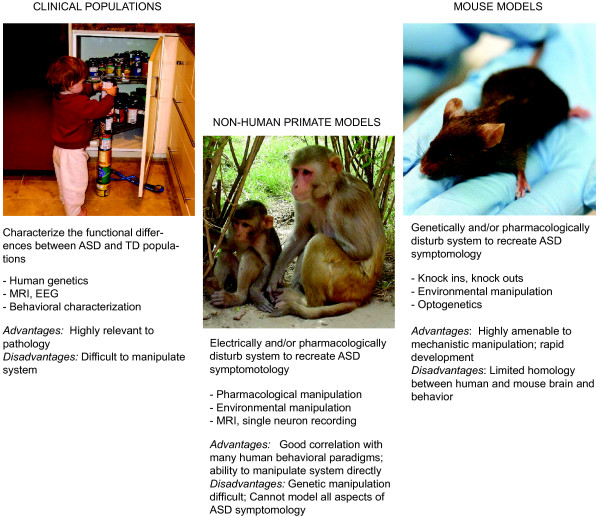
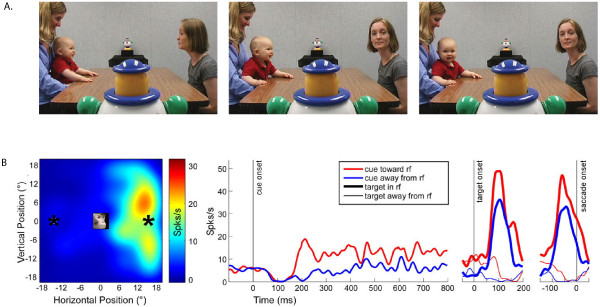
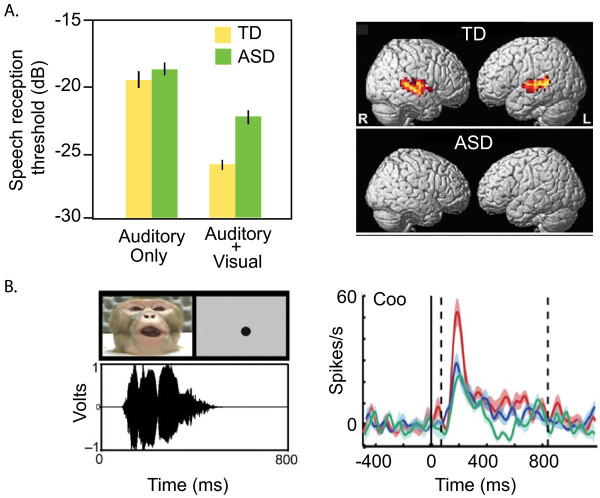
The autism spectrum disorders (ASDs) arise from a diverse array of genetic and environmental origins that disrupt the typical developmental trajectory of neural connectivity and synaptogenesis. ASDs are marked by dysfunctional social behavior and cognition, among other deficits. Greater understanding of the biological substrates of typical social behavior in animal models will further our understanding of the etiology of ASDs. Despite the precision and tractability of molecular genetics models of ASDs in rodents, these organisms lack the complexity of human social behavior, thus limiting their impact on understanding ASDs to basic mechanisms. Non-human primates (NHPs) provide an attractive, complementary model for ASDs, due in part to the complexity and dynamics of social structures, reliance on vision for social signaling, and deep homology in brain circuitry mediating social behavior and reward. This knowledge is based on a rich literature, compiled over 50 years of observing primate behavior in the wild, which, in the case of rhesus macaques, is complemented by a large body of research characterizing neuronal activity during cognitive behavior. Several recent developments in this field are directly relevant to ASDs, including how the brain represents the perceptual features of social stimuli, how social information influences attention processes in the brain, and how the value of social interaction is computed. Because the symptoms of ASDs may represent extreme manifestations of traits that vary in intensity within the general population, we will additionally discuss ways in which nonhuman primates also show variation in social behavior and reward sensitivity. In cases where variation in species-typical behavior is analogous to similar variations in human behavior, we believe that study of the neural circuitry underlying this variation will provide important insights into the systems-level mechanisms contributing to ASD pathology.
自闭症谱系障碍 (ASD) 源于多种遗传和环境因素,这些因素破坏了神经连接和突触发生的典型发育轨迹。ASD 的特征是社交行为和认知功能障碍等缺陷。在动物模型中,对典型社交行为的生物学基础有更深入的了解,将有助于我们理解 ASD 的病因。尽管啮齿动物的 ASD 分子遗传学模型具有精确性和可操作性,但这些生物缺乏人类社交行为的复杂性,因此限制了它们对 ASD 基本机制的理解。非人类灵长类动物 (NHP) 为 ASD 提供了一个有吸引力的、互补的模型,部分原因是非人类灵长类动物的社会结构复杂且具有动态性、依靠视觉进行社交信号传递、以及调节社交行为和奖励的大脑回路具有深度同源性。这些知识基于丰富的文献,这些文献是在过去 50 多年中观察野生灵长类动物行为的基础上汇编而成的,对于恒河猴来说,这些文献还补充了大量描述认知行为期间神经元活动的研究。该领域的几个最近的发展与 ASD 直接相关,包括大脑如何表示社交刺激的感知特征、社交信息如何影响大脑中的注意力过程以及社交互动的价值如何计算。由于 ASD 的症状可能代表了在一般人群中强度不同的特征的极端表现,我们还将讨论非人类灵长类动物在社交行为和奖励敏感性方面也存在变化的方式。在物种典型行为存在变化与人类行为类似变化的情况下,我们相信,对这种变化背后的神经回路的研究将为理解导致 ASD 病理的系统级机制提供重要的见解。