Labs & Infection Control, Artemis Health Institute, Sector 51, Gurgaon, Haryana-122001, India.
Antimicrob Resist Infect Control. 2012 Jun 6;1(1):23. doi: 10.1186/2047-2994-1-23.
The objective of this study was to assess the impact of antimicrobial stewardship programs on the multidrug resistance patterns of bacterial isolates. The study comprised an initial retrospective analysis of multidrug resistance in bacterial isolates for one year (July 2007-June 2008) followed by prospective evaluation of the impact of Antimicrobial Stewardship programs on resistance for two years and nine months (July 2008-March 2011).
A 300-bed tertiary care private hospital in Gurgaon, Haryana (India)
Study Design• July 2007 to June 2008: Resistance patterns of bacterial isolates were studied.• July 2008: Phase I intervention programme Implementation of an antibiotic policy in the hospital.• July 2008 to June 2010: Assessment of the impact of the Phase I intervention programme.• July 2010 to March 2011: Phase II intervention programme: Formation and effective functioning of the antimicrobial stewardship committee. Statistical correlation of the Defined daily dose (DDD) for prescribed drugs with the antimicrobial resistance of Gram negatives.
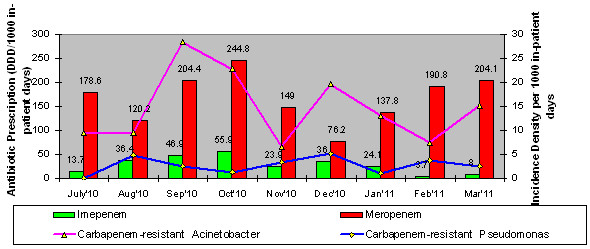
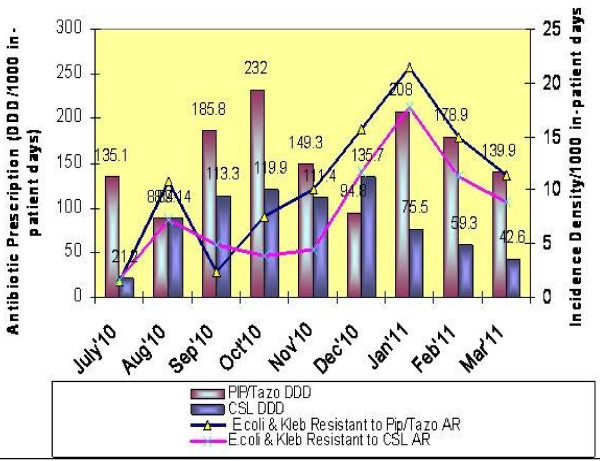
Phase I intervention programme (July 2008) resulted in a decrease of 4.47% in ESBLs (E.coli and Klebsiella) and a significant decrease of 40.8% in carbapenem-resistant Pseudomonas. Phase II intervention (July 2010) brought a significant reduction (24.7%) in carbapenem-resistant Pseudomonas. However, the resistance in the other Gram negatives (E.coli, Klebsiella, and Acinetobacter) rose and then stabilized. A positive correlation was observed in Pseudomonas and Acinetobacter with carbapenems and cefoperazone-sulbactam.Piperacillin-tazobactam showed a positive correlation with Acinetobacter only. E.coli and Klebsiella showed positive correlation with cefoparazone-sulbactam and piperacillin-tazobactam.
An antimicrobial stewardship programme with sustained and multifaceted efforts is essential to promote the judicious use of antibiotics.
本研究旨在评估抗菌药物管理计划对细菌分离物多药耐药模式的影响。该研究包括对细菌分离物多药耐药性进行为期一年的回顾性分析(2007 年 7 月至 2008 年 6 月),然后前瞻性评估抗菌药物管理计划对耐药性的影响,为期两年零九个月(2008 年 7 月至 2011 年 3 月)。
印度哈里亚纳邦古尔冈的一家 300 床三级私立医院
研究设计• 2007 年 7 月至 2008 年 6 月:研究细菌分离物的耐药模式。• 2008 年 7 月:实施第一阶段干预计划,在医院实施抗生素政策。• 2008 年 7 月至 2010 年 6 月:评估第一阶段干预计划的影响。• 2010 年 7 月至 2011 年 3 月:第二阶段干预计划:抗菌药物管理委员会的成立和有效运作。与革兰氏阴性菌的抗菌药物耐药性相关的规定日剂量(DDD)与处方药物的相关性统计。
第一阶段干预计划(2008 年 7 月)导致 ESBL(大肠埃希菌和肺炎克雷伯菌)减少 4.47%,碳青霉烯类耐药铜绿假单胞菌显著减少 40.8%。第二阶段干预(2010 年 7 月)使碳青霉烯类耐药铜绿假单胞菌显著减少(24.7%)。然而,其他革兰氏阴性菌(大肠埃希菌、肺炎克雷伯菌和不动杆菌)的耐药性上升并随后稳定下来。铜绿假单胞菌和鲍曼不动杆菌与碳青霉烯类和头孢哌酮-舒巴坦呈正相关。哌拉西林-他唑巴坦仅与鲍曼不动杆菌呈正相关。大肠埃希菌和肺炎克雷伯菌与头孢哌酮-舒巴坦和哌拉西林-他唑巴坦呈正相关。
抗菌药物管理计划需要持续和多方面的努力,以促进抗生素的合理使用。