Department of Gastroenterology, All India Institute of Medical Sciences, New Delhi, India.
Indian J Med Res. 2012 Aug;136(2):229-36.
BACKGROUND & OBJECTIVES: The cytokines, adipokines, and oxidative stress have been implicated in the pathogenesis of non-alcoholic fatty liver disease (NAFLD); however, such data remain scarce in India. The present study evaluated pro-inflammatory cytokines, adipokines, and markers of oxidative stress in patients with non-alcoholic fatty liver disease (NAFLD), and their association with degree of adiposity, insulin resistance and markers of disease severity.
The present prospective cross-sectional pilot study included 79 subjects; 34 NAFLD, 22 chronic hepatitis B (CH-B) and 23 healthy controls (HC). The parameters studied were adiponectin, leptin, tumour necrosis factor α (TNFα), interleukin-1 and 6 (IL-1, IL-6), and systemic markers of oxidative stress.
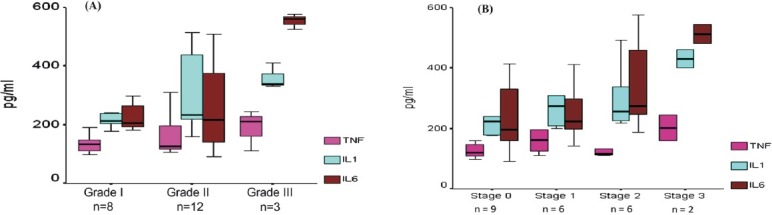
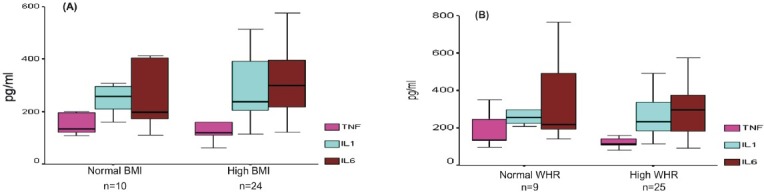
The mean body mass index (kg/m 2 ) in NAFLD patients, CHB, and HC were 26.4±3.7, 21.3±2.3, and 22.3±2.7, respectively. The median serum levels of all pro-inflammatory cytokines were significantly higher (P<0.001) in NAFLD compared to control groups. Compared to HC, levels of adiponectin and leptin were significantly (P<0.05, P<0.01) reduced in both NAFLD and CHB. IL-6 showed marked and selective increase only in NAFLD patients. The levels of IL-6 were significantly (P<0.02) higher in NAFLD patients with advanced histology grade and correlated with IR (r=0.42, P=0.02). In a sub-group, markers of oxidative stress were significantly higher, and that of antioxidant potential were significantly lower among NAFLD patients compared to control subjects.
INTERPRETATION & CONCLUSIONS: Patients with NAFLD revealed significantly elevated levels of pro-inflammatory cytokines, increased oxidative stress, and a significant association of IL-6 with IR and advanced histopathology.
细胞因子、脂肪因子和氧化应激与非酒精性脂肪性肝病(NAFLD)的发病机制有关;然而,在印度,此类数据仍然很少。本研究评估了非酒精性脂肪性肝病(NAFLD)患者的促炎细胞因子、脂肪因子和氧化应激标志物,并研究了它们与肥胖程度、胰岛素抵抗和疾病严重程度标志物的关系。
本前瞻性横断面研究纳入了 79 名受试者;34 名 NAFLD 患者、22 名慢性乙型肝炎(CH-B)患者和 23 名健康对照者(HC)。研究的参数包括脂联素、瘦素、肿瘤坏死因子-α(TNF-α)、白细胞介素-1 和 6(IL-1、IL-6)以及系统性氧化应激标志物。
NAFLD 患者、CHB 患者和 HC 的平均体重指数(kg/m 2 )分别为 26.4±3.7、21.3±2.3 和 22.3±2.7。与对照组相比,NAFLD 患者所有促炎细胞因子的中位数血清水平均显著升高(P<0.001)。与 HC 相比,NAFLD 和 CHB 患者的脂联素和瘦素水平均显著降低(P<0.05,P<0.01)。只有在 NAFLD 患者中,IL-6 显示出明显且选择性的增加。IL-6 水平在具有晚期组织学分级的 NAFLD 患者中显著升高(P<0.02),并与 IR 相关(r=0.42,P=0.02)。在一个亚组中,与对照组相比,NAFLD 患者的氧化应激标志物显著升高,抗氧化潜力标志物显著降低。
NAFLD 患者表现出明显升高的促炎细胞因子水平、氧化应激增加,并且 IL-6 与 IR 和晚期组织病理学显著相关。