Department of Chemistry, University of Cambridge, Lensfield Road, Cambridge CB2 1EW, UK.
Mol Cell Proteomics. 2012 Dec;11(12):1768-76. doi: 10.1074/mcp.M112.021394. Epub 2012 Sep 10.
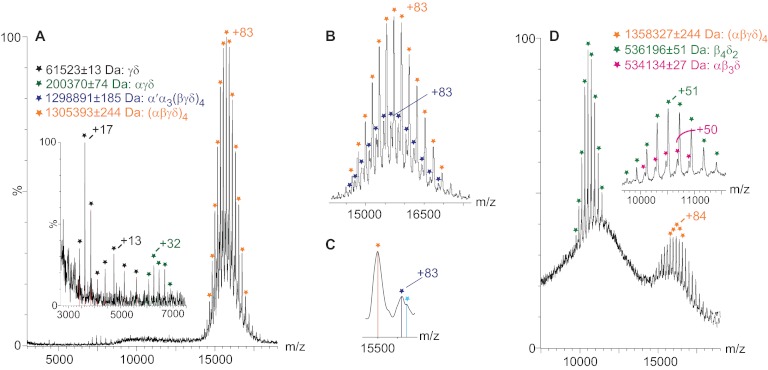
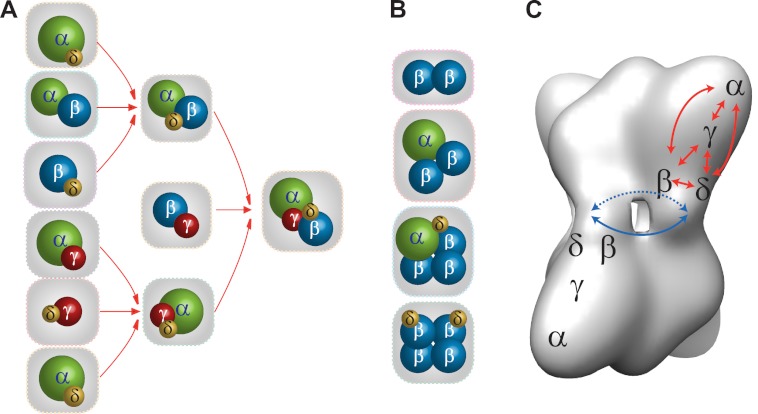
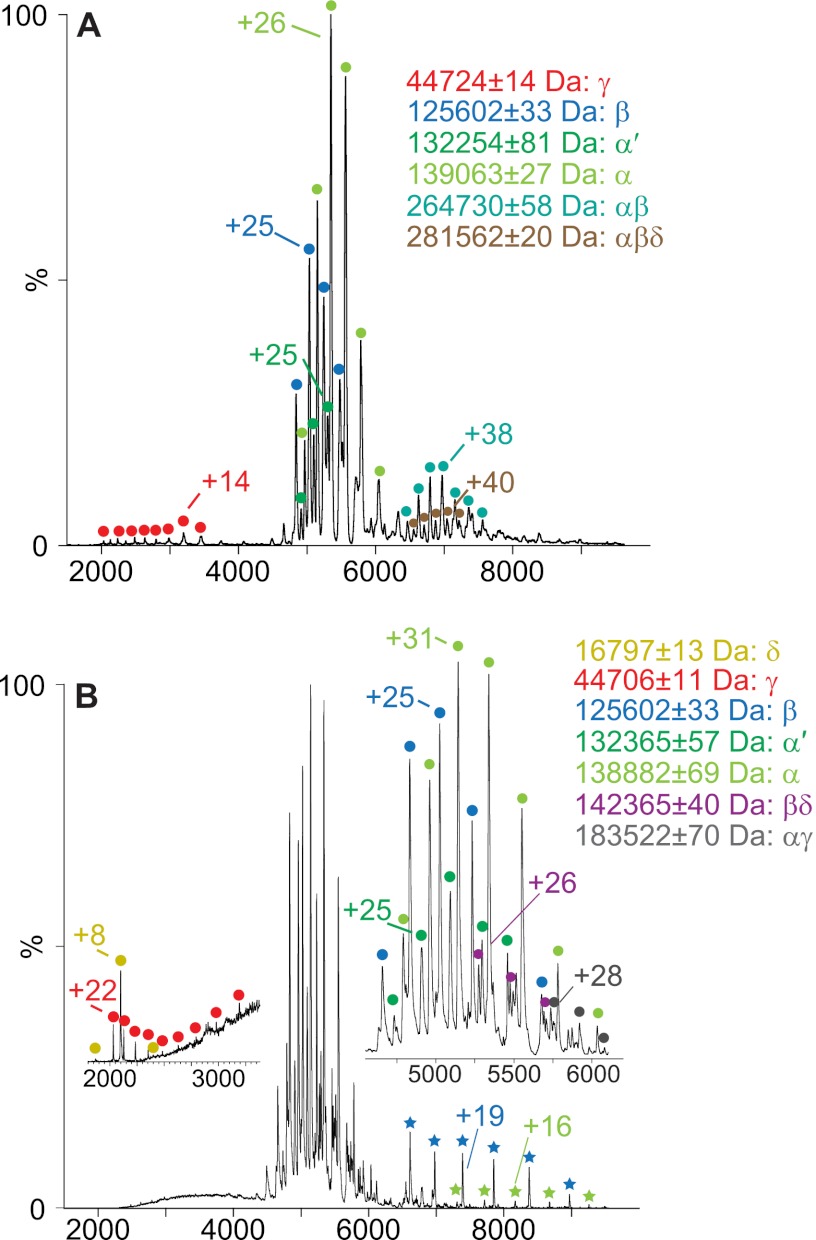
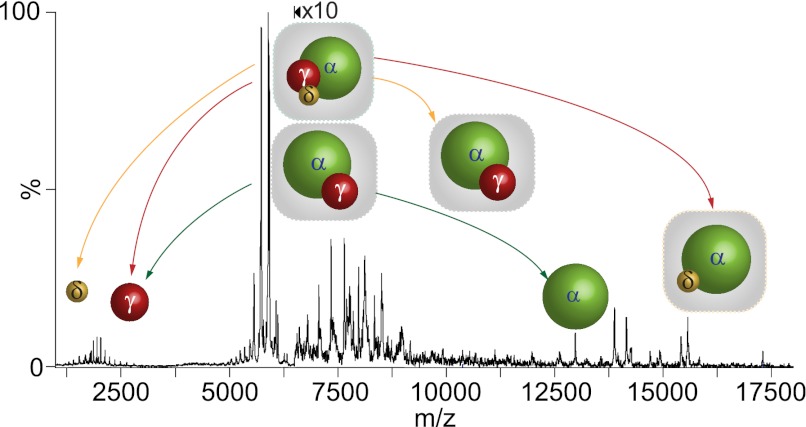
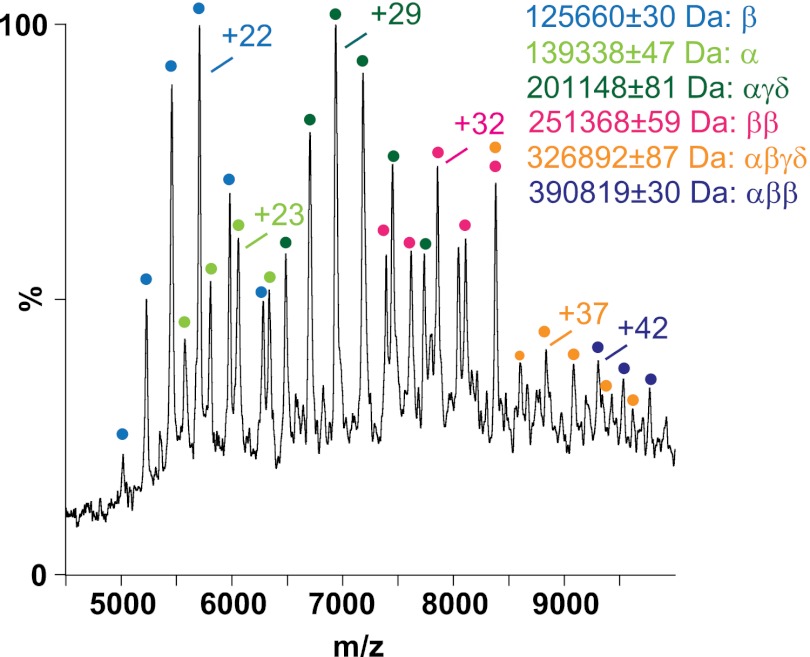
Phosphorylase kinase (PhK), a 1.3 MDa enzyme complex that regulates glycogenolysis, is composed of four copies each of four distinct subunits (α, β, γ, and δ). The catalytic protein kinase subunit within this complex is γ, and its activity is regulated by the three remaining subunits, which are targeted by allosteric activators from neuronal, metabolic, and hormonal signaling pathways. The regulation of activity of the PhK complex from skeletal muscle has been studied extensively; however, considerably less is known about the interactions among its subunits, particularly within the non-activated versus activated forms of the complex. Here, nanoelectrospray mass spectrometry and partial denaturation were used to disrupt PhK, and subunit dissociation patterns of non-activated and phospho-activated (autophosphorylation) conformers were compared. In so doing, we have established a network of subunit contacts that complements and extends prior evidence of subunit interactions obtained from chemical crosslinking, and these subunit interactions have been modeled for both conformers within the context of a known three-dimensional structure of PhK solved by cryoelectron microscopy. Our analyses show that the network of contacts among subunits differs significantly between the nonactivated and phospho-activated conformers of PhK, with the latter revealing new interprotomeric contact patterns for the β subunit, the predominant subunit responsible for PhK's activation by phosphorylation. Partial disruption of the phosphorylated conformer yields several novel subcomplexes containing multiple β subunits, arguing for their self-association within the activated complex. Evidence for the theoretical αβγδ protomeric subcomplex, which has been sought but not previously observed, was also derived from the phospho-activated complex. In addition to changes in subunit interaction patterns upon phospho-activation, mass spectrometry revealed a large change in the overall stability of the complex, with the phospho-activated conformer being more labile, in concordance with previous hypotheses on the mechanism of allosteric activation of PhK through perturbation of its inhibitory quaternary structure.
磷酸化酶激酶(PhK)是一种 1.3 MDa 的酶复合物,可调节糖原分解,由四个独特亚基(α、β、γ和δ)的各四个拷贝组成。该复合物内的催化蛋白激酶亚基为γ,其活性受到来自神经元、代谢和激素信号通路的别构激活剂的调节。人们已经广泛研究了骨骼肌中 PhK 复合物的活性调节;然而,对于其亚基之间的相互作用,特别是在复合物的非激活形式与激活形式之间的相互作用,了解甚少。本研究采用纳喷雾质谱法和部分变性技术来破坏 PhK,并比较了非激活态和磷酸化激活态(自磷酸化)构象的亚基解离模式。通过这种方式,我们建立了一个亚基相互作用网络,该网络补充并扩展了先前通过化学交联获得的亚基相互作用的证据,并且这些亚基相互作用已针对通过冷冻电子显微镜解析的已知 PhK 三维结构的两种构象进行了建模。我们的分析表明,PhK 的非激活态和磷酸化激活态之间的亚基相互作用网络存在显著差异,后者揭示了β亚基的新的亚基间接触模式,β亚基是 PhK 磷酸化激活的主要亚基。磷酸化激活态的部分破坏产生了几个包含多个β亚基的新型亚基复合物,表明它们在激活复合物内的自组装。从磷酸化激活复合物中还获得了理论上的αβγδ原聚体亚基复合物的证据,尽管之前曾寻求过但未观察到该复合物。除了磷酸化激活后亚基相互作用模式的变化外,质谱分析还显示复合物的整体稳定性发生了很大变化,磷酸化激活态的复合物更不稳定,这与通过干扰其抑制性四级结构来实现 PhK 别构激活的机制假说一致。