Ganapathy-Kanniappan Shanmugasundaram, Kunjithapatham Rani, Geschwind Jean-Francois
Department of Radiology and Radiological Sciences, Johns Hopkins University School of Medicine, Baltimore, MD, USA.
Oncotarget. 2012 Sep;3(9):940-53. doi: 10.18632/oncotarget.623.
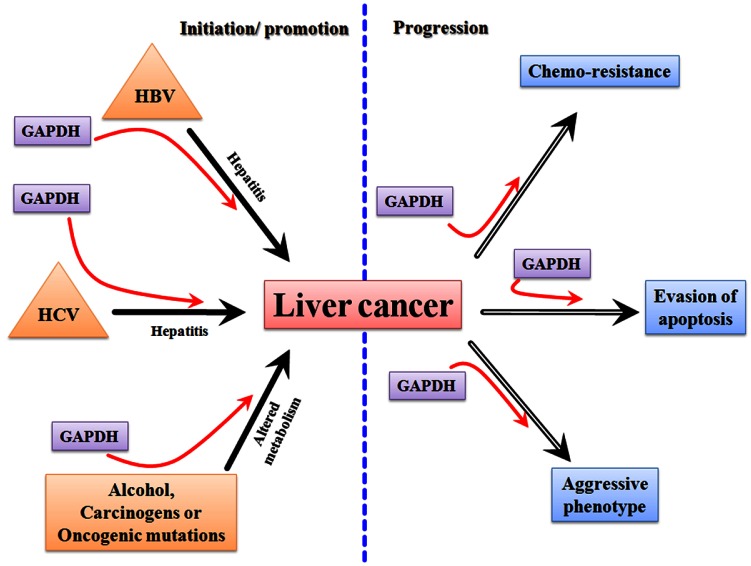
Hepatocellular carcinoma (HCC) is one of the most highly lethal malignancies ranking as the third leading-cause of cancer-related death worldwide. Although surgical resection and transplantation are effective curative therapies, very few patients qualify for such treatments due to the advanced stage of the disease at diagnosis. In this context, loco-regional therapies provide a viable therapeutic alternative with minimal systemic toxicity. However, as chemoresistance and tumor recurrence negatively impact the success of therapy resulting in poorer patient outcomes it is imperative to identify new molecular target(s) in cancer cells that could be effectively targeted by novel agents. Recent research has demonstrated that proliferation in HCC is associated with increased glucose metabolism. The glycolytic enzyme, glyceraldehyde-3-phosphate dehydrogenase (GAPDH), a multifunctional protein primarily recognized for its role in glucose metabolism, has already been shown to affect the proliferative potential of cancer cells. In human HCC, the increased expression of GAPDH is invariably associated with enhanced glycolytic capacity facilitating tumor progression. Though it is not yet known whether GAPDH up-regulation contributes to tumorigenesis sensu stricto, emerging evidence points to the existence of a link between GAPDH up-regulation and the promotion of survival mechanisms in cancer cells as well as chemoresistance. The involvement of GAPDH in several hepatocarcinogenic mechanisms (e.g. viral hepatitis, metabolic alterations) and its sensitivity to a new class of prospective anticancer agents prompted us to review the current understanding of the therapeutic potential of targeting GAPDH in HCC.
肝细胞癌(HCC)是最具致死性的恶性肿瘤之一,在全球癌症相关死亡原因中位列第三。尽管手术切除和移植是有效的治愈性疗法,但由于诊断时疾病已处于晚期,很少有患者适合此类治疗。在此背景下,局部区域疗法提供了一种可行的治疗选择,全身毒性最小。然而,由于化疗耐药性和肿瘤复发对治疗成功产生负面影响,导致患者预后较差,因此必须在癌细胞中识别出新的分子靶点,以便新型药物能够有效靶向这些靶点。最近的研究表明,HCC中的增殖与葡萄糖代谢增加有关。糖酵解酶甘油醛-3-磷酸脱氢酶(GAPDH)是一种多功能蛋白,主要因其在葡萄糖代谢中的作用而为人所知,已被证明会影响癌细胞的增殖潜力。在人类HCC中,GAPDH表达增加总是与糖酵解能力增强相关,从而促进肿瘤进展。虽然尚不清楚GAPDH上调是否严格意义上导致肿瘤发生,但新出现的证据表明,GAPDH上调与癌细胞生存机制的促进以及化疗耐药性之间存在联系。GAPDH参与多种肝癌致癌机制(如病毒性肝炎、代谢改变)及其对一类新型前瞻性抗癌药物的敏感性,促使我们回顾目前对靶向GAPDH治疗HCC潜力的理解。