Liu Bing, Tomé João P C, Cunha-Silva Luís, Almeida Paz Filipe A
Acta Crystallogr Sect E Struct Rep Online. 2012 Sep 1;68(Pt 9):o2700-1. doi: 10.1107/S1600536812034691. Epub 2012 Aug 11.
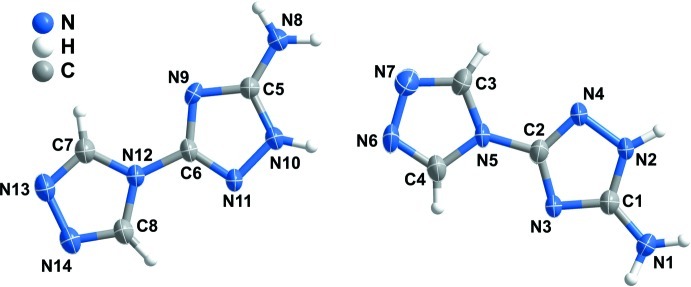
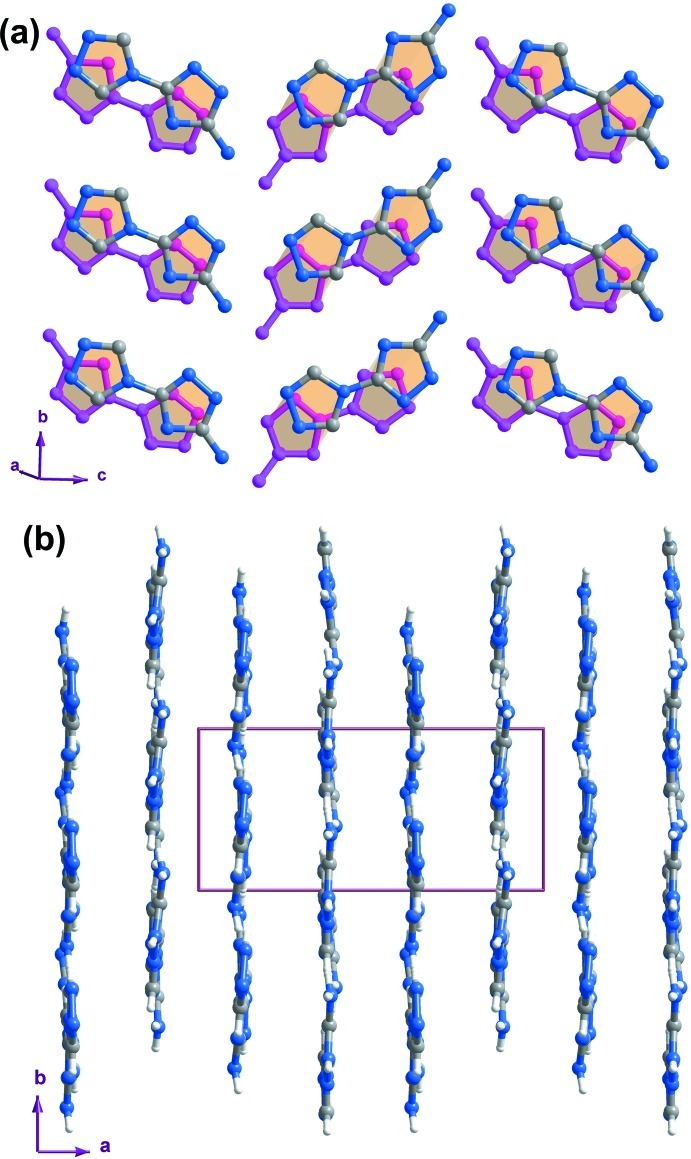
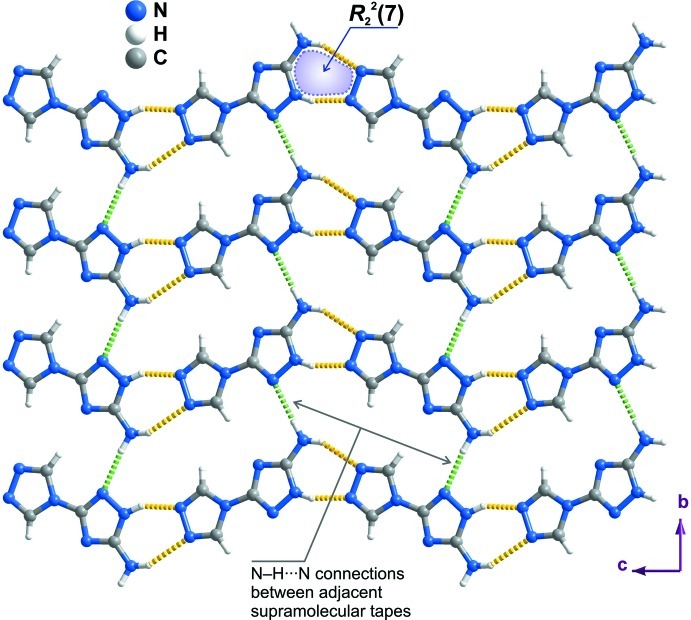
The asymmetric unit of the title compound, C(4)H(5)N(7), comprises two independent but virtually superimposable mol-ecules. Each mol-ecule is planar with the dihedral angles between the five-membered rings being 2.8 (3) and 2.1 (3)°. The crystal structure is formed by an extensive network of relatively strong N-H⋯N hydrogen-bond inter-actions. Individual mol-ecules are arranged into supra-molecular zigzag chains running parallel to [001] by way of the strongest N-H⋯N inter-actions. Adjacent chains are inter-connected by rather long (D⋯A distances range from ca 3.00 to 3.03 Å) but highly directional (inter-action angles above ca 173°) hydrogen bonds forming a supra-molecular layer in the bc plane.
标题化合物C(4)H(5)N(7)的不对称单元由两个独立但几乎重叠的分子组成。每个分子呈平面状,五元环之间的二面角分别为2.8 (3)°和2.1 (3)°。晶体结构由广泛的相对较强的N-H⋯N氢键相互作用网络构成。单个分子通过最强的N-H⋯N相互作用排列成平行于[001]的超分子锯齿链。相邻链通过相当长(D⋯A距离范围约为3.00至3.03 Å)但高度定向(相互作用角大于约173°)的氢键相互连接,在bc平面形成超分子层。