Carl-Ludwig-Institute for Physiology, University of Leipzig, Medical School Leipzig, Germany.
Front Neural Circuits. 2012 Aug 31;6:60. doi: 10.3389/fncir.2012.00060. eCollection 2012.
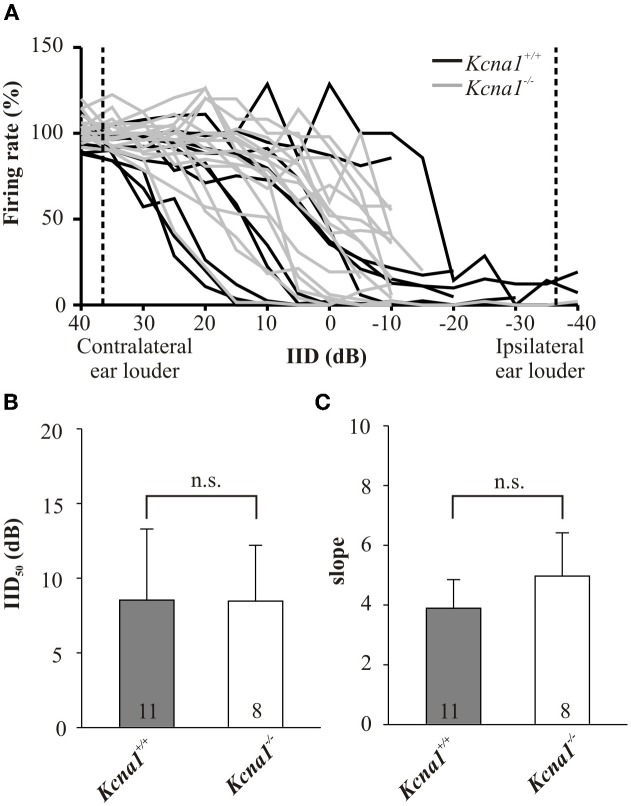
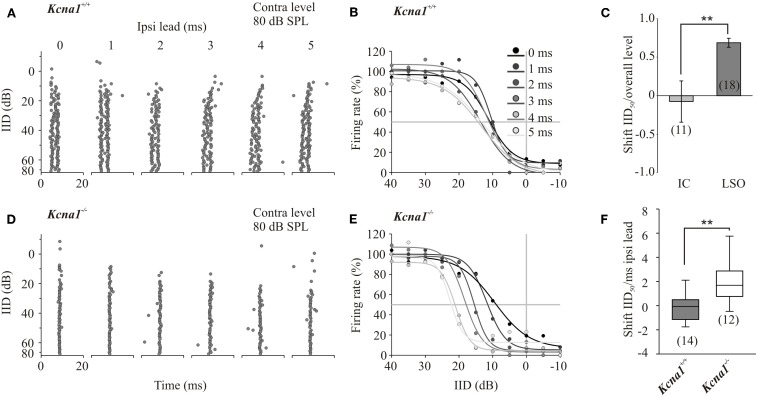
The inferior colliculus (IC) is a midbrain nucleus that exhibits sensitivity to differences in interaural time and intensity (ITDs and IIDs) and integrates information from the auditory brainstem to provide an unambiguous representation of sound location across the azimuth. Further upstream, in the lateral superior olive (LSO), absence of low-threshold potassium currents in Kcna1(-/-) mice interfered with response onset timing and restricted IID-sensitivity to the hemifield of the excitatory ear. Assuming the IID-sensitivity in the IC to be at least partly inherited from LSO neurons, the IC IID-encoding was compared between wild-type (Kcna1(+/+)) and Kcna1(-/-) mice. We asked whether the effect observed in the Kcna1(-/-) LSO is (1) simply propagated into the IC, (2) is enhanced and amplified or, (3) alternatively, is compensated and so no longer detectable. Our results show that general IC response properties as well as the distribution of IID-functions were comparable in Kcna1(-/-) and Kcna1(+/+) mice. In agreement with the literature IC neurons exhibited a higher level-invariance of IID-sensitivity compared to LSO neurons. However, manipulating the timing between the inputs of the two ears caused significantly larger shifts of IID-sensitivity in Kcna1(-/-) mice, whereas in the wild-type IC the IID functions were stable and less sensitive to changes of the temporal relationship between the binaural inputs. We conclude that the IC not only inherits IID-sensitivity from the LSO, but that the convergence with other, non-olivary inputs in the wild-type IC acts to quality-control, consolidate, and stabilize IID representation; this necessary integration of inputs is impaired in the absence of the low-threshold potassium currents mediated by Kv1.1.
下丘(IC)是中脑核,对两耳间时间和强度差异(ITD 和 IID)敏感,并整合来自听觉脑干的信息,以在整个方位上提供声音位置的明确表示。在上游,在外侧上橄榄核(LSO)中,Kcna1(-/-)小鼠中缺乏低阈值钾电流会干扰响应起始时间,并将 IID 敏感性限制在兴奋性耳的半视野内。假设 IC 中的 IID 敏感性至少部分源自 LSO 神经元,因此比较了野生型(Kcna1(+/+))和 Kcna1(-/-)小鼠的 IC IID 编码。我们想知道在 Kcna1(-/-)LSO 中观察到的效应是(1)简单地传播到 IC,(2)增强和放大,还是(3)替代地被补偿而不再可检测。我们的结果表明,Kcna1(-/-)和 Kcna1(+/+)小鼠的 IC 一般反应特性和 IID 函数分布相似。与文献一致,IC 神经元表现出比 LSO 神经元更高的 IID 敏感性的水平不变性。然而,操纵双耳输入之间的时间关系导致 Kcna1(-/-)小鼠的 IID 敏感性发生显著更大的变化,而在野生型 IC 中,IID 功能是稳定的,对双耳输入之间的时间关系变化不敏感。我们得出的结论是,IC 不仅从 LSO 继承了 IID 敏感性,而且在野生型 IC 中与其他非橄榄核输入的会聚作用会对 IID 表示进行质量控制、巩固和稳定;在缺乏 Kv1.1 介导的低阈值钾电流的情况下,这种必需的输入整合受到损害。