Department of Psychiatry, University of Pittsburgh Pittsburgh, PA, USA.
Front Integr Neurosci. 2012 Aug 31;6:65. doi: 10.3389/fnint.2012.00065. eCollection 2012.
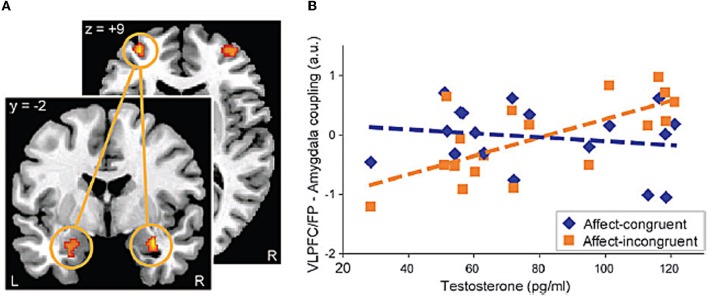
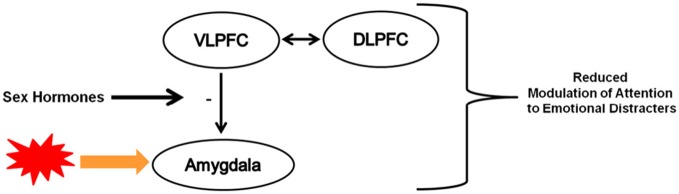
Evidence from longitudinal studies suggests that adolescence may represent a period of vulnerability that, in the context of adverse events, could contribute to developmental trajectories toward behavioral and emotional health problems, including affective disorders. Adolescence is also a sensitive period for the development of neural systems supporting cognitive-affective processes, which have been implicated in the pathophysiology of affective disorders such as anxiety and mood disorders. In particular, the onset of puberty brings about a cascade of physical, hormonal, psychological, and social changes that contribute in complex ways to the development of these systems. This article provides a brief overview of neuroimaging research pertaining to the development of cognitive-affective processes in adolescence. It also includes a brief review of evidence from animal and human neuroimaging studies suggesting that sex steroids influence the connectivity between prefrontal cortical and subcortical limbic regions in ways that contribute to increased reactivity to emotionally salient stimuli. We integrate these findings in the context of a developmental affective neuroscience framework suggesting that the impact of rising levels of sex steroids during puberty on fronto-limbic connectivity may be even greater in the context of protracted development of prefrontal cortical regions in adolescence. We conclude by discussing the implications of these findings for future research aimed at identifying neurodevelopmental markers of risk for future onset of affective disorders.
来自纵向研究的证据表明,青春期可能是一个脆弱期,在不利事件的背景下,可能会导致行为和情绪健康问题(包括情感障碍)的发展轨迹。青春期也是支持认知情感过程的神经系统发育的敏感时期,认知情感过程与焦虑和情绪障碍等情感障碍的病理生理学有关。特别是,青春期的到来带来了一系列身体、激素、心理和社会变化,这些变化以复杂的方式促进了这些系统的发展。本文简要概述了与青春期认知情感过程发展相关的神经影像学研究。它还包括对动物和人类神经影像学研究证据的简要回顾,这些研究表明,性激素以增加对情绪相关刺激的反应性的方式影响前额皮质和皮质下边缘区域之间的连接。我们将这些发现整合到一个发展情感神经科学框架中,该框架表明,在青春期前额皮质区域发育延长的情况下,青春期性激素水平升高对额-边缘连接的影响可能更大。最后,我们讨论了这些发现对未来旨在确定情感障碍未来发病风险的神经发育标志物的研究的意义。