Developmental Cognitive Neuroimaging Laboratory, Children's Hospital Los Angeles, Los Angeles, California, United States of America.
PLoS One. 2012;7(3):e33850. doi: 10.1371/journal.pone.0033850. Epub 2012 Mar 29.
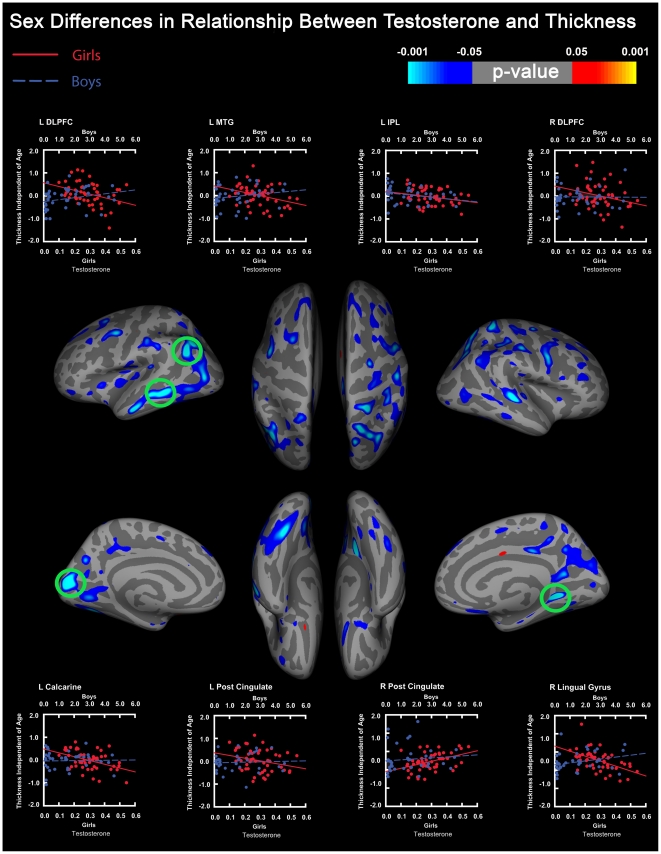
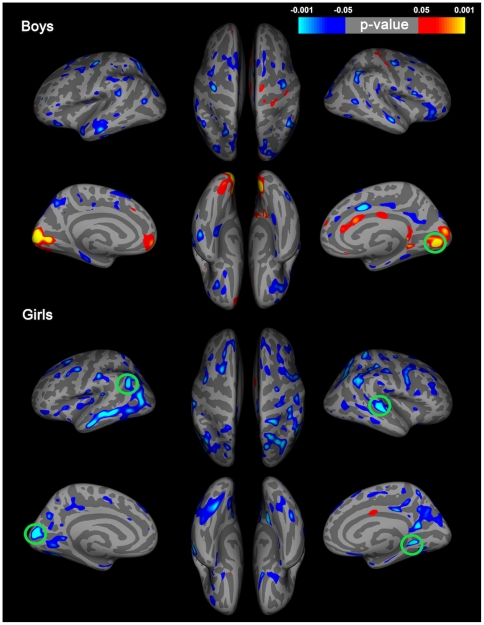
Age-related changes in cortical thickness have been observed during adolescence, including thinning in frontal and parietal cortices, and thickening in the lateral temporal lobes. Studies have shown sex differences in hormone-related brain maturation when boys and girls are age-matched, however, because girls mature 1-2 years earlier than boys, these sex differences could be confounded by pubertal maturation. To address puberty effects directly, this study assessed sex differences in testosterone-related cortical maturation by studying 85 boys and girls in a narrow age range and matched on sexual maturity. We expected that testosterone-by-sex interactions on cortical thickness would be observed in brain regions known from the animal literature to be high in androgen receptors. We found sex differences in associations between circulating testosterone and thickness in left inferior parietal lobule, middle temporal gyrus, calcarine sulcus, and right lingual gyrus, all regions known to be high in androgen receptors. Visual areas increased with testosterone in boys, but decreased in girls. All other regions were more impacted by testosterone levels in girls than boys. The regional pattern of sex-by-testosterone interactions may have implications for understanding sex differences in behavior and adolescent-onset neuropsychiatric disorders.
在青春期期间,人们观察到了皮质厚度的与年龄相关的变化,包括额叶和顶叶皮质变薄,以及外侧颞叶增厚。研究表明,当男孩和女孩年龄相匹配时,激素相关的大脑成熟存在性别差异,然而,由于女孩比男孩早成熟 1-2 年,这些性别差异可能会受到青春期成熟的影响。为了直接解决青春期的影响,本研究通过研究 85 名年龄范围狭窄且性成熟匹配的男孩和女孩,评估了与睾酮相关的皮质成熟中的性别差异。我们预计,在已知雄激素受体含量高的动物文献中,大脑区域的皮质厚度与循环睾酮之间的性别与睾酮相互作用会存在差异。我们发现,在左侧顶下小叶、中颞回、楔前回和右侧舌回等已知雄激素受体含量高的区域,循环睾酮与厚度之间的关联存在性别差异。视觉区域在男孩中随睾酮增加,而在女孩中随睾酮减少。所有其他区域受女孩的睾酮水平影响都比男孩大。性别与睾酮相互作用的区域模式可能对理解行为和青少年期开始的神经精神障碍中的性别差异具有重要意义。