Department of Urology, Nara Medical University, Kashihara, Nara, Japan.
BMC Urol. 2012 Sep 14;12:28. doi: 10.1186/1471-2490-12-28.
To clarify the significant clinicopathological and postdosimetric parameters to predict PSA bounce in patients who underwent low-dose-rate brachytherapy (LDR-brachytherapy) for prostate cancer.
We studied 200 consecutive patients who received LDR-brachytherapy between July 2004 and November 2008. Of them, 137 patients did not receive neoadjuvant or adjuvant androgen deprivation therapy. One hundred and forty-two patients were treated with LDR-brachytherapy alone, and 58 were treated with LDR-brachytherapy in combination with external beam radiation therapy. The cut-off value of PSA bounce was 0.1 ng/mL. The incidence, time, height, and duration of PSA bounce were investigated. Clinicopathological and postdosimetric parameters were evaluated to elucidate independent factors to predict PSA bounce in hormone-naïve patients who underwent LDR-brachytherapy alone.
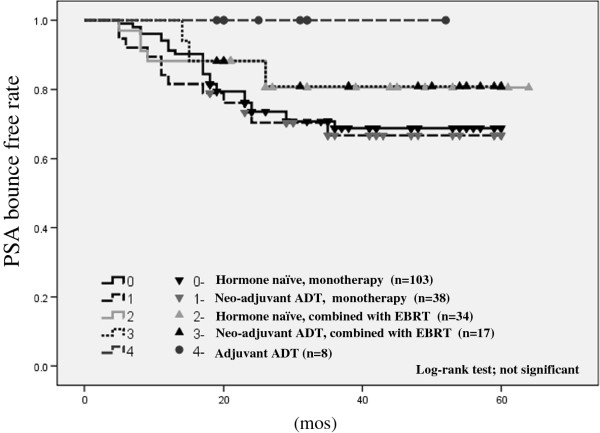
Fifty patients (25%) showed PSA bounce and 10 patients (5%) showed PSA failure. The median time, height, and duration of PSA bounce were 17 months, 0.29 ng/mL, and 7.0 months, respectively. In 103 hormone-naïve patients treated with LDR-brachytherapy alone, and univariate Cox proportional regression hazard model indicated that age and minimal percentage of the dose received by 30% and 90% of the urethra were independent predictors of PSA bounce. With a multivariate Cox proportional regression hazard model, minimal percentage of the dose received by 90% of the urethra was the most significant parameter of PSA bounce.
Minimal percentage of the dose received by 90% of the urethra was the most significant predictor of PSA bounce in hormone-naïve patients treated with LDR-brachytherapy alone.
为了明确预测接受低剂量率近距离放射治疗(LDR-近距离放射治疗)的前列腺癌患者 PSA 反弹的重要临床病理和后剂量参数。
我们研究了 200 例 2004 年 7 月至 2008 年 11 月期间接受 LDR-近距离放射治疗的连续患者。其中,137 例患者未接受新辅助或辅助雄激素剥夺治疗。142 例患者单独接受 LDR-近距离放射治疗,58 例患者接受 LDR-近距离放射治疗联合外照射治疗。PSA 反弹的截止值为 0.1ng/mL。研究了 PSA 反弹的发生率、时间、高度和持续时间。评估临床病理和后剂量参数,以阐明独立因素,预测单独接受 LDR-近距离放射治疗的激素初治患者的 PSA 反弹。
50 例(25%)患者出现 PSA 反弹,10 例(5%)患者出现 PSA 失败。PSA 反弹的中位时间、高度和持续时间分别为 17 个月、0.29ng/mL 和 7.0 个月。在 103 例单独接受 LDR-近距离放射治疗的激素初治患者中,单因素 Cox 比例风险回归模型表明年龄和最小剂量百分比是接受 30%和 90%尿道剂量的最小百分比是预测 PSA 反弹的独立因素。在多因素 Cox 比例风险回归模型中,90%尿道接受的最小剂量百分比是 PSA 反弹的最重要参数。
90%尿道接受的最小剂量百分比是单独接受 LDR-近距离放射治疗的激素初治患者 PSA 反弹的最重要预测因素。