Department of Medicine/Rheumatology, Northwestern University, Feinberg School of Medicine, 240 East Huron Street, Room Chicago, IL 60611, USA.
J Transl Med. 2012 Sep 13;10:190. doi: 10.1186/1479-5876-10-190.
Substantial advances have been generated in understanding the pathogenesis of rheumatoid arthritis (RA). Current murine models of RA-like disease have provided great insights into the molecular mechanism of inflammatory arthritis due to the use of genetically deficient or transgenic mice. However, these studies are limited by differences that exist between human and murine immune systems. Thus, the development of an animal model that utilizes human immune cells, will afford the opportunity to study their function in the initiation and propagation of inflammatory arthritis.
One to two-day old irradiated NOD-scid IL2rγ(null) (NSG) mice were reconstituted with human CD34+ cord blood stem cells. Leukocytes were analyzed by flow cytometry and circulating antibodies were determined by ELISA. Arthritis was induced by injecting complete Freund's adjuvant into knee or ankle joints. Mice were also treated with the TNF inhibitor, Etanercept, or PBS and joints were analyzed histologically.
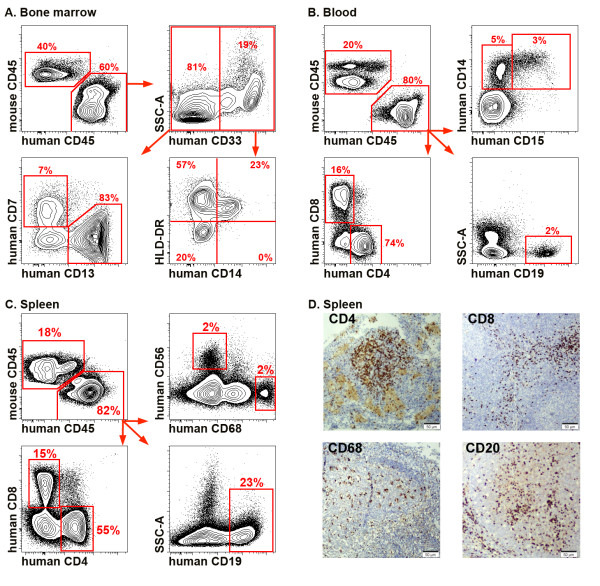
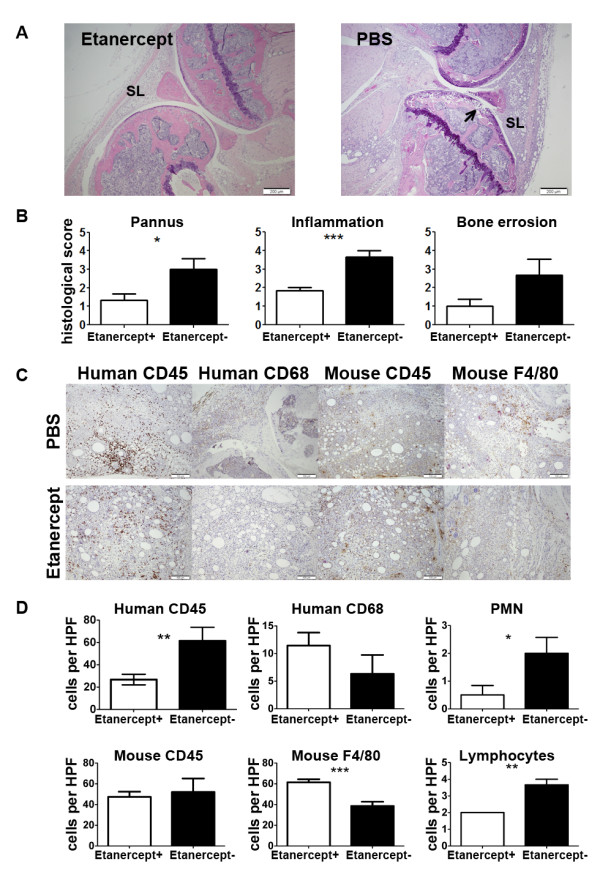
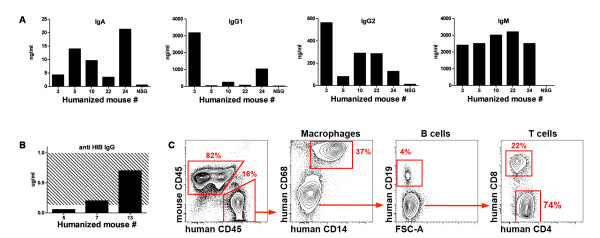
Humanized mice were established with high reconstitution rates and were able to spontaneously produce human immunoglobulins as well as specific IgG in response to immunization. Intraperitoneal injection of thioglycolate or injection of complete Freund's adjuvant into joints resulted in migration of human immune cells to the injected sites. Arthritic humanized mice treated with Etanercept had markedly less inflammation, which was associated with decreased total numbers of human CD45+ cells, including human lymphocytes and neutrophils.
The humanized mouse model is a new model to study inflammatory arthritis disease using human leukocytes without rejection of engrafted tissue. Future studies may adapt this system to incorporate RA patient cord blood and develop a chimeric animal model of inflammatory arthritis using genetically predisposed immune cells.
在理解类风湿关节炎(RA)发病机制方面取得了实质性进展。由于使用基因缺陷或转基因小鼠,当前类似 RA 的鼠类疾病模型为炎症性关节炎的分子机制提供了深入了解。然而,这些研究受到人类和鼠类免疫系统之间存在差异的限制。因此,开发利用人类免疫细胞的动物模型将为研究其在炎症性关节炎的起始和传播中的功能提供机会。
1 至 2 天大的辐照 NOD-scid IL2rγ(null)(NSG)小鼠用人类 CD34+脐带血干细胞重建。通过流式细胞术分析白细胞,通过 ELISA 测定循环抗体。通过向膝关节或踝关节注射完全弗氏佐剂诱导关节炎。还通过 TNF 抑制剂依那西普或 PBS 治疗小鼠,并进行关节组织学分析。
成功建立了高重建率的人源化小鼠,能够自发产生人免疫球蛋白以及针对免疫接种的特异性 IgG。巯基乙醇酸盐的腹腔内注射或完全弗氏佐剂注入关节会导致人免疫细胞迁移到注射部位。用依那西普治疗的关节炎人源化小鼠的炎症明显减轻,与总数量减少的人 CD45+细胞有关,包括人淋巴细胞和中性粒细胞。
人源化小鼠模型是一种使用人白细胞而不排斥植入组织来研究炎症性关节炎疾病的新模型。未来的研究可能会适应该系统,纳入 RA 患者脐带血,并利用具有遗传易感性的免疫细胞开发炎症性关节炎的嵌合动物模型。