Rich Tyvin A, Winter Kathryn, Safran Howard, Hoffman John P, Erickson Beth, Anne Pramila R, Myerson Robert J, Cline-Burkhardt Vivian Jm, Perez Kimberly, Willett Christopher
The Cancer Center, University of Virginia Health System West, University of Virginia, Charlottesville, VA, USA.
Onco Targets Ther. 2012;5:161-70. doi: 10.2147/OTT.S33560. Epub 2012 Aug 23.
The Radiation Therapy Oncology Group (RTOG) multi-institutional Phase II study 98-12, evaluating paclitaxel and concurrent radiation (RT) for locally advanced pancreatic cancer, demonstrated a median survival of 11.3 months and a 1-year survival of 43%. The purpose of the randomized Phase II study by RTOG 0020 was to evaluate the addition of weekly low- dose gemcitabine with concurrent paclitaxel/RT and to evaluate the efficacy and safety of the farnesyl transferase inhibitor R115777 following chemoradiation.
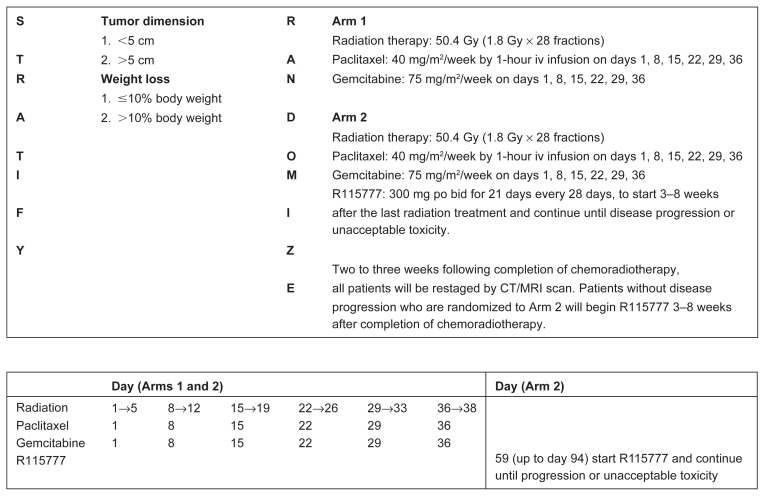
Patients with unresectable, nonmetastatic adenocarcinoma of the pancreas were eligible. Patients in Arm 1 received gemcitabine, 75 mg/m(2)/week, and paclitaxel, 40 mg/m(2)/week, for 6 weeks, with 50.4 Gy radiation (CXRT). Patients in Arm 2 received an identical chemoradiation regimen but then received maintenance R115777, 300 mg twice a day for 21 days every 28 days (CXRT+R115777), until disease progression or unacceptable toxicity.
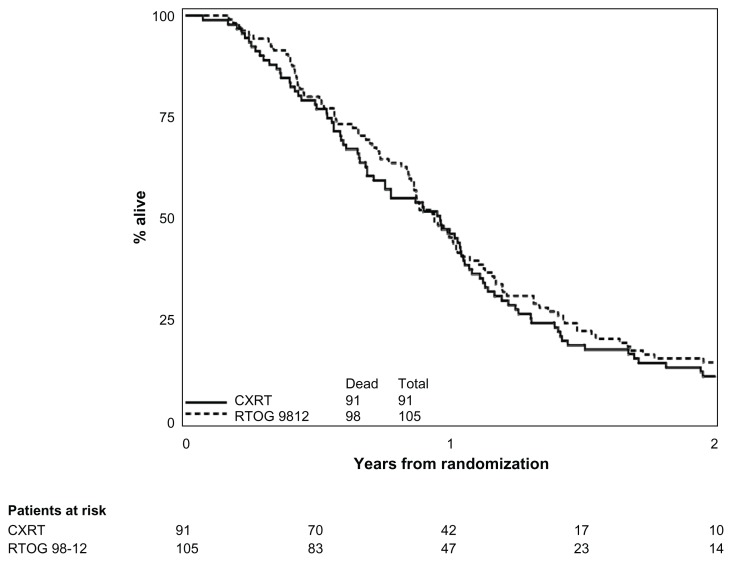
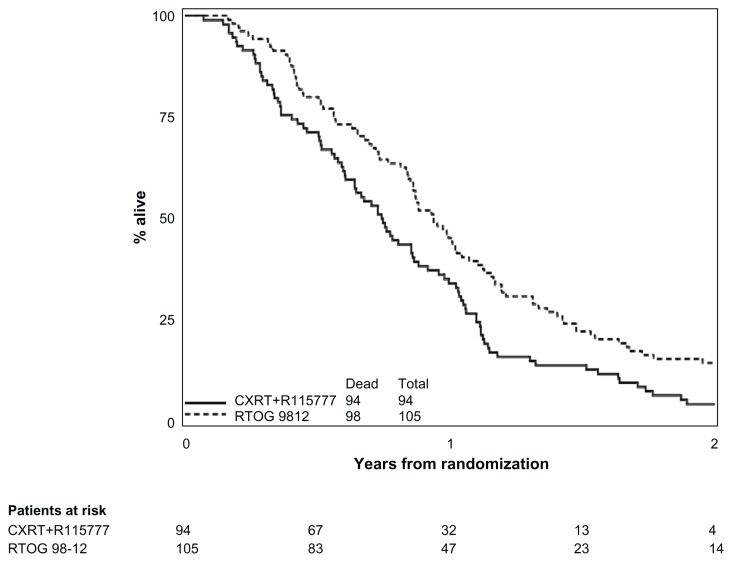
One hundred ninety-five patients were entered into this study, and 184 were analyzable. Grade 4 nonhematologic toxicities occurred in less than 5% of CXRT patients. The most common grade 3/4 toxicity from R115777 was myelosuppression; however, grade 3/4 hepatic, metabolic, musculoskeletal, and neurologic toxicities were also reported. The median survival time was 11.5 months and 8.9 months for the CXRT and CXRT+R115777 arms, respectively.
The CXRT arm achieved a median survival of almost 1-year, supporting chemoradiation as an important therapeutic modality for locally advanced pancreatic cancer. Maintenance R115777 is not effective and is associated with a broad range of toxicities. These findings provide clinical evidence that inhibition of farnesylation affects many metabolic pathways, underscoring the challenge of developing an effective K-ras inhibitor.
放射治疗肿瘤学组(RTOG)的多机构II期研究98 - 12评估了紫杉醇与同步放疗(RT)用于局部晚期胰腺癌的疗效,结果显示中位生存期为11.3个月,1年生存率为43%。RTOG 0020随机II期研究的目的是评估在同步紫杉醇/放疗基础上加用每周低剂量吉西他滨,并评估化疗放疗后法尼基转移酶抑制剂R115777的疗效和安全性。
符合条件的患者为无法切除的非转移性胰腺腺癌患者。1组患者接受吉西他滨,75mg/m²/周,和紫杉醇,40mg/m²/周,共6周,同时接受50.4Gy放疗(同步放化疗)。2组患者接受相同的放化疗方案,但随后接受维持剂量的R115777,300mg,每日2次,每28天服用21天(同步放化疗 + R115777),直至疾病进展或出现不可接受的毒性反应。
195例患者进入本研究,184例可进行分析。同步放化疗患者中4级非血液学毒性发生率低于5%。R115777最常见的3/4级毒性为骨髓抑制;不过,也报告了3/4级肝脏、代谢、肌肉骨骼和神经毒性。同步放化疗组和同步放化疗 + R115777组的中位生存时间分别为11.5个月和8.9个月。
同步放化疗组的中位生存期接近1年,支持放化疗作为局部晚期胰腺癌的一种重要治疗方式。维持使用R115777无效且伴有多种毒性。这些发现提供了临床证据,表明法尼基化抑制会影响许多代谢途径,凸显了开发有效的K - ras抑制剂的挑战。