Department of Biological Sciences, California State University, Long Beach, 1250 Bellflower Blvd., Long Beach, CA 90840-9502, United States.
Front Neuroendocrinol. 2012 Oct;33(4):342-63. doi: 10.1016/j.yfrne.2012.08.004. Epub 2012 Sep 7.
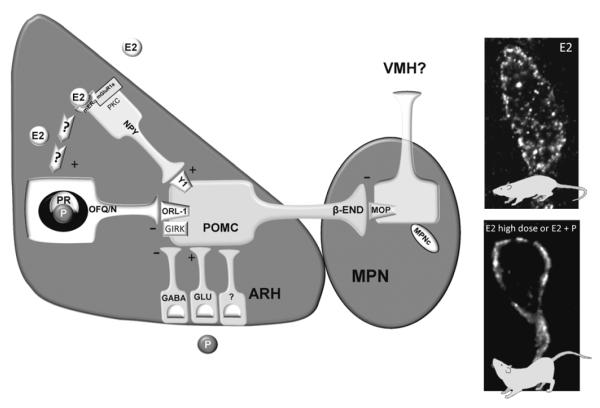
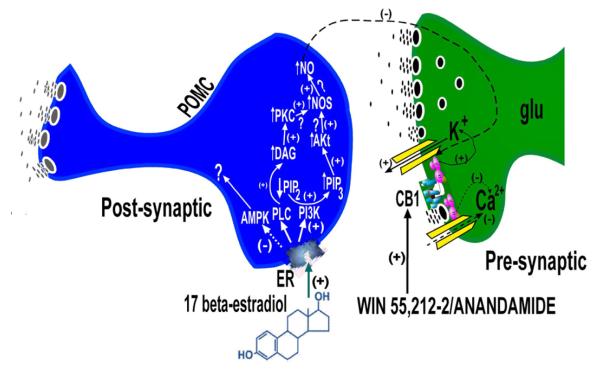
Our knowledge of membrane estrogenic signaling mechanisms and their interactions that regulate physiology and behavior has grown rapidly over the past three decades. The discovery of novel membrane estrogen receptors and their signaling mechanisms has started to reveal the complex timing and interactions of these various signaling mechanisms with classical genomic steroid actions within the nervous system to regulate physiology and behavior. The activation of the various estrogenic signaling mechanisms is site specific and differs across the estrous cycle acting through both classical genomic mechanisms and rapid membrane-initiated signaling to coordinate reproductive behavior and physiology. This review focuses on our current understanding of estrogenic signaling mechanisms to promote: (1) sexual receptivity within the arcuate nucleus of the hypothalamus, (2) estrogen positive feedback that stimulates de novo neuroprogesterone synthesis to trigger the luteinizing hormone surge important for ovulation and estrous cyclicity, and (3) alterations in energy balance.
在过去的三十年里,我们对调节生理和行为的膜雌激素信号机制及其相互作用的了解迅速增加。新型膜雌激素受体及其信号机制的发现,开始揭示这些不同信号机制与神经系统内经典基因组甾体作用之间的复杂时间和相互作用,以调节生理和行为。各种雌激素信号机制的激活具有特定的部位,并在发情周期内通过经典基因组机制和快速的膜起始信号的作用而不同,以协调生殖行为和生理。本综述重点介绍我们对雌激素信号机制的现有认识,以促进:(1)在下丘脑弓状核内的性行为接受,(2)雌激素正反馈刺激新合成的神经孕酮以触发促黄体生成素激增,对排卵和发情周期很重要,以及(3)能量平衡的改变。