Department of non-coronarogenic Heart Disease and Clinical Rheumatology, NSC Institute of Cardiology, Kiev, Ukraine.
Ann Rheum Dis. 2013 Aug;72(8):1335-41. doi: 10.1136/annrheumdis-2012-201909. Epub 2012 Sep 15.
Performance of the 2010 American College of Rheumatology (ACR)/European League Against Rheumatism (EULAR) rheumatoid arthritis (RA) criteria was analysed in an internationally recruited early arthritis cohort (≤16 weeks symptom duration) enrolled in the 'Stop-Arthritis-Very-Early' trial. This sample includes patients with a variety of diseases diagnosed during follow-up.
Two endpoints were defined: Investigators' diagnosis and disease-modifying antirheumatic drug (DMARD) treatment start during the 12-month follow-up. The 2010 criteria were applied to score Patients' baseline data. Sensitivity, specificity, predictive values and areas under the receiver operating curves of this scoring with respect to both endpoints were calculated and compared to the 1987 criteria. The optimum level of agreement between the endpoints and the 2010 classification score ways estimated by Cohen's ϰ coefficients.
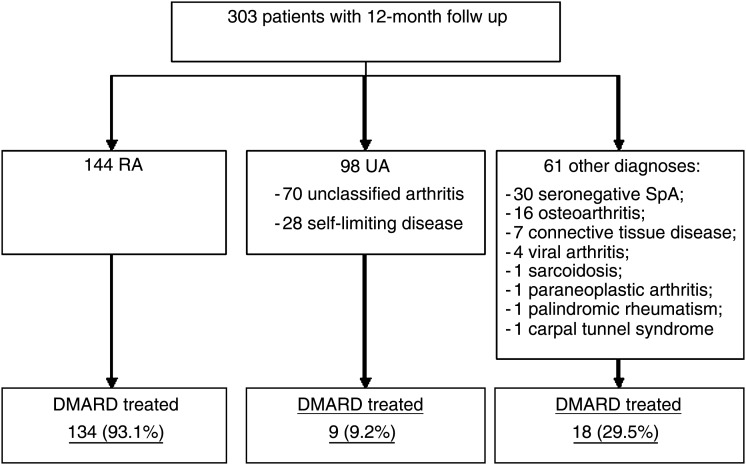
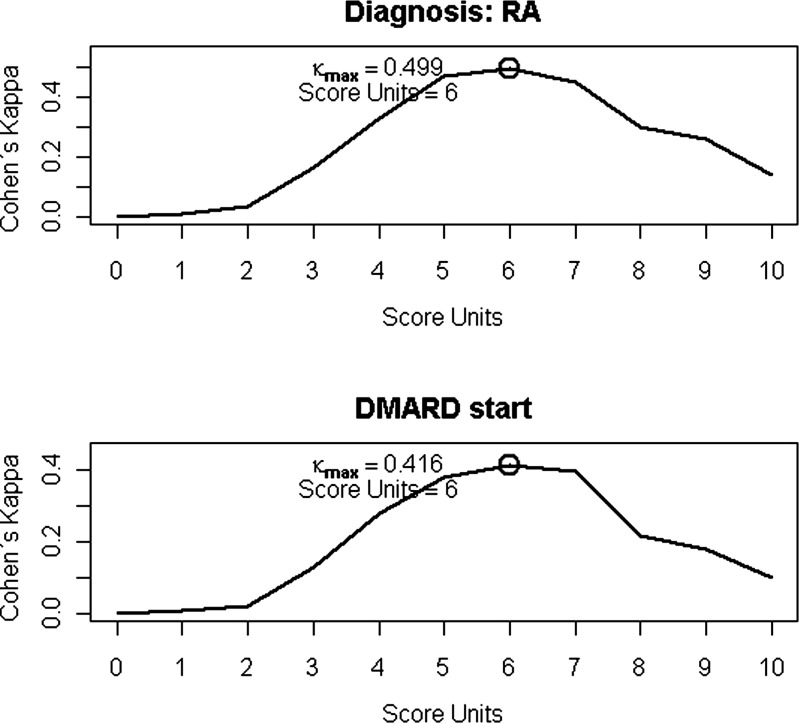
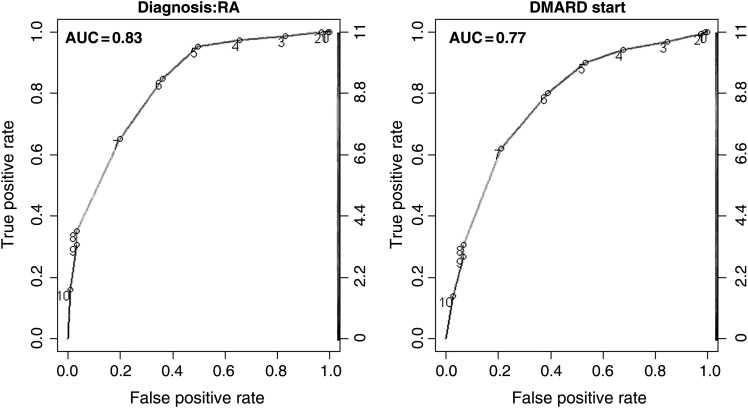
303 patients had 12-months follow-up. Positive predictive values of the 2010 criteria were 0.68 and 0.71 for RA-diagnosis and DMARD-start, respectively. Sensitivity for RA-diagnosis was 0.85, for DMARD-start 0.8, whereas the 1987 criteria's sensitivities were 0.65 and 0.55. The areas under the receiver operating curves of the 2010 criteria for RA-diagnosis and DMARD-start were 0.83 and 0.78. Analysis of inter-rater-agreement using Cohen's ϰ demonstrated the highest ϰ values (0.5 for RA-diagnosis and 0.43 for DMARD-start) for the score of 6.
In this international very early arthritis cohort predictive and discriminative abilities of the 2010 ACR/EULAR classification criteria were satisfactory and substantially superior to the 'old' 1987 classification criteria. This easier classification of RA in early stages will allow targeting truly early disease stages with appropriate therapy.
在“关节炎早期停止”试验中,对国际招募的早期关节炎队列(症状持续时间≤16 周)进行了分析,该队列纳入了符合 2010 年美国风湿病学会(ACR)/欧洲抗风湿病联盟(EULAR)类风湿关节炎(RA)标准的患者。该样本包括在随访期间诊断出的各种疾病的患者。
定义了两个终点:在 12 个月的随访期间,研究者诊断和使用疾病修饰抗风湿药物(DMARD)治疗开始。将 2010 年标准应用于评分患者的基线数据。计算并比较了该评分与 1987 年标准对两个终点的敏感性、特异性、预测值和接收者操作特征曲线下面积。通过 Cohen's k 系数估计终点与 2010 分类评分之间的最佳一致性水平。
303 例患者有 12 个月的随访。2010 年标准对 RA 诊断和 DMARD 开始的阳性预测值分别为 0.68 和 0.71。RA 诊断的敏感性为 0.85,DMARD 开始的敏感性为 0.8,而 1987 年标准的敏感性分别为 0.65 和 0.55。2010 年标准对 RA 诊断和 DMARD 开始的接收者操作特征曲线下面积分别为 0.83 和 0.78。使用 Cohen's k 分析评分者间一致性表明,RA 诊断的 k 值最高(0.5),DMARD 开始的 k 值最高(0.43)。
在这个国际早期关节炎队列中,2010 年 ACR/EULAR 分类标准的预测和区分能力令人满意,并且大大优于“旧”1987 年分类标准。这种在早期阶段更容易对 RA 进行分类,将使我们能够针对真正的早期疾病阶段进行适当的治疗。