Kim Giwon, Kim Yeon Sil, Han Eun Ji, Yoo Ie Ryung, Song Jin-Ho, Lee Sang-Nam, Lee Jong Hoon, Choi Byung-Oak, Jang Hong-Seok, Yoon Sei-Chul
Department of Radiation Oncology, The Catholic University of Korea School of Medicine, Seoul, Korea.
Radiat Oncol J. 2011 Dec;29(4):243-51. doi: 10.3857/roj.2011.29.4.243. Epub 2011 Dec 28.
To evaluate the prognostic value of metabolic tumor volume (MTV) and maximum standardized uptake value (SUVmax) on initial positron emission tomography-computed tomography (PET-CT) and investigate the clinical value of SUVmax for early detection of locoregional recurrent disease after postoperative radiotherapy in patients with locally advanced head and neck squamous cell carcinoma (HNSCC).
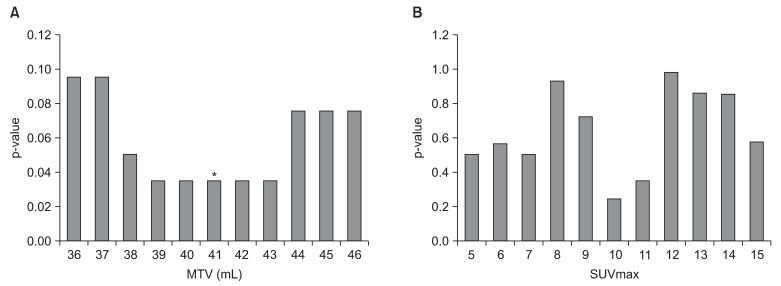
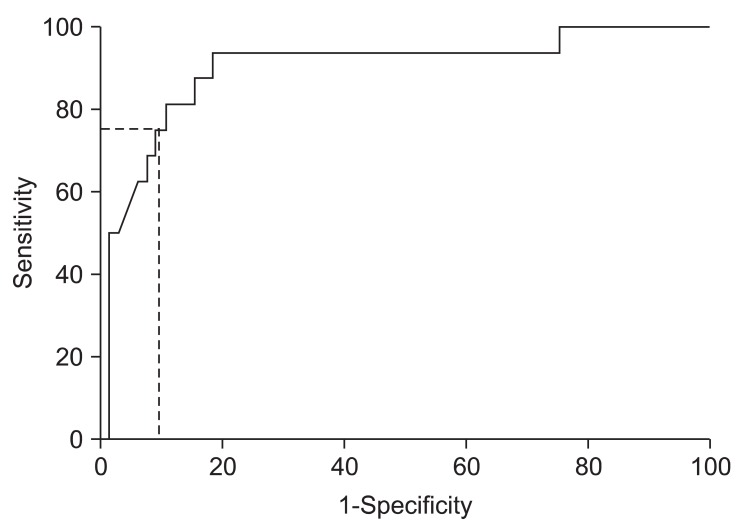
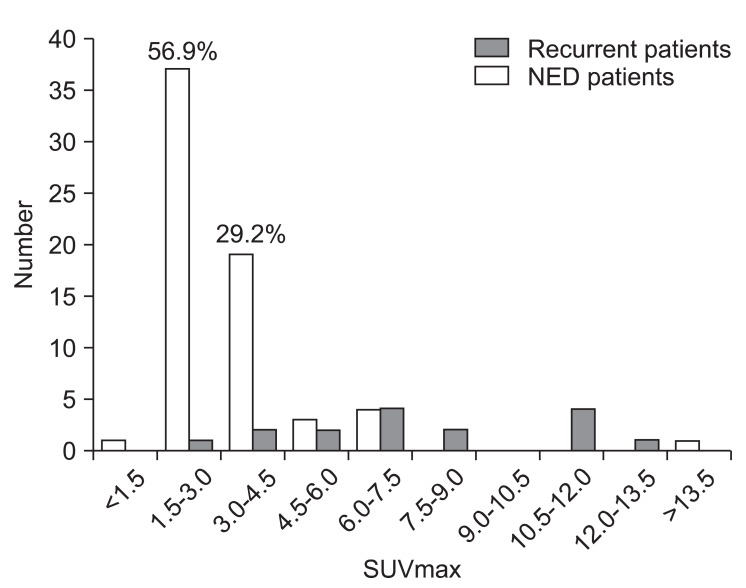
A total of 100 patients with locally advanced HNSCC received primary tumor excision and neck dissection followed by adjuvant radiotherapy with or without chemotherapy. The MTV and SUVmax were measured from primary sites and neck nodes. The prognostic value of MTV and SUVmax were assessed using initial staging PET/CT (study A). Follow-up PET/CT scan available after postoperative concurrent chemoradiotherapy or radiotherapy were evaluated for the SUVmax value and correlated with locoregional recurrence (study B). A receiver operating characteristic (ROC) curve analysis was used to define a threshold value of SUVmax with the highest accuracy for recurrent disease assessment.
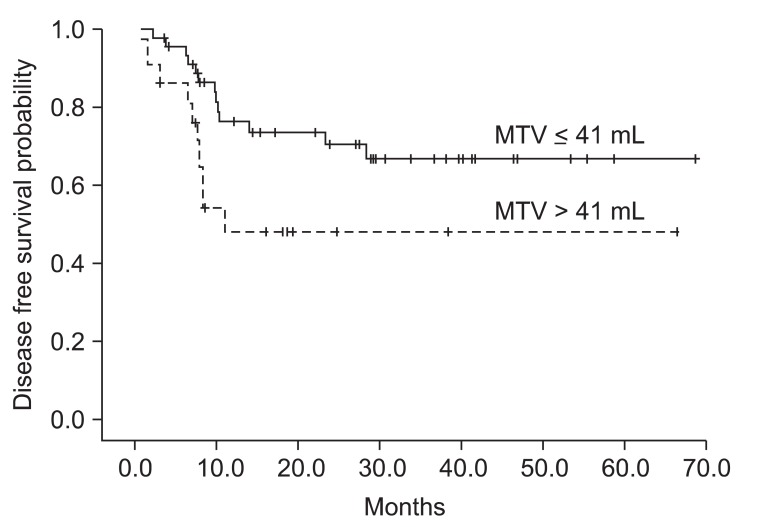
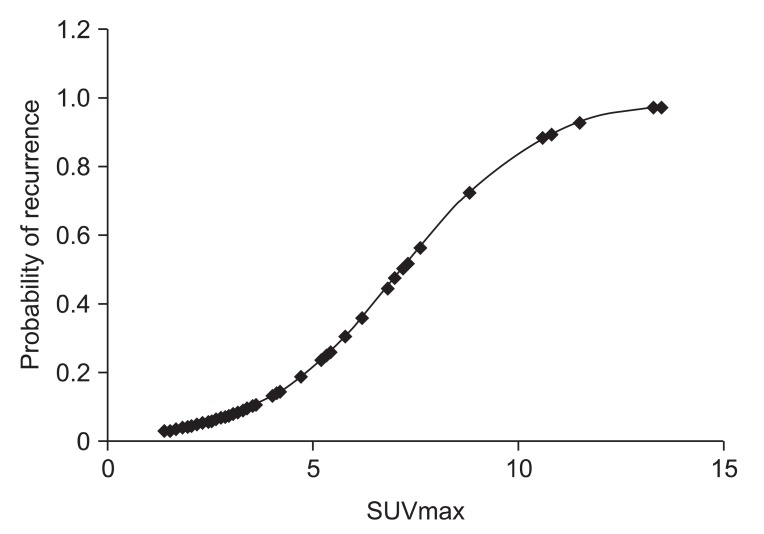
High MTV (>41 mL) is negative prognostic factor for disease free survival (p = 0.041). Postradiation SUVmax was significantly correlated with locoregional recurrence (hazard ratio, 1.812; 95% confidence interval, 1.361 to 2.413; p < 0.001). A cut-off value of 5.38 from follow-up PET/CT was identified as having maximal accuracy for detecting locoregional recurrence by ROC analysis.
MTV at staging work-up was significantly associated with disease free survival. The SUVmax value from follow-up PET/CT showed high diagnostic accuracy for the detection of locoregional recurrence in postoperatively irradiated HNSCC.
评估代谢肿瘤体积(MTV)和最大标准化摄取值(SUVmax)在初始正电子发射断层扫描-计算机断层扫描(PET-CT)中的预后价值,并探讨SUVmax对局部晚期头颈部鳞状细胞癌(HNSCC)患者术后放疗后局部区域复发性疾病早期检测的临床价值。
总共100例局部晚期HNSCC患者接受了原发性肿瘤切除和颈部清扫术,随后接受辅助放疗,可选择有或无化疗。从原发部位和颈部淋巴结测量MTV和SUVmax。使用初始分期PET/CT评估MTV和SUVmax的预后价值(研究A)。对术后同步放化疗或放疗后可获得的随访PET/CT扫描评估SUVmax值,并与局部区域复发相关联(研究B)。使用受试者操作特征(ROC)曲线分析来定义对复发性疾病评估具有最高准确性的SUVmax阈值。
高MTV(>41 mL)是无病生存的负性预后因素(p = 0.041)。放疗后SUVmax与局部区域复发显著相关(风险比,1.812;95%置信区间,1.361至2.413;p < 0.001)。通过ROC分析确定随访PET/CT中5.38的临界值对检测局部区域复发具有最大准确性。
分期检查时的MTV与无病生存显著相关。随访PET/CT的SUVmax值对检测术后放疗的HNSCC中的局部区域复发显示出高诊断准确性。