Department of Pathology, Haartman Institute, University of Helsinki, Finland.
BMC Med Genet. 2012 Sep 17;13:84. doi: 10.1186/1471-2350-13-84.
Diagnostic analysis of patients with developmental disorders has improved over recent years largely due to the use of microarray technology. Array methods that facilitate copy number analysis have enabled the diagnosis of up to 20% more patients with previously normal karyotyping results. A substantial number of patients remain undiagnosed, however.
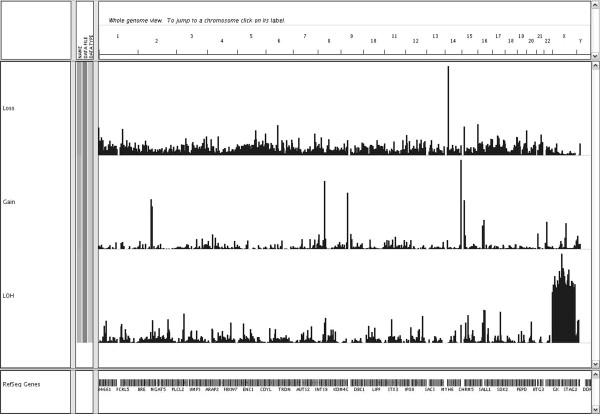
Using the Genome-Wide Human SNP array 6.0, we analyzed 35 patients with a developmental disorder of unknown cause and normal array comparative genomic hybridization (array CGH) results, in order to characterize previously undefined genomic aberrations. We detected no seemingly pathogenic copy number aberrations. Most of the vast amount of data produced by the array was polymorphic and non-informative. Filtering of this data, based on copy number variant (CNV) population frequencies as well as phenotypically relevant genes, enabled pinpointing regions of allelic homozygosity that included candidate genes correlating to the phenotypic features in four patients, but results could not be confirmed.
In this study, the use of an ultra high-resolution SNP array did not contribute to further diagnose patients with developmental disorders of unknown cause. The statistical power of these results is limited by the small size of the patient cohort, and interpretation of these negative results can only be applied to the patients studied here. We present the results of our study and the recurrence of clustered allelic homozygosity present in this material, as detected by the SNP 6.0 array.
近年来,由于微阵列技术的应用,对发育障碍患者的诊断分析得到了改善。有助于进行拷贝数分析的阵列方法使以前核型正常的结果的患者中有多达 20%的患者可以得到诊断。但是,仍有大量患者未被诊断。
我们使用全基因组人类 SNP 阵列 6.0 分析了 35 名原因不明的发育障碍患者和正常的阵列比较基因组杂交(array CGH)结果,以描述以前未定义的基因组异常。我们没有检测到看似致病性的拷贝数异常。该阵列产生的大量数据大部分是多态性的,且没有信息。基于拷贝数变异(CNV)群体频率以及表型相关基因对该数据进行过滤,使我们能够精确定位等位基因纯合的区域,这些区域包括与四个患者的表型特征相关的候选基因,但结果无法得到确认。
在这项研究中,使用超高分辨率 SNP 阵列并没有帮助进一步诊断原因不明的发育障碍患者。由于患者队列规模较小,这些结果的统计效力受到限制,并且对这些阴性结果的解释只能应用于我们在此处研究的患者。我们介绍了我们的研究结果以及 SNP 6.0 阵列检测到的这种材料中聚集的等位基因纯合性的重现。