Department of Medical Genetics, University of British Columbia, Vancouver, Canada.
BMC Genomics. 2009 Nov 16;10:526. doi: 10.1186/1471-2164-10-526.
Array genomic hybridization is being used clinically to detect pathogenic copy number variants in children with intellectual disability and other birth defects. However, there is no agreement regarding the kind of array, the distribution of probes across the genome, or the resolution that is most appropriate for clinical use.
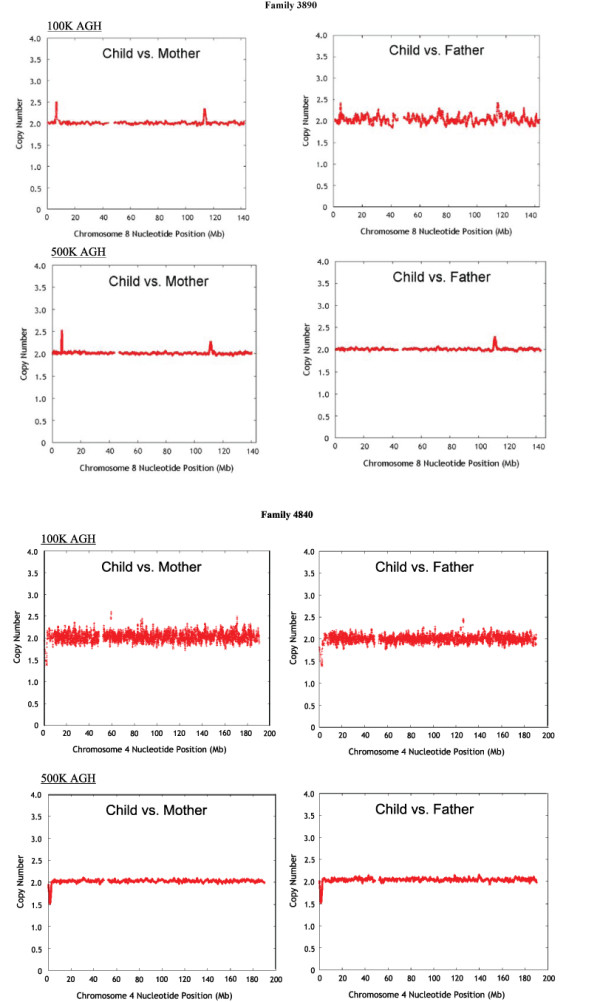
We performed 500 K Affymetrix GeneChip array genomic hybridization in 100 idiopathic intellectual disability trios, each comprised of a child with intellectual disability of unknown cause and both unaffected parents. We found pathogenic genomic imbalance in 16 of these 100 individuals with idiopathic intellectual disability. In comparison, we had found pathogenic genomic imbalance in 11 of 100 children with idiopathic intellectual disability in a previous cohort who had been studied by 100 K GeneChip array genomic hybridization. Among 54 intellectual disability trios selected from the previous cohort who were re-tested with 500 K GeneChip array genomic hybridization, we identified all 10 previously-detected pathogenic genomic alterations and at least one additional pathogenic copy number variant that had not been detected with 100 K GeneChip array genomic hybridization. Many benign copy number variants, including one that was de novo, were also detected with 500 K array genomic hybridization, but it was possible to distinguish the benign and pathogenic copy number variants with confidence in all but 3 (1.9%) of the 154 intellectual disability trios studied.
Affymetrix GeneChip 500 K array genomic hybridization detected pathogenic genomic imbalance in 10 of 10 patients with idiopathic developmental disability in whom 100 K GeneChip array genomic hybridization had found genomic imbalance, 1 of 44 patients in whom 100 K GeneChip array genomic hybridization had found no abnormality, and 16 of 100 patients who had not previously been tested. Effective clinical interpretation of these studies requires considerable skill and experience.
阵列基因组杂交技术目前被临床用于检测智障和其他出生缺陷儿童的致病性拷贝数变异。然而,在何种阵列、基因组探针分布以及分辨率最适合临床使用等方面尚未达成共识。
我们对 100 个特发性智障三联体进行了 500 K 安捷伦基因芯片基因组杂交,每个三联体由一个病因不明的智障儿童及其未受影响的父母组成。我们在这 100 名特发性智障个体中发现了 16 名存在致病性基因组失衡。相比之下,我们在之前的 100 K 基因芯片基因组杂交研究的 100 名特发性智障儿童中发现了 11 名存在致病性基因组失衡。在从之前的队列中选择的 54 个接受 500 K 基因芯片基因组杂交重新测试的智障三联体中,我们发现了之前检测到的所有 10 个致病性基因组改变,以及之前用 100 K 基因芯片基因组杂交检测不到的至少一个额外致病性拷贝数变异。用 500 K 阵列基因组杂交还检测到了许多良性拷贝数变异,包括一个新生的,在研究的 154 个智障三联体中,除了 3 个(1.9%)之外,都可以自信地区分良性和致病性拷贝数变异。
在 100 K 基因芯片基因组杂交发现基因组失衡的 10 名特发性发育障碍患者、100 K 基因芯片基因组杂交发现无异常的 44 名患者中的 1 名以及之前未接受过测试的 100 名患者中的 10 名中,安捷伦基因芯片 500 K 阵列基因组杂交检测到了致病性基因组失衡。对这些研究进行有效的临床解读需要相当的技能和经验。