Camara-Lemarroy Carlos Rodrigo, Gonzalez-Moreno Emmanuel Irineo, Guzman-de la Garza Francisco Javier, Fernandez-Garza Nancy Esthela
Departamento de Medicina Interna, Hospital Universitario "José Eleuterio González", Universidad Autónoma de Nuevo León, School of Medicine, Colonia Mitras Centro, 64460 Monterrey, Nuevo León, Mexico.
ScientificWorldJournal. 2012;2012:168953. doi: 10.1100/2012/168953. Epub 2012 Sep 10.
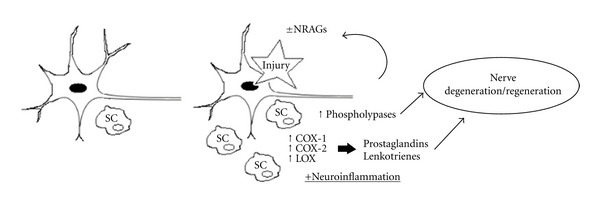
After peripheral nerve injury, a process of axonal degradation, debris clearance, and subsequent regeneration is initiated by complex local signaling, called Wallerian degeneration (WD). This process is in part mediated by neuroglia as well as infiltrating inflammatory cells and regulated by inflammatory mediators such as cytokines, chemokines, and the activation of transcription factors also related to the inflammatory response. Part of this neuroimmune signaling is mediated by the innate immune system, including arachidonic acid (AA) derivatives such as prostaglandins and leukotrienes. The enzymes responsible for their production, cyclooxygenases and lipooxygenases, also participate in nerve degeneration and regeneration. The interactions between signals for nerve regeneration and neuroinflammation go all the way down to the molecular level. In this paper, we discuss the role that AA derivatives might play during WD and nerve regeneration, and the therapeutic possibilities that arise.
周围神经损伤后,轴突降解、碎片清除以及随后的再生过程由复杂的局部信号启动,这一过程称为沃勒变性(WD)。此过程部分由神经胶质细胞以及浸润的炎症细胞介导,并受细胞因子、趋化因子等炎症介质以及与炎症反应相关的转录因子激活的调节。这种神经免疫信号的一部分由先天免疫系统介导,包括花生四烯酸(AA)衍生物,如前列腺素和白三烯。负责其产生的酶,即环氧化酶和脂氧合酶,也参与神经变性和再生。神经再生信号与神经炎症之间的相互作用一直延伸到分子水平。在本文中,我们讨论了AA衍生物在沃勒变性和神经再生过程中可能发挥的作用,以及由此产生的治疗可能性。