INSERM, U1016, Institut Cochin, 22 rue Méchain, 75014 Paris, France.
Retrovirology. 2012 Sep 25;9:77. doi: 10.1186/1742-4690-9-77.
The Tax protein encoded by Human T-lymphotropic virus type 1 (HTLV-1) is a powerful activator of the NF-κB pathway, a property critical for HTLV-1-induced immortalization of CD4⁺ T lymphocytes. Tax permanently stimulates this pathway at a cytoplasmic level by activating the IκB kinase (IKK) complex and at a nuclear level by enhancing the binding of the NF-κB factor RelA to its cognate promoters and by forming nuclear bodies, believed to represent transcriptionally active structures. In previous studies, we reported that Tax ubiquitination and SUMOylation play a critical role in Tax localization and NF-κB activation. Indeed, analysis of lysine Tax mutants fused or not to ubiquitin or SUMO led us to propose a two-step model in which Tax ubiquitination first intervenes to activate IKK while Tax SUMOylation is subsequently required for promoter activation within Tax nuclear bodies. However, recent studies showing that ubiquitin or SUMO can modulate Tax activities in either the nucleus or the cytoplasm and that SUMOylated Tax can serve as substrate for ubiquitination suggested that Tax ubiquitination and SUMOylation may mediate redundant rather than successive functions.
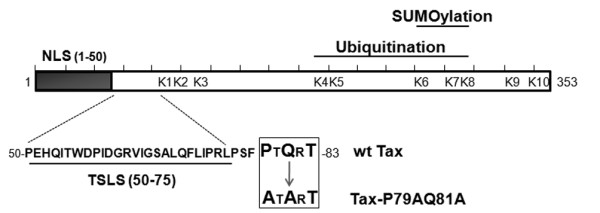
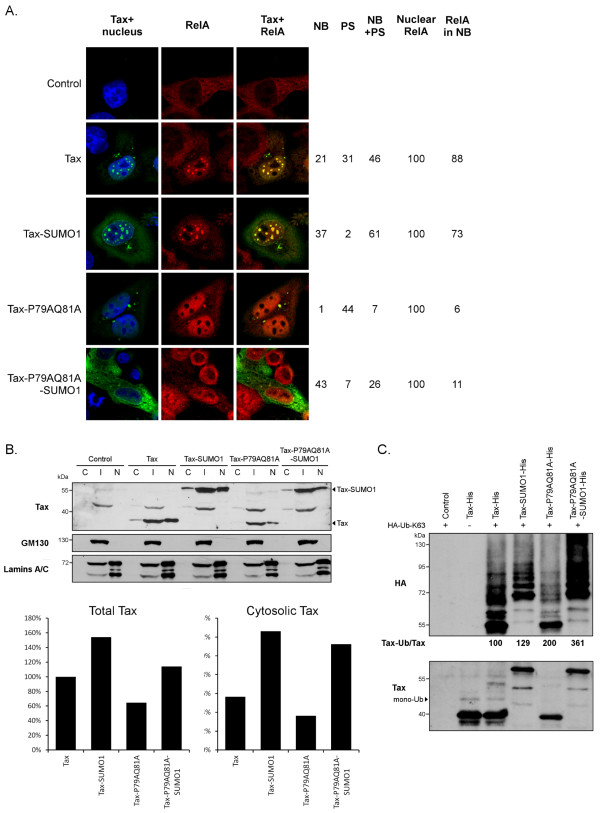
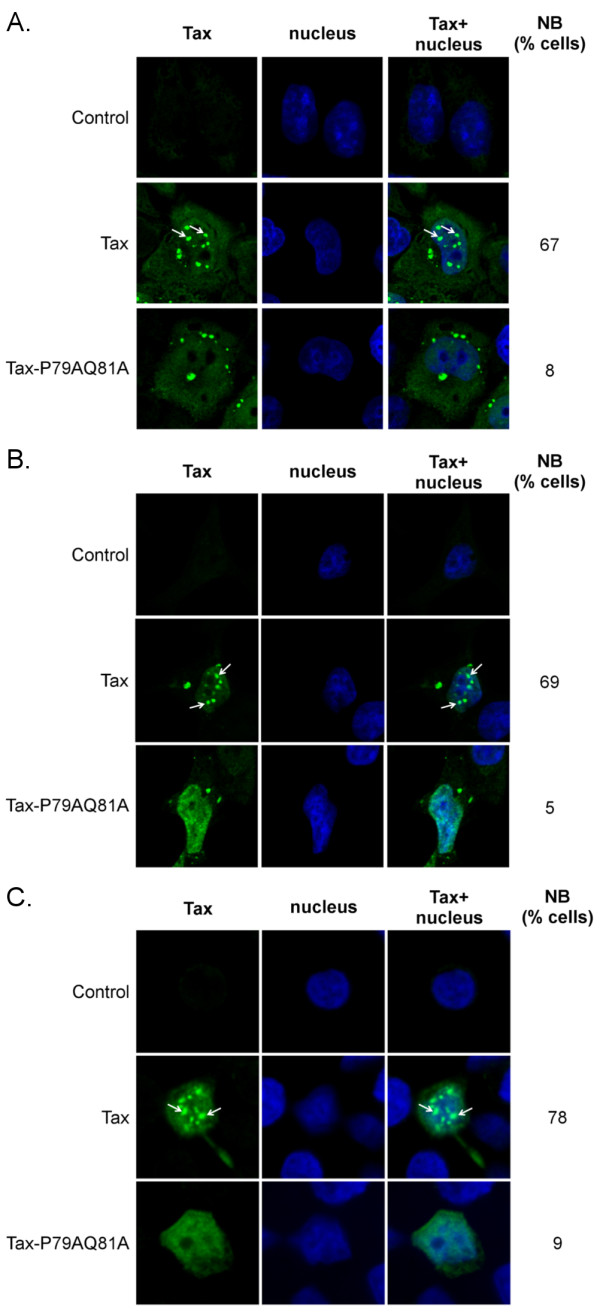
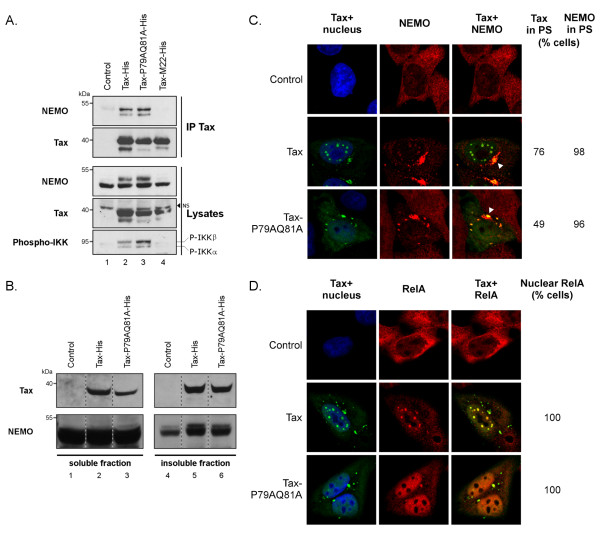
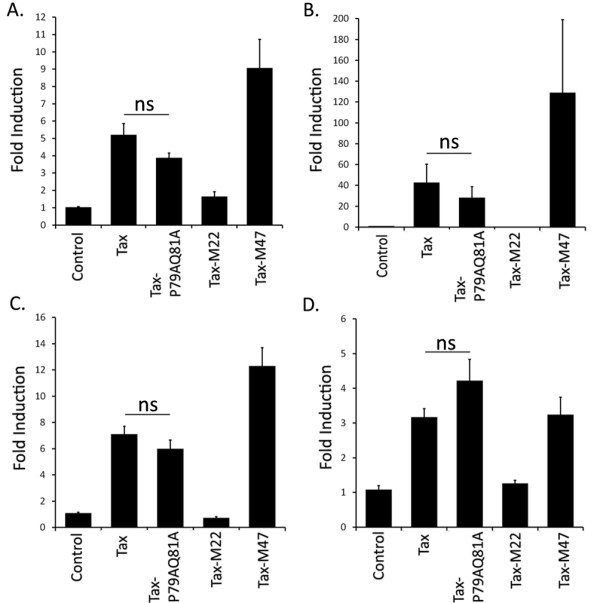
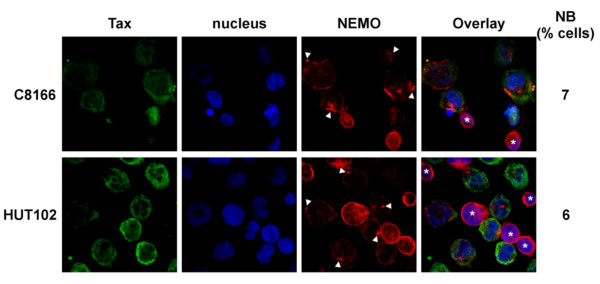
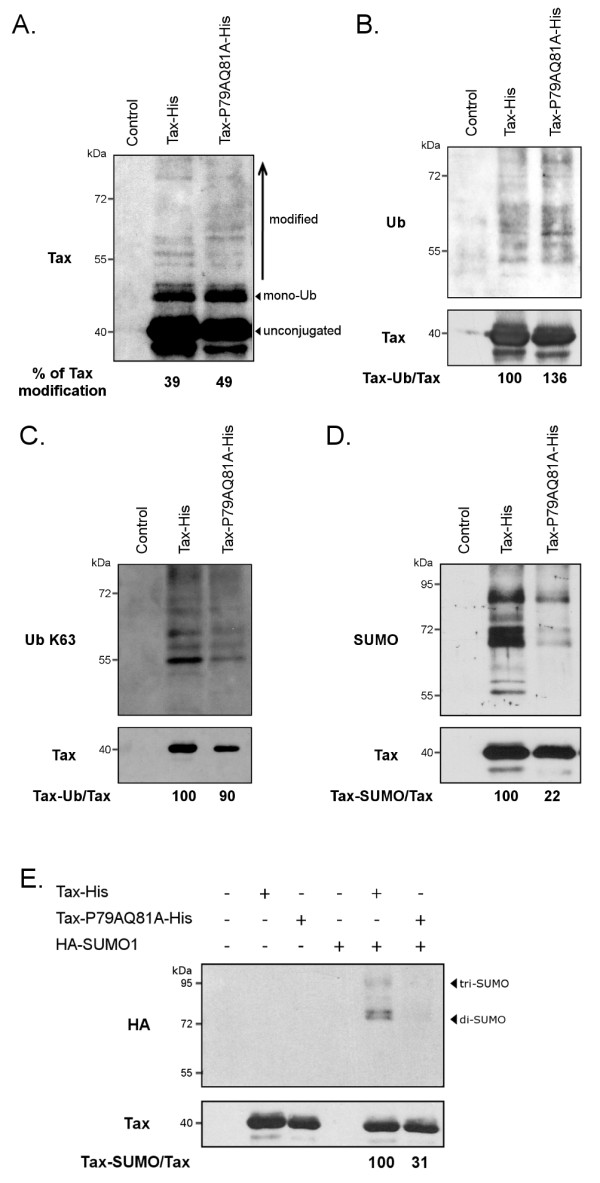
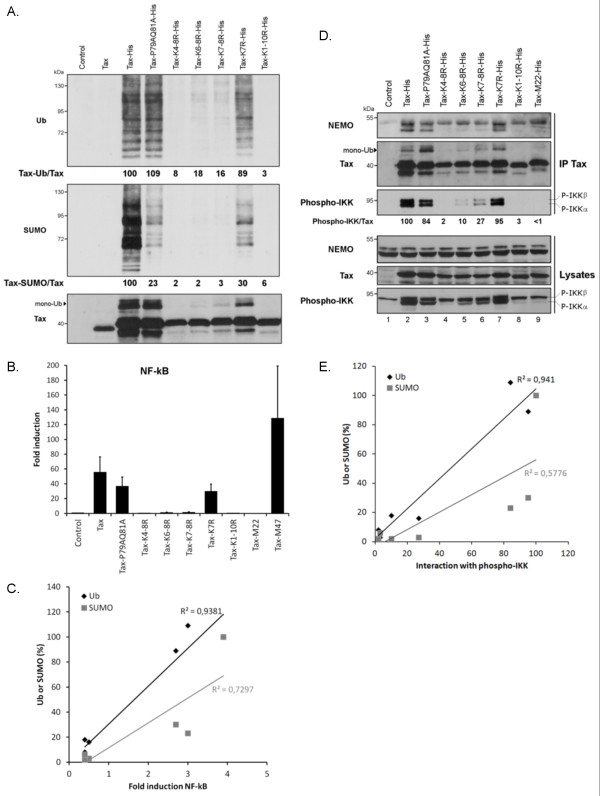
In this study, we analyzed the properties of a new Tax mutant that is properly ubiquitinated, but defective for both nuclear body formation and SUMOylation. We report that reducing Tax SUMOylation and nuclear body formation do not alter the ability of Tax to activate IKK, induce RelA nuclear translocation, and trigger gene expression from a NF-κB promoter. Importantly, potent NF-κB promoter activation by Tax despite low SUMOylation and nuclear body formation is also observed in T cells, including CD4⁺ primary T lymphocytes. Moreover, we show that Tax nuclear bodies are hardly observed in HTLV-1-infected T cells. Finally, we provide direct evidence that the degree of NF-κB activation by Tax correlates with the level of Tax ubiquitination, but not SUMOylation.
These data reveal that the formation of Tax nuclear bodies, previously associated to transcriptional activities in Tax-transfected cells, is dispensable for NF-κB promoter activation, notably in CD4⁺ T cells. They also provide the first evidence that Tax SUMOylation is not a key determinant for Tax-induced NF-κB activation.
人类 T 淋巴细胞白血病病毒 1(HTLV-1)编码的 Tax 蛋白是 NF-κB 途径的强大激活剂,这一特性对于 HTLV-1 诱导 CD4⁺T 淋巴细胞永生化至关重要。Tax 通过激活 IκB 激酶(IKK)复合物在细胞质水平上永久刺激这条途径,通过增强 NF-κB 因子 RelA 与其同源启动子的结合,并通过形成核小体,在核水平上刺激这条途径,这些核小体被认为代表转录活性结构。在之前的研究中,我们报道 Tax 的泛素化和 SUMO 化在 Tax 定位和 NF-κB 激活中起着关键作用。事实上,对融合或不融合泛素或 SUMO 的赖氨酸 Tax 突变体的分析使我们提出了一个两步模型,其中 Tax 的泛素化首先干预以激活 IKK,而 Tax 的 SUMO 化随后需要在 Tax 核小体中启动子的激活。然而,最近的研究表明,泛素或 SUMO 可以在核内或细胞质中调节 Tax 的活性,并且 SUMO 化的 Tax 可以作为泛素化的底物,这表明 Tax 的泛素化和 SUMO 化可能介导冗余而不是连续的功能。
在这项研究中,我们分析了一个新的 Tax 突变体的特性,该突变体被正确泛素化,但核小体形成和 SUMO 化均有缺陷。我们报告称,降低 Tax 的 SUMO 化和核小体形成并不改变 Tax 激活 IKK、诱导 RelA 核易位以及触发 NF-κB 启动子基因表达的能力。重要的是,即使在 SUMO 化和核小体形成水平较低的情况下,Tax 也能在包括 CD4⁺原代 T 淋巴细胞在内的 T 细胞中强烈激活 NF-κB 启动子。此外,我们发现 Tax 核小体在 HTLV-1 感染的 T 细胞中几乎观察不到。最后,我们提供了直接证据表明 Tax 对 NF-κB 的激活程度与 Tax 的泛素化程度相关,而与 SUMO 化程度无关。
这些数据表明,先前与转染细胞中 Tax 转录活性相关的 Tax 核小体的形成对于 NF-κB 启动子的激活是可有可无的,尤其是在 CD4⁺T 细胞中。它们还首次提供了证据表明,Tax 的 SUMO 化不是 Tax 诱导的 NF-κB 激活的关键决定因素。