Dipartimento di Biologia e Biotecnologie Lazzaro Spallanzani, Università di Pavia, via Ferrata 9, Pavia, Italy.
Eur J Histochem. 2012 Jun 29;56(3):e27. doi: 10.4081/ejh.2012.e27.
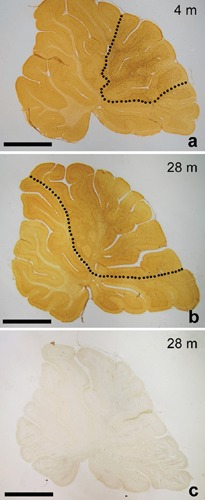
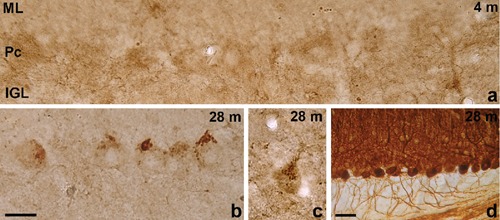
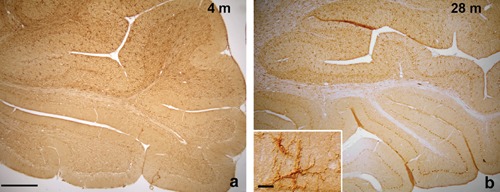
We describe by NG2 (neuron-glia chondroitin sulphate proteoglycan 2) immunocytochemistry an uneven distribution of NG2 glial cells in the rat cerebellum, being them more represented in the central lobules of the cerebellar vermis, belonging to the cerebrocerebellum. The cerebellar distribution of NG2 cells changes in aging rats, in which the area where the cells appear to be densely scattered throughout all cerebellar layers involves also more rostral and caudal lobules. In addition, in aging rats, in the most rostral and caudal lobules belonging to the spinocerebellum, punctate reaction product is present at the apical pole of Purkinje cells, i.e. in the area where the majority of synapses between olivary climbing fibers and Purkinje cells occur. Data suggest that the different distribution of NG2 cells is correlated to differences in physiology among cerebellar areas and reflects changes during aging.
我们通过 NG2(神经元-胶质硫酸软骨素蛋白聚糖 2)免疫细胞化学描述了 NG2 神经胶质细胞在大鼠小脑的不均匀分布,它们在小脑蚓部的中央小叶中更为代表,属于大脑小脑。NG2 细胞在衰老大鼠中的小脑分布发生变化,在这些细胞似乎密集分布在整个小脑层的区域也涉及更多的小脑前叶和后叶。此外,在衰老大鼠中,在属于脊髓小脑的最前叶和后叶,点状反应产物存在于浦肯野细胞的顶端极,即在橄榄小脑纤维和浦肯野细胞之间的大多数突触发生的区域。数据表明,NG2 细胞的不同分布与小脑区域之间的生理学差异相关,反映了衰老过程中的变化。